What epigenetic aging means
Epigenetics describes changes that regulate how genes are used without changing the underlying DNA sequence. DNA methylation is one important layer: chemical marks near or within genes can be associated with transcriptional activity and cellular state. Histone modifications, chromatin structure, non-coding RNAs and three-dimensional genome organization add further layers.
These marks change with development, cell division, inflammation, environmental exposure, disease and chronological age. Some changes may be consequences of aging; others may help drive cellular dysfunction; still others may be adaptive responses. A list of age-associated marks is therefore not automatically a list of causes.
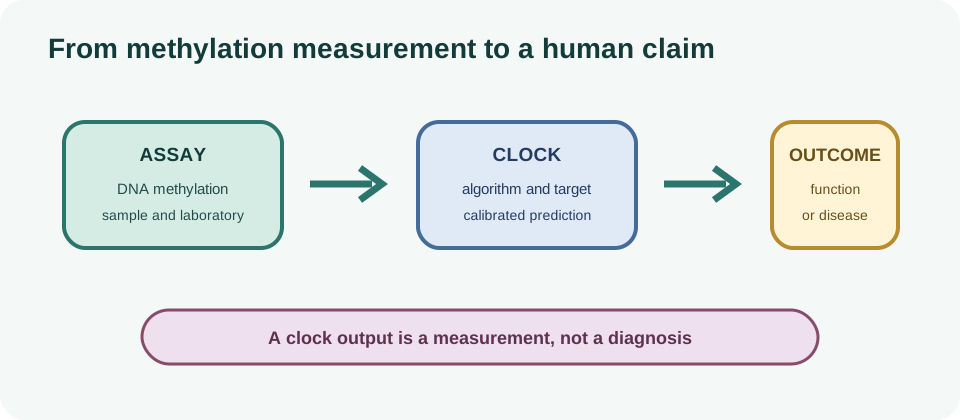
An epigenetic clock is an algorithm that combines methylation measurements at selected genomic sites to estimate a target. The target might be chronological age, mortality risk, a composite health measure or a pace-of-aging phenotype. The output is a model-derived score, not a direct readout of every tissue’s biological age.
The biological-age test guide places clocks alongside other biomarkers. The key question is not whether a number can be calculated, but what it predicts, how reproducible it is, and whether changing it has been shown to improve an outcome that matters.
DNA methylation, histones, chromatin and gene regulation
DNA methylation is often measured at cytosine-phosphate-guanine sites, or CpGs. Age-related patterns can be remarkably reproducible across people, which is why methylation-based clocks became possible. Reproducibility does not mean the mark is a master controller of aging. Many sites may be downstream of cell composition, immune activation, metabolism or cumulative exposure.
Histones package DNA and can carry chemical modifications that influence chromatin accessibility. Chromatin remodeling determines which regulatory regions are available to transcription machinery. These systems interact, but a methylation array samples only one layer and usually only a fraction of the genome. A clock result should not be described as a complete map of epigenetic state.
Technical choices matter: sample handling, bisulfite conversion, array platform, normalization, batch correction, imputation and computational pipeline can all affect the result. Researchers should report the clock version, tissue, platform and preprocessing approach. A commercial test that uses a proprietary algorithm may not be directly comparable with a published clock.
| Measurement | What it describes | Evidence boundary |
|---|---|---|
| Single CpG or region | local methylation state | not a whole-body aging score |
| Clock estimate | algorithmic prediction of a defined target | not automatically tissue age |
| Age acceleration | clock residual after accounting for chronological age | depends on model and covariates |
| Pace-of-aging score | estimated rate of change or decline | not proof that an intervention changed future survival |
Age-associated change versus causal driver
Three questions are often collapsed into one. First, does a methylation site or clock score change with age? Second, does the score predict morbidity, mortality or functional decline? Third, does changing the score change the outcome? The first can be true while the second is weak, and the second can be true while the third remains unproven.
Prediction is not causation. A clock may summarize cumulative exposure to smoking, socioeconomic stress, inflammation, cell composition and chronic illness. If so, it can predict risk while being only partly causal. Lowering the score without changing those underlying processes may not lower risk.
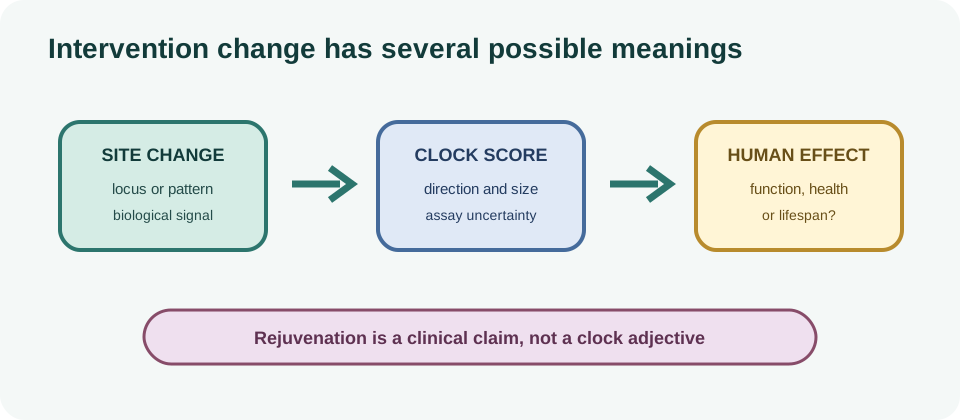
Intervention studies add another layer. A clock can be responsive to an intervention because the intervention changes blood-cell composition, metabolism or a methylation-sensitive pathway. That response may be useful for monitoring biology, but it is not proof of tissue repair. Causal interpretation requires randomization, appropriate controls, durable outcomes and a validated surrogate relationship.
First-generation and next-generation clocks
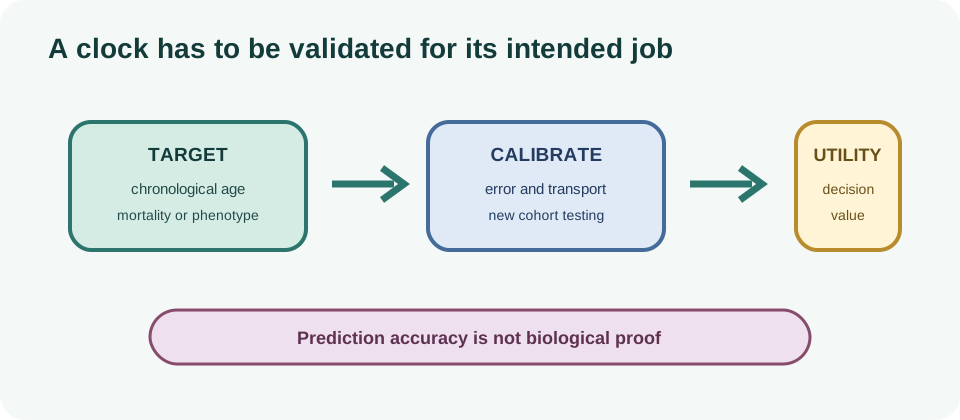
First-generation clocks were designed mainly to predict chronological age. Their performance is often summarized by prediction error: how close the estimated age is to the calendar age in a validation sample. A clock can be excellent at estimating chronological age and still be uninformative about disease or intervention response.
Second-generation clocks were trained against mortality risk, morbidity or composite phenotypes rather than chronological age alone. Examples include measures related to mortality risk and physiological aging. They may have stronger associations with health outcomes, but association remains distinct from intervention efficacy.
Next-generation clocks and pace-of-aging algorithms pursue more clinically relevant targets, including rate of change. They may be more responsive in some intervention settings, but their extra complexity can increase dependence on training cohort, tissue, cell composition, demographics and preprocessing. A result that is meaningful for one clock is not automatically meaningful for another.
Why prediction is not the same as biological-age measurement
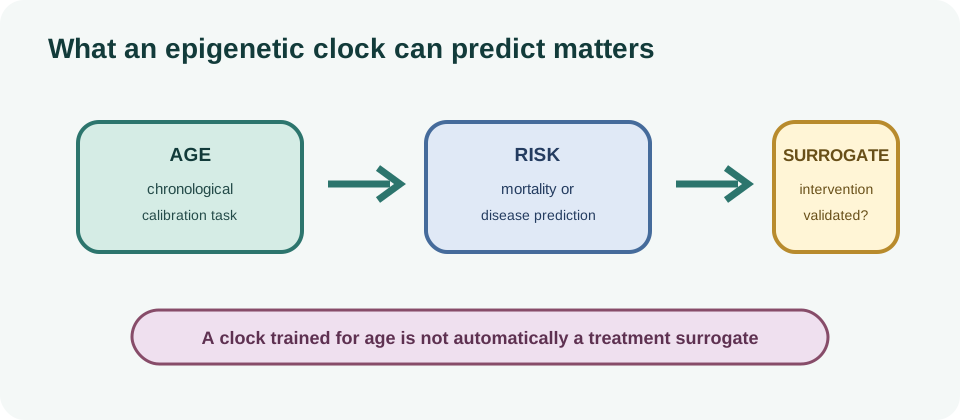
When a clock predicts chronological age, the model is solving a supervised prediction problem. It is not measuring a hidden universal quantity called biological age. When a clock predicts mortality or a physiological composite, it is estimating risk through the features selected in its training data. The output may be useful, but the biological interpretation must match the validation evidence.
Age acceleration is commonly calculated as the difference between predicted and chronological age, sometimes with regression adjustment. The residual depends on the reference population and covariates. Changing the sample or model can change the value even when the underlying methylation data are identical.
Commercial “biological age” reports can be helpful as exploratory wellness information, but consumers should not treat them as clinical diagnoses or personal forecasts. A score should not determine medication, supplement use or a high-stakes health decision without validated clinical utility.
Mortality-predictive clocks and pace-of-aging measures
Some clocks predict mortality or morbidity more strongly than chronological-age clocks. That makes them important for epidemiology and risk stratification. It does not mean that a lower score caused the lower risk, or that lowering the score with a product will produce the same outcome.
Pace-of-aging measures attempt to describe how quickly a person is changing rather than how old they appear on one test date. Longitudinal measurement is conceptually attractive because aging is a process. In practice, estimates still depend on measurement error, regression to the mean, follow-up length and whether the algorithm was developed for the tissue and population being studied.
For an intervention, the ideal pattern would be a reproducible change in a prespecified pace measure followed by a meaningful improvement in function or disease outcomes. If the clock changes but the clinical endpoint does not, the clock may be responsive without being a valid surrogate.
Cell composition, tissue specificity and technical noise
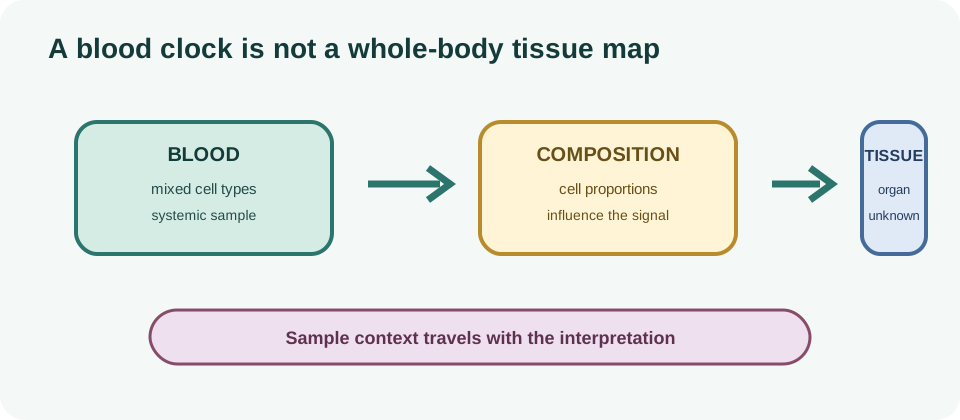
Whole blood contains mixtures of immune and other cell types. Aging, infection, exercise, medication and chronic disease can change that mixture. A methylation shift in bulk blood may therefore reflect a different proportion of cells rather than a reprogramming of every cell. Cell-type deconvolution can help, but estimates are themselves model-dependent.
Brain, liver, muscle, skin, adipose tissue and blood have different cellular environments and methylation landscapes. A blood clock should not be described as proof that all organs became younger. Multi-tissue and single-cell methods may clarify tissue specificity, but they introduce new sampling, cost and computational challenges.
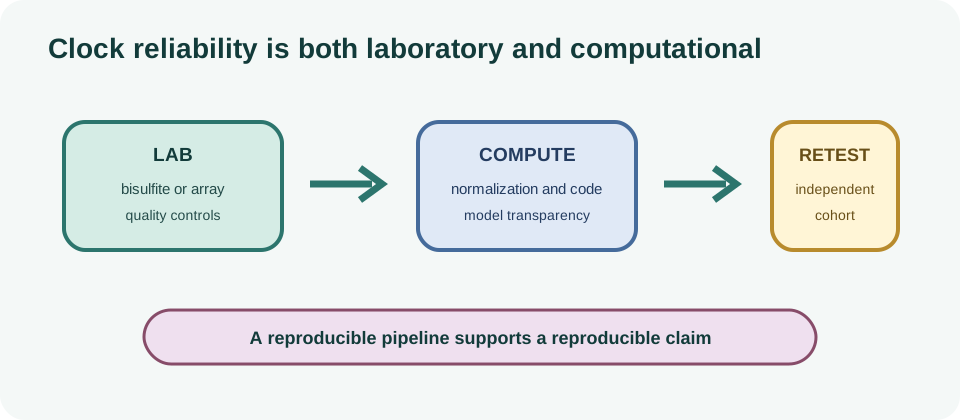
Batch effects and small sample sizes can create apparently large changes. Blinded laboratory processing, randomized sample order, technical replicates and prespecified pipelines are important. Validation in an independent cohort is more informative than a highly optimized result in the discovery dataset.
Acute stress and reversible influences on clock readings
Sleep loss, infection, inflammation, weight change, smoking, alcohol, psychological stress, exercise and medication can affect methylation or blood-cell composition. Some influences may be reversible; others may leave longer-term marks. A one-time sample cannot establish whether a difference is a stable aging trajectory or a transient state.
Repeated measurements can improve interpretation, but they do not eliminate all uncertainty. The interval between samples must match the expected rate of change, and the laboratory pipeline must be stable. An intervention measured immediately after a physiological stressor may produce a response that does not persist.
Timing is especially important for lifestyle studies. An exercise or diet intervention can change weight, sleep, inflammation and cell composition simultaneously. If a clock moves, it may reflect any combination of those processes. The correct conclusion may be that the intervention changed a methylation-based score under the study conditions, not that it reversed aging.
What methodological reviews say about interpretation
The 2025 Nature Reviews Genetics review on epigenetic aging clocks emphasizes methodological and computational challenges, including heterogeneity among clocks, tissue and cell-type effects, and the difficulty of linking a statistical predictor to a biological mechanism. That review is useful precisely because it prevents one number from carrying too much meaning.
The 2025 public-health review by Kusters and Horvath describes the promise of second-generation clocks for preventive medicine while discussing validation across sex, race and lifestyle contexts. A clock that performs differently across populations can still be valuable, but calibration and transportability must be reported rather than assumed.
Conflict-of-interest disclosure matters when clock developers, laboratories or commercial testing companies are involved. It does not invalidate a result. It tells readers to examine preregistration, independent validation, data access, assay reproducibility and whether the analysis was prespecified.
Human intervention studies before 2026
Human interventions have reported changes in selected methylation clocks after dietary patterns, exercise, weight loss, medication, hormonal or other pharmacologic exposures. The studies vary in randomization, sample size, duration, tissue, clock choice and handling of multiple comparisons. A favorable result on one clock may coexist with null results on others.
Short pilot studies can be valuable for feasibility and target exploration. They are not normally powered for mortality or disability. If the primary endpoint is a clock, the trial should state whether that endpoint was prespecified, what direction was expected, how missing samples were handled and whether the result replicated.
Earlier human claims of “reversal” often relied on small uncontrolled studies or a selected clock. Their findings should be described as preliminary unless later randomized evidence supports the same intervention and outcome. The 2026 clocks review is the appropriate home for updates as the literature moves.
The 2026 TranslAGE analysis across 51 intervention datasets
The 2026 Nature Medicine TranslAGE analysis harmonized 51 longitudinal intervention studies and 3,128 samples. Its value is methodological as well as substantive: bringing studies together can show whether apparent responsiveness is consistent across clock families and intervention categories rather than relying on one exciting pilot.
The analysis reported stronger and more consistent DNA-methylation changes with some pharmacologic interventions than with supplements or lifestyle interventions. That is a comparative research finding, not a prescription ranking. Pharmacologic studies may have different doses, adherence, sample timing, participant selection and biological targets. A larger clock effect does not automatically mean a larger health benefit.
Harmonization also has limits. Combining studies cannot erase differences in assay platform, clock algorithm, tissue, intervention, duration or endpoint. A pooled signal can identify patterns and priorities for research; it cannot validate every clock or establish that any intervention extends healthspan.
Why pharmacologic effects can be larger than supplement effects
A drug can be designed to engage a specific receptor, enzyme or pathway at a controlled exposure. A supplement may contain a different active compound, have variable absorption and depend on a baseline nutritional state. Comparing their clock effects without comparing target, dose, tissue exposure and adherence can be misleading.
“Larger clock change” is also not equivalent to “better intervention.” A pharmacologic exposure may shift a score through a potent pathway while carrying adverse effects. A modest lifestyle signal may be harder to detect but clinically meaningful through multiple routes. Benefit-risk and outcome evidence remain more important than the size of one biomarker movement.
Next-generation clock interventions and the rejuvenation claim
A 2026 systematic review identified 41 human interventional studies that reported decreases in next-generation clocks. This is a useful inventory of what has been tested, not a declaration that all listed interventions rejuvenate people. Review-level conclusions inherit differences in design, clock choice, sample quality and risk of bias.
When a review reports that a clock decreased, ask whether the change was between randomized groups, whether the confidence interval excluded no effect, whether multiple clocks were tested, and whether a functional or disease endpoint moved in parallel. A lower clock value without a clinical result remains an intermediate finding.
Commercial language often converts “decreased epigenetic age” into “reversed aging.” That phrasing is not justified unless the study establishes that the score is a validated surrogate and the intervention improves outcomes through the proposed pathway. No current epigenetic clock meets that standard for general consumer rejuvenation claims.
Relationship to partial cellular reprogramming
Partial cellular reprogramming aims to alter cell state using defined reprogramming factors while avoiding a loss of cellular identity. In animal and cell research, such approaches can change epigenetic patterns and tissue phenotypes. They are conceptually different from taking a supplement that shifts a blood-based clock.
Reprogramming research raises important safety questions, including loss of cell identity, abnormal growth and delivery to the right tissue. A younger methylation pattern in a reprogrammed cell would not, by itself, demonstrate safe whole-organism rejuvenation. The partial cellular reprogramming page covers this distinction.
Requirements for a validated surrogate endpoint
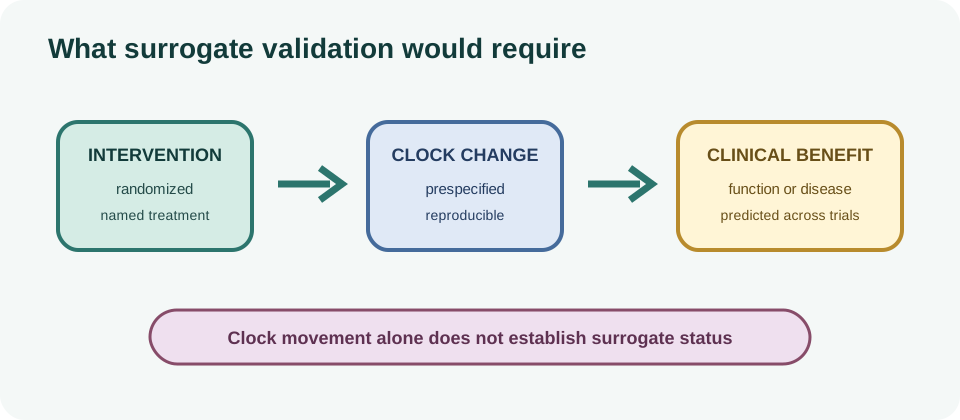
A surrogate endpoint must do more than correlate with a clinical outcome. It should be reliably measured, predict the outcome, respond to interventions, and capture the intervention’s effect on the outcome. Strong validation normally requires evidence across multiple randomized trials showing that changes in the surrogate explain changes in patient-important outcomes.
For an epigenetic clock, that means prespecified measurement, analytical reproducibility, appropriate tissue, calibration across populations, and a demonstrated relationship to function, disease, disability or survival. The clock should respond in the direction expected when an intervention works, but should not move spuriously when the outcome does not improve.
Until those criteria are met, clocks are best treated as research biomarkers. They can help compare interventions, generate hypotheses and study biology. They should not be used alone to diagnose accelerated aging, approve an anti-aging product or promise extra years of life.
Evidence verdict and best practices for reporting clock changes
Epigenetic patterns change with age and can predict important outcomes. That makes methylation clocks valuable research tools. It does not create a universal biological-age meter. Each clock has a target, training population, tissue, algorithm and error profile.
Human interventions can shift selected clocks. The TranslAGE analysis adds evidence that responsiveness differs by intervention category and that some pharmacologic effects are more consistent than supplement or lifestyle effects. The next-generation-clock review shows that many interventional studies exist, but the number of studies is not the same as validated surrogate status.
The responsible conclusion is epigenetic clock changes are promising intervention signals, not proven rejuvenation. Report the exact clock, tissue, assay, baseline, comparator, time point, effect estimate, uncertainty and clinical endpoints. State whether the analysis was randomized, prespecified and independently replicated. Avoid translating a lower score into longer life unless a validated causal chain supports the claim.
- name the clock and its prediction target;
- separate blood findings from tissue-wide claims;
- distinguish prediction, association and intervention responsiveness;
- report primary endpoints separately from exploratory clock measures;
- disclose commercial or developer conflicts when material;
- never call a clock decrease proof of rejuvenation on its own.