How to read this hub
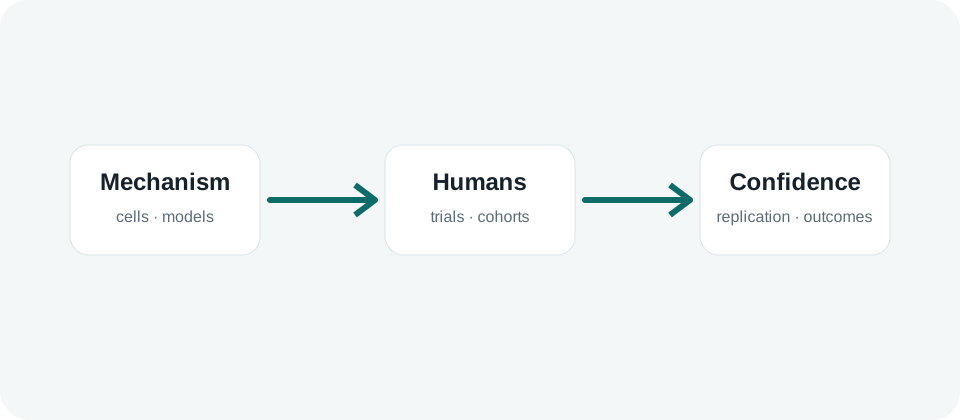
Longevity is a broad label, but the evidence underneath it is not interchangeable. Human randomized trials, prospective cohorts, cross-sectional studies, animal experiments, cell systems and computational models answer different questions. This hub keeps those layers visible so a mechanism is not presented as a treatment, an association is not presented as a causal effect, and a biomarker movement is not automatically described as rejuvenation.
Pages in this hub are organized to make uncertainty inspectable. The goal is not to eliminate nuance with a single score; it is to show what kind of evidence supports a claim, how directly it applies to people, whether the measured endpoint matters, and which limitations could change the conclusion. Stronger evidence should feel easier to identify, while early evidence should remain useful without being inflated.
What belongs in Interventions
Core questions
- Has the intervention been tested in humans?
- Which endpoints improved, and were they clinically meaningful?
- What harms, contraindications, burdens or trade-offs were observed?
- Is the evidence appropriate for generally healthy adults or only a disease population?
Topic clusters
- Exercise — reviewed within the same evidence hierarchy.
- Caloric restriction — reviewed within the same evidence hierarchy.
- Time-restricted eating — reviewed within the same evidence hierarchy.
- Rapamycin — reviewed within the same evidence hierarchy.
- Metformin — reviewed within the same evidence hierarchy.
- SGLT2 inhibitors — reviewed within the same evidence hierarchy.
- Passive heat — reviewed within the same evidence hierarchy.
- Emerging technologies — reviewed within the same evidence hierarchy.
Updates follow a living-canonical model. Broad topics keep one durable page that can absorb important new studies, while Research Watch briefs cover genuinely time-sensitive papers or trial results. That reduces duplication, keeps internal links coherent, and makes it possible to revise a conclusion when better evidence arrives instead of leaving contradictory versions scattered across the site.
Practical decisions also need context. Age, baseline health, medications, deficiency status, frailty, training status and disease populations can all change whether a finding applies to an individual reader. A result observed in one cohort is therefore described with its population intact rather than generalized to everyone interested in healthy aging.
Outcome first, mechanism second
Interventions are ranked by what they have actually demonstrated. A change in a clock, protein, metabolite or pathway is treated as a biomarker result unless validated evidence connects it to health, function or survival.
Commercial availability is never treated as evidence. Products, tests and services may be discussed when they help readers understand a decision, but the evidence verdict is determined before affiliate or conversion considerations. Safety information, study limitations and the distinction between established care and experimental approaches remain more prominent than purchase pathways.
Where evidence conflicts, the page should explain why. Differences in dose, duration, population, assay, adherence, comparator, endpoint definition and statistical design can produce apparently inconsistent findings. The editorial task is to identify those differences rather than average them into a falsely simple answer.
Safety changes the evidence threshold
Low-risk behaviors can be discussed differently from prescription drugs, experimental biologics or invasive procedures. Higher-risk interventions require stronger human evidence and more explicit clinical context.
Negative and null findings are part of the map. A well-designed study that fails to confirm an expected benefit can be more informative than a small positive signal. Retaining that evidence protects the site from novelty bias and makes later updates more stable.
The final standard is usefulness without overreach. Readers should leave knowing what is reasonably established, what remains uncertain, which measurements or outcomes matter most, and where to go next. The hub therefore acts as navigation, interpretation and quality control at the same time.
How the hub stays current
Important new evidence enters through Research Watch or the clinical-trial tracker, but durable conclusions live on canonical pages. Editors review whether a new study changes the verdict, only adds context, or should remain an isolated preliminary signal.
Refreshes are documented so a reader can tell whether the page reflects a new paper, a revised interpretation, a safety update or a structural editorial change. That keeps “updated” from becoming a vague marketing label.
Evidence ladder
The same study can be strong for one claim and weak for another. A trial may establish that a marker changes while remaining uninformative about survival, disability or disease. Verdicts therefore attach to claims rather than to papers as a whole.
Primary places we check
Hub pages point readers toward source systems rather than asking them to trust a summary without provenance.
Individual articles add study-specific citations and may use additional specialist sources. External links are selected for evidence access or regulatory context, not because a publisher or institution agrees with every editorial interpretation on DentalsReview.
Explore the longevity map
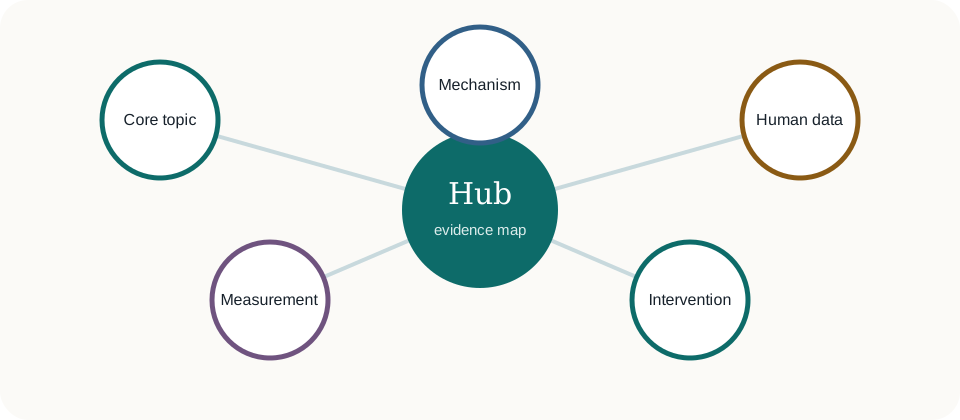
The hubs are designed to cross-link. A mechanism may lead to an intervention; an intervention may change a biomarker; a biomarker may matter differently in a specific organ system.
Use those connections to follow the evidence question rather than staying inside one category. When a topic belongs in more than one place, a single canonical article remains authoritative and the hubs act as curated entrances.
Continue with a focused review
Start with a topic card above or move into the current canonical collection. The next page should tell you what the evidence can support, what it cannot support, and what would meaningfully change the conclusion.