
What rapamycin is and why mTOR matters
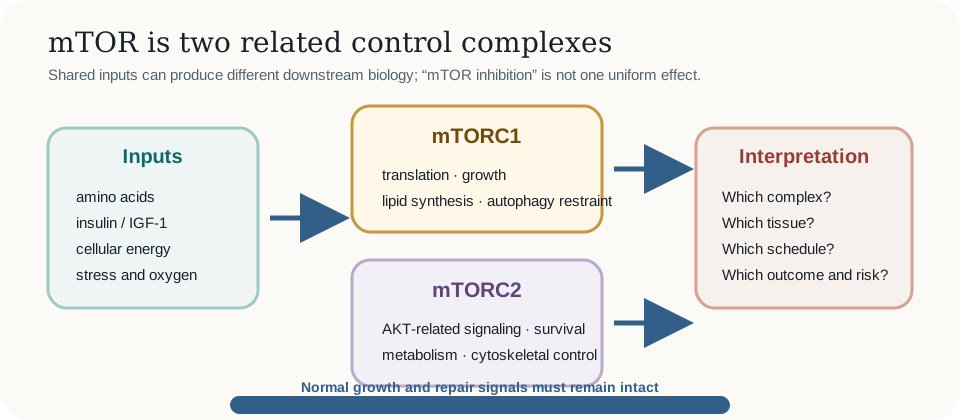
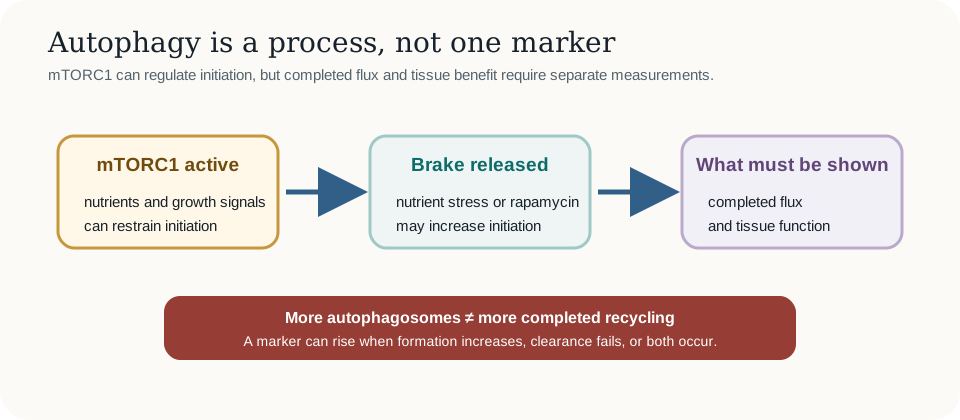
Rapamycin is a macrolide compound that binds FKBP12; the complex interacts with mTOR and suppresses mTORC1 signaling. mTORC1 coordinates nutrients, growth, protein synthesis, autophagy and cellular metabolism. Because excessive or poorly timed growth signaling is linked with several aging processes, reducing mTORC1 activity became a major geroscience strategy.
mTOR is not a single “bad aging pathway.” mTORC1 and mTORC2 have different biology, and the degree, tissue, timing and duration of inhibition matter. Rapamycin can affect immune function, lipids, glucose regulation, wound healing and mucosal tissues. A pathway rationale does not erase those trade-offs.
The related mTOR and aging page explains nutrient sensing, autophagy and tissue context. The Systems hub adds tissue-level context. Rapamycin should be judged by the endpoint actually tested, not by a general claim that lower mTOR is always better.
How strong is the model-organism lifespan evidence?
Rapamycin has extended lifespan in multiple mouse studies, including late-life intervention experiments. The NIA Interventions Testing Program made the result especially influential because treatment began relatively late and benefit was observed across genetically heterogeneous mice. Model work also reports improvements in selected immune, cardiac, neurologic, intestinal and skin phenotypes.
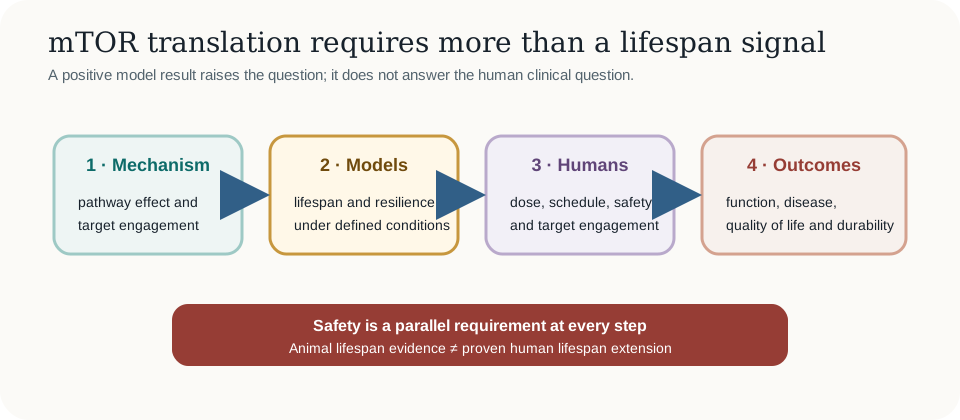
Animal evidence is unusually coherent for a pharmacologic geroprotector, but mice are not miniature humans. Laboratory animals differ in pathogen exposure, diet, genetics, metabolism, cancer risk and lifespan. A dose that improves survival in a protected mouse colony may carry a different infection or metabolic risk in people.
Late-life benefit is important because it makes translation plausible, not because it proves human efficacy. The required human test is a sufficiently powered trial with validated function, disease outcomes or survival—not a surrogate chosen after the result.
Rapamycin versus rapalogs
Rapalogs are rapamycin derivatives such as everolimus and temsirolimus. They can differ in pharmacokinetics, tissue distribution, potency, target engagement and clinical indications. Evidence from one rapalog cannot automatically be assigned to rapamycin, and a result in oncology or transplantation is not a healthy-aging result.
Some catalytic mTOR inhibitors affect signaling differently from allosteric rapamycin complexes. The term “mTOR inhibitor” therefore hides important pharmacology. A careful evidence page should name the molecule, route, exposure pattern, population and endpoint.
Human evidence before PEARL
Before PEARL, human studies of rapamycin and rapalogs were scattered across immune aging, cardiovascular measures, skin, metabolic health, disease-specific treatment and small exploratory cohorts. A 2024 systematic review identified 19 human studies. It found improvements in selected immune, cardiovascular and integumentary parameters, but no significant overall effects in endocrine, muscular or neurologic systems and no human lifespan evidence.
The review found no serious adverse events attributed to rapamycin in healthy participants in the included studies, while disease populations showed more infections and increases in total cholesterol, LDL cholesterol and triglycerides. These findings do not define a safe longevity regimen; they show why exposure, population and indication must remain explicit.
PEARL design: a healthy normative-aging cohort
The PEARL trial was a 48-week decentralized, double-blind, randomized, placebo-controlled study in healthy adults described as a normative-aging cohort. Participants received placebo or compounded rapamycin in two weekly exposure groups labeled 5 mg and 10 mg in the publication. The primary outcome was visceral adiposity measured by DXA; secondary outcomes included blood biomarkers, lean tissue, bone mineral content and surveys of health and well-being.
This design was valuable because it tested a relatively healthy population and included a placebo comparator. It was still a 48-week study, not a lifespan trial. A healthy volunteer sample may not represent frail adults, people with chronic disease or those taking interacting medicines. The study was also conducted by authors who were employees or shareholders of AgelessRx, a relationship that should be disclosed when interpreting subgroup findings.
| Feature | What was tested | What it cannot establish |
|---|---|---|
| Duration | 48 weeks. | long-term safety or lifespan extension. |
| Comparator | placebo-controlled randomized design. | generalization beyond the enrolled cohort. |
| Primary outcome | DXA-measured visceral adiposity. | whole-body biological-age reversal. |
| Exposure | weekly study groups labeled 5 mg and 10 mg. | a personal or off-label dosing instruction. |
Primary outcome: visceral adiposity was null
PEARL’s primary visceral-adiposity outcome did not change significantly. The reported partial eta-squared was 0.001 with P = .942. That is the central result for judging the trial’s main efficacy question. A favorable secondary or subgroup result cannot replace a null primary endpoint.
Some male participants showed a visceral-adiposity difference between the 5 mg and 10 mg groups at 24 weeks, but the comparison against placebo was not significant and the signal was no longer significant at 48 weeks. This pattern illustrates why multiple comparisons and time points need cautious interpretation.
Selected subgroup signals in lean mass, pain and self-reported health
Women in the 10 mg group showed statistically significant improvements in lean tissue mass at 24 and 48 weeks relative to placebo and the 5 mg group. The same subgroup showed lower self-reported pain. Participants in the 5 mg group reported improvements in general health, while emotional-well-being changes were observed in more than one group at 48 weeks.
These results may be useful for designing future trials. They are not proof that rapamycin improves lean mass or pain in women generally. Subgroups can be smaller, estimates can be unstable, and a study with many outcomes can produce apparently positive findings by chance. Confirmation requires prespecified replication with an outcome selected for clinical importance.
“Self-reported health” is also not interchangeable with fewer diseases, preserved independence or longer life. A survey signal can matter, but its clinical meaning depends on scale validity, baseline imbalance, missing data and whether the placebo group changed.
| Evidence | What it supports | What remains open |
|---|---|---|
| Adverse events | similar rates across groups in this trial. | rare or delayed harms. |
| Blood biomarkers | values remained within normal ranges in the cohort. | all organ-specific risks. |
| Healthy volunteers | information about selected normative-aging adults. | frailty, disease and medication interactions. |
Safety in PEARL versus known sirolimus risks
PEARL reported similar adverse and serious-adverse-event rates across groups, and measured blood biomarkers remained within normal ranges. That is reassuring for the participants and period studied. It does not prove safety for indefinite use, different formulations, higher exposure, older or frailer populations, or people with medical conditions.
Clinical sirolimus experience includes immunosuppression, infections, hyperlipidemia, hyperglycemia, mouth or mucosal problems, delayed wound healing, cytopenias, edema and drug interactions among other potential risks. The balance depends on indication, exposure and monitoring. “Low dose” or “intermittent” is not a guarantee that these risks disappear.
Immune effects and infection considerations
mTOR inhibition can modulate aging immune cells and has improved vaccine responses in some studies of rapalogs. That does not make rapamycin an uncomplicated immune “rejuvenator.” The same pharmacology can impair host defense, increase infections or change vaccine and wound responses depending on exposure and baseline risk.
A human trial should therefore report infections, vaccination responses, immune-cell phenotypes, oral and skin effects, wound outcomes and serious adverse events. A marker of immune-cell state is not the same as protection from infection. The immune-aging page covers that endpoint distinction, while the Biomarkers hub explains why a measurable signal is not automatically a clinical outcome.
Lipids, glucose, wound healing and other adverse-event domains
Rapamycin’s effects can extend beyond the intended mTORC1 hypothesis. Lipids and glucose may change, especially in people with disease or metabolic susceptibility. Wound healing and mucosal health matter for older adults who may undergo procedures or have dental, skin or gastrointestinal needs. Drug interactions can alter exposure to rapamycin or to co-administered medicines.
These domains should be measured prospectively rather than treated as background noise. A trial can show a promising body-composition signal and still have an unfavorable net clinical balance if harms are underestimated or follow-up is too short.
Intermittent exposure and the absence of a longevity dose
Intermittent exposure is biologically attractive because it may reduce continuous mTOR suppression and preserve some mTORC2-related functions. This is a rationale for comparative trials, not prescribing guidance. The correct interval, exposure, tissue effect and safety margin remain unknown.
There is no validated longevity dose for healthy people. The amounts studied in a particular trial belong to that protocol and population. A dose that changes a biomarker is not automatically the dose that improves function, and a dose that appears tolerable for 48 weeks may not be safe for years.
| Trial status | What it tells us | What it does not tell us |
|---|---|---|
| Protocol | the planned population, intervention and endpoints. | whether the treatment worked. |
| Recruiting study | the question is being tested. | the eventual safety or efficacy result. |
| Completed analysis | results can be assessed if reported transparently. | generalization beyond the study design. |
Current clinical-trial landscape
Clinical trials are exploring rapamycin and rapalogs in aging-related immune, metabolic, cardiovascular, neurologic, musculoskeletal and other settings. The key questions are increasingly specific: which population, which mTOR complex, which exposure pattern, which biomarker and which patient-important outcome?
The longevity clinical-trials page should distinguish protocols, recruiting trials, completed analyses and peer-reviewed outcomes. A trial registry entry is evidence that a question is being studied, not evidence that rapamycin is effective.
What a convincing geroprotective trial would need
A geroprotective trial should begin with a defined population and a clinically meaningful problem rather than an attractive pathway alone. It should prespecify whether the primary goal is immune resilience, physical function, cardiovascular risk, cognitive performance, disease progression or survival. A biological-age score may be exploratory, but it should not replace an outcome that matters to participants.
The design should characterize the intervention, measure adherence and exposure, and monitor the systems most likely to be affected by mTOR inhibition. This includes infections, blood counts, lipids, glucose, oral health, edema, wound healing, medication interactions and serious adverse events. It should report the full analysis, not only the most favorable subgroup.
| Requirement | Why it matters | Weak substitute |
|---|---|---|
| Prespecified primary outcome | protects against selective emphasis after results appear. | a post hoc subgroup. |
| Adequate follow-up | tests durability and delayed harm. | a short biomarker change. |
| Independent replication | tests generalizability and sponsorship effects. | one product-sponsored study. |
| Net clinical balance | weighs function against infection and metabolic risk. | “well tolerated” without context. |
These requirements are especially important for a prescription drug used outside its approved indications. Scientific plausibility can justify a trial; it cannot justify self-prescribing or a universal longevity protocol.
Evidence verdict and what would prove geroprotective efficacy
Rapamycin deserves serious study because mTOR biology is conserved and late-life animal lifespan extension is unusually reproducible. Human evidence is more modest. PEARL’s primary visceral-adiposity outcome was null; its lean-mass, pain and self-reported-health signals were subgroup or secondary findings requiring replication. The human literature still contains no proof of lifespan extension or broad, consistent healthspan benefit.
A convincing geroprotective program would require adequately powered, independently replicated trials with validated function or disease outcomes, transparent safety monitoring, objective exposure measures, prespecified analyses and long enough follow-up to evaluate durability. It would compare benefit against immune, metabolic, wound-healing and interaction risks. It would also report who was excluded and how adherence was verified. The broader Biology hub is useful for separating pathway plausibility from outcome evidence.
- separate mTOR pathway engagement from clinical efficacy;
- report primary outcomes before subgroup signals;
- distinguish rapamycin from rapalogs and medical indications;
- avoid off-label dosing instructions and consumer protocols;
- do not convert animal lifespan or a biomarker into human longevity proof.