Biology of aging · evidence reviewed September 2026
What mTOR is and why longevity researchers care
mTOR is short for mechanistic target of rapamycin, a kinase that integrates information about nutrients, growth factors, cellular energy and stress. It helps a cell decide whether conditions support growth and construction or whether resources should be conserved and maintenance prioritized. The pathway is not an “aging switch” with one correct setting. It is a control system whose activity must be matched to tissue, age, nutritional state and task.
Longevity researchers care because aging involves a long-term balance between building new material and maintaining existing material. Persistent growth signaling may support short-term anabolism while reducing autophagy or other recycling processes. Conversely, excessive inhibition could impair wound repair, immune responses, muscle adaptation or reproductive biology. The useful question is therefore not “How do we shut mTOR off?” but “When, where and to what degree could mTOR modulation improve resilience without disrupting essential physiology?”
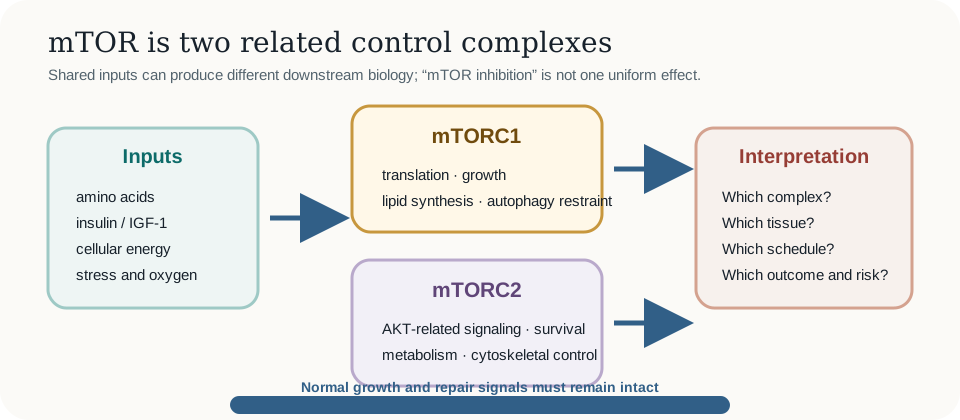
mTOR is organized mainly into two complexes: mTOR complex 1, or mTORC1, and mTOR complex 2, or mTORC2. They share the mTOR catalytic subunit but have different partner proteins, upstream inputs and downstream effects. Treating “mTOR” as one uniform signal hides the trade-offs that matter most for translation.
mTORC1 versus mTORC2
mTORC1: growth, translation and recycling
mTORC1 responds strongly to amino acids, insulin and growth-factor signals, cellular energy and stress. When active, it promotes protein and lipid synthesis and suppresses important steps in autophagy. It also influences mitochondrial and lysosomal biology, ribosome production and cell growth. This makes mTORC1 a logical place to study the tension between biosynthesis and maintenance.
mTORC2: organization, survival and metabolism
mTORC2 regulates signaling through AGC-family kinases, including AKT, and helps organize the actin cytoskeleton. It contributes to cell survival, metabolism and some aspects of stress response. Rapamycin’s immediate action is most closely associated with mTORC1, but prolonged or context-dependent exposure can affect mTORC2 assembly in some settings. That distinction matters because the benefits and harms of pathway modulation may not come from the same complex.
Animal studies and cell experiments often use doses or exposure schedules that produce broad pathway effects. A human trial must show which complex is affected in the relevant tissue, whether the effect is sustained, and whether the proposed benefit is separable from immunologic, metabolic or tissue-repair costs.
How nutrients, insulin and energy regulate mTOR
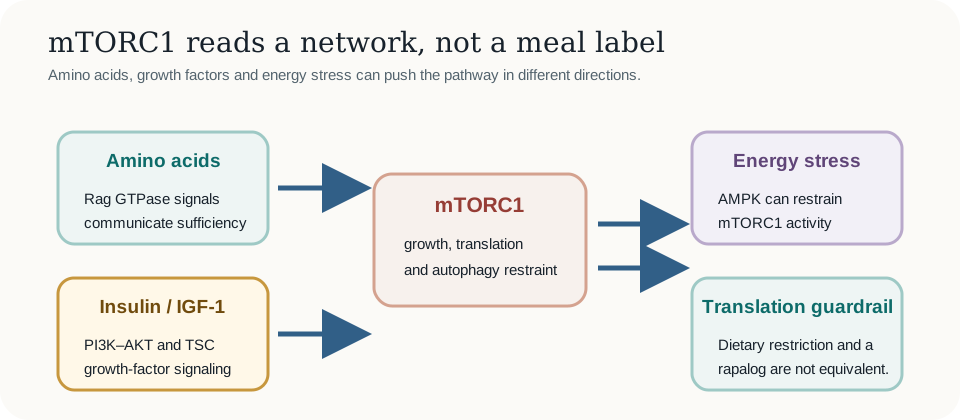
Cells do not read a meal as a single signal. Amino-acid availability, insulin and IGF-1, ATP status, oxygen, inflammation and cellular damage arrive through partly overlapping networks. Rag GTPases help communicate amino-acid sufficiency to mTORC1; growth-factor signaling through PI3K and AKT can inhibit the TSC complex and increase mTORC1 activity; AMPK responds to energetic stress and can restrain mTORC1 while promoting conservation. This is why mTOR biology belongs beside, not above, AMPK and aging research.
Dietary restriction research has often highlighted lower nutrient signaling, increased autophagy and altered insulin/IGF-1 biology. But dietary restriction is not identical to a drug. It changes energy balance, body composition, meal timing, micronutrient intake and behavior. A rapalog that changes one pathway cannot be assumed to reproduce the complete physiology of a dietary intervention.
In a healthy person, mTOR signaling rises and falls. Resistance training, feeding, wound repair and immune activation all require anabolic responses. The goal of an aging intervention would not be to flatten those normal pulses; it would be to test whether an appropriate schedule improves long-term resilience. Human trials need to measure both target engagement and real outcomes rather than infer the latter from pathway diagrams.
Protein synthesis, growth and the maintenance trade-off
mTORC1 activation supports translation and growth. That is beneficial when a cell must produce contractile proteins after exercise, repair tissue or respond to a growth signal. Aging research asks whether chronically elevated or poorly timed anabolic signaling leaves less capacity for quality control. This is a trade-off hypothesis, not a rule that growth is harmful.
Protein quality depends on synthesis, folding, repair and removal. A large amount of new protein does not guarantee a healthy proteome if damaged proteins accumulate or the recycling systems that remove them are suppressed. The relevant biology overlaps with proteostasis and aging, mitochondrial quality control and the autophagy pathway.
mTOR and autophagy
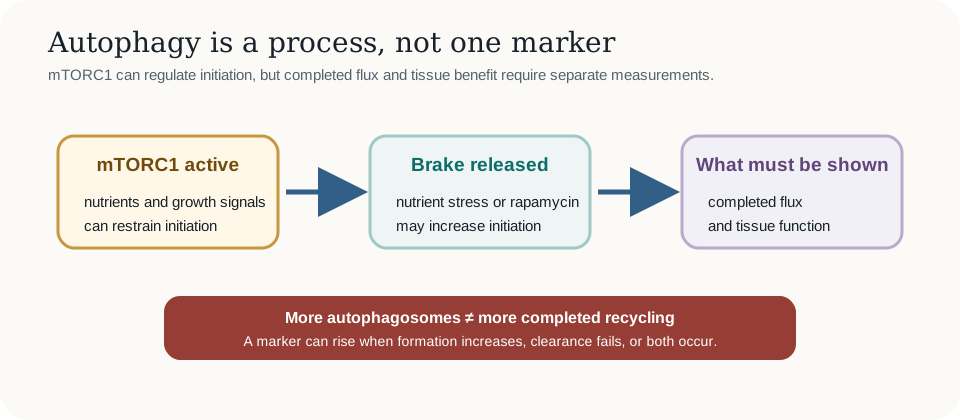
Autophagy is a family of processes that deliver cellular material to lysosomes for recycling or disposal. mTORC1 can suppress autophagy initiation when nutrients and growth signals are abundant. In experimental systems, rapamycin or nutrient stress can release that brake. However, measuring an autophagy-related marker at one time point is not the same as measuring completed flux or proving improved tissue function.
The distinction matters because cells can accumulate autophagosomes when formation increases, when clearance fails or when both occur. A credible study must explain the assay and what aspect of the process it captures. If an article says mTOR inhibition “activates autophagy,” readers should ask in which cells, under what exposure, and whether the change was linked to a patient-important endpoint.
mTOR and proteostasis
Proteostasis includes the production, folding, trafficking and removal of proteins. mTOR influences translation and lysosomal programs, but it is only one node in a wider network that includes the unfolded-protein response, chaperones, ubiquitin-proteasome activity and autophagy. A beneficial intervention would need to improve the balance of this system rather than simply maximize or minimize one signal.
mTOR signaling in aging tissues
In immune cells, mTOR modulation may alter differentiation, metabolism and responses to stress. In muscle, the pathway participates in adaptation to feeding and exercise, so chronic inhibition could have different consequences from intermittent inhibition. In the brain, vascular system, skin and liver, the relevant cell types and disease contexts differ again. A whole-body label such as “geroprotection” can hide this heterogeneity.
The same intervention can look beneficial in one tissue and harmful in another. An older adult with an infection, healing wound, metabolic disease or low muscle reserve is not equivalent to a healthy animal in a controlled laboratory. This is one reason the evidence for an intervention should be described by population, schedule, endpoint and follow-up rather than as a single score.
| Question | Why it matters | Common overreach |
|---|---|---|
| Which tissue? | Pathway effects are cell- and organ-specific. | Assuming a blood marker represents every tissue. |
| Which schedule? | Intermittent and sustained exposure can differ. | Translating one schedule to all uses. |
| Which outcome? | Function and disease are not interchangeable. | Calling a biomarker shift healthspan. |
| Which risk? | Repair and immune costs may emerge later. | Calling short-term tolerability long-term safety. |
What model-organism lifespan studies show
Rapamycin and related interventions have produced some of the most reproducible pharmacologic lifespan signals in aging models. The value of these studies is substantial: they support causal experiments, identify dose and timing questions, and show that a pathway can influence aging phenotypes across more than one species. The results also have limits. Model organisms differ in genetics, metabolism, disease spectrum, environment and lifespan, and an exposure that is feasible in a mouse may not be appropriate for people.
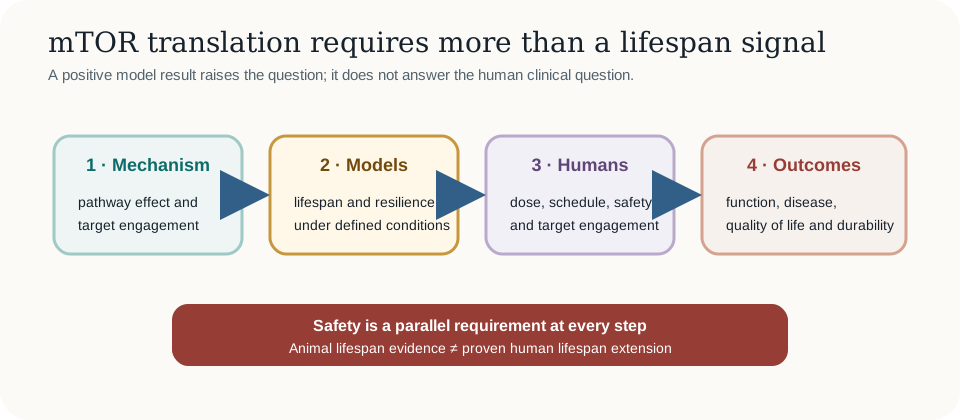
Even when lifespan increases, the mechanism may not be identical between species. The effect can depend on sex, strain, age at treatment, diet, microbiome and housing. A positive model-organism result therefore raises the priority of human translation; it does not become a human lifespan claim.
Rapamycin and rapalogs in human aging studies
Rapamycin, also called sirolimus, is an established prescription drug in clinical medicine, including immunosuppressive use. That clinical history provides pharmacology and safety experience, but it does not mean an aging indication has been established. The question in geroscience is whether a carefully designed exposure can improve meaningful outcomes in a selected population with an acceptable risk-benefit profile.
A systematic review of human rapamycin and rapalog studies found signals in some immune, cardiovascular and integumentary measures, while effects were not consistently demonstrated across endocrine, muscular or neurological systems. It also highlighted infection and lipid changes in some people with aging-related disease and the need for longer-term study. This is a mixed translational picture: informative, promising in places and not a proof of lifespan extension.
Recent experimental-medicine work continues to test target engagement, safety, dose timing and functional outcomes. The RESTOR study record, for example, describes a placebo-controlled design in older adults comparing daily and intermittent mTOR inhibition over treatment and follow-up periods. A registered trial is evidence that a question is being tested—not evidence that its answer is positive.
What human studies do not yet prove
Human studies do not yet prove that rapamycin or another mTOR inhibitor extends lifespan in healthy people. They also do not establish that a lower mTOR signal is universally desirable, that a mouse schedule is suitable for a person, or that one favorable biomarker predicts a broad reduction in age-related disease.
They may provide evidence for narrower conclusions: a regimen was tolerated over a defined interval in a defined group; a pathway marker changed; a vaccine or immune measure differed; or a functional outcome changed in a subgroup. Those conclusions can be useful without being inflated into an anti-aging promise.
- Was the study randomized and adequately powered?
- Was the endpoint patient-important or exploratory?
- Were adverse events and withdrawals reported clearly?
- Was the result replicated outside the original study group?
Relationships with AMPK, insulin/IGF-1 and NAD signaling
Aging pathways form a network. AMPK senses energetic stress and can restrain mTORC1. Insulin and IGF-1 signals promote growth through overlapping pathways. NAD-related metabolism interacts with redox state, sirtuin activity and mitochondrial function, but it should not be reduced to a simple “more NAD, less aging” story. These networks can support or oppose one another depending on tissue and state.
This network view explains why a single-target narrative is attractive but incomplete. A drug can change a pathway and still produce no clinical benefit if the endpoint is wrong, the exposure is poorly timed, the population is heterogeneous or the effect is offset by harm elsewhere. It also explains why exercise, nutrition and sleep cannot be replaced conceptually by a pathway label.
It also changes how combination strategies should be evaluated. Adding interventions because they touch different hallmarks does not guarantee synergy; it can multiply uncertainty, interactions and attribution problems. A careful trial should define the contribution of each component, monitor the most plausible harms and distinguish a pathway signature from a meaningful improvement in how people function.
Evidence verdict and open questions
mTORC1 is a central, conserved regulator of growth, nutrient sensing, translation, lysosomal biology and autophagy. Its role in aging is supported by mechanistic work and strong model-organism evidence. The human evidence is more limited and heterogeneous. Rapamycin-related studies are testing whether carefully bounded schedules can influence immune, functional or other outcomes, but they have not proven human lifespan extension.
The next decisive work will connect target engagement to outcomes that matter: function, frailty, multimorbidity, quality of life and durable safety. It will need prespecified analyses, adequate follow-up, transparent reporting of harms and replication. In that setting, mTOR is neither a magic aging switch nor a dead end. It is a high-value biological hypothesis whose clinical claim remains open.