What metformin is and why longevity researchers study it
Metformin is a biguanide used primarily to treat type 2 diabetes. Its clinical value comes from improving glycemic control and reducing diabetes-related risk when it is prescribed for an appropriate patient. That indication is well established and should not be confused with a general-purpose anti-aging indication.
Interest in longevity comes from several sources: effects on hepatic glucose production, cellular energy sensing, inflammation and mitochondrial biology; favorable signals in some animal models; and epidemiological observations in people with diabetes. Those observations justify research, but they do not establish that a person without diabetes will live longer by taking metformin.
The central question is causal. Does metformin directly slow a biological process of aging, or do some users appear healthier because they receive effective care, have different metabolic risk, or differ in ways that routine data cannot fully measure? A responsible review has to keep those explanations separate.
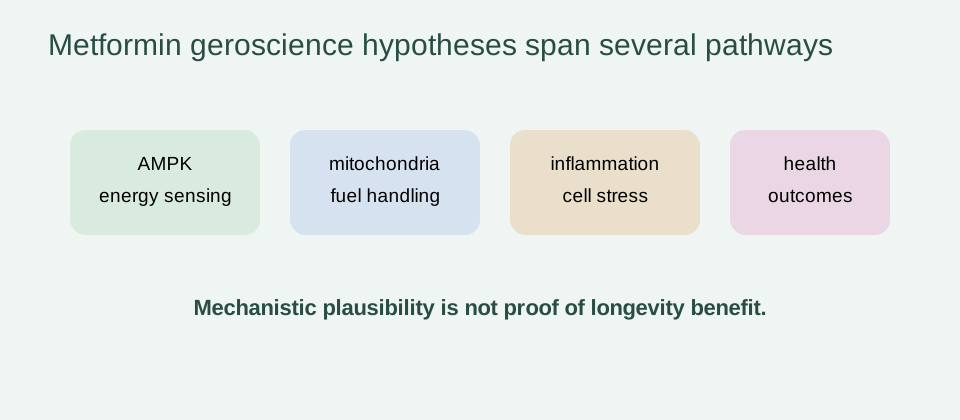
AMPK, mTOR, mitochondria and inflammation: a plausible pathway map
Metformin is often discussed through the lens of AMP-activated protein kinase, or AMPK, a cellular energy-sensing pathway. Depending on tissue, dose and metabolic state, metformin can alter energy balance and downstream signaling. The AMPK and aging page explains why pathway engagement is interesting without treating it as proof of a younger biological age.
Reviews also discuss relationships with mTOR signaling, autophagy, mitochondrial function, oxidative stress, epigenetic regulation and inflammatory signaling. These systems overlap with the hallmarks of aging. That overlap creates a coherent hypothesis, not a validated clinical endpoint. A pathway can change without producing a net benefit across organs or across all people.
AMPK and mTOR are context-sensitive networks rather than simple on/off switches. Nutritional state, exercise, kidney function, insulin signaling and concurrent disease can affect their behavior. An intervention that appears adaptive in one metabolic context may have a different effect in another.
Metformin may also influence the gut and microbial metabolites, and changes in glucose or insulin can have indirect downstream effects. Such findings can be valuable for designing experiments. They should be labeled as mechanistic or translational evidence unless they are tied to a prespecified human outcome.
| Evidence layer | What it can show | What it cannot show alone |
|---|---|---|
| Cellular mechanism | energy-sensing or inflammatory pathway changes | longer human life |
| Animal model | context-specific healthspan or lifespan signal | human anti-aging efficacy |
| Diabetes cohort | association with outcomes under clinical care | effect in healthy adults |
| Randomized aging trial | causal effect on prespecified outcomes | benefit beyond its enrolled population |
What model-organism studies contribute
Animal and cellular experiments are important because they can test mechanisms under controlled conditions. Some studies report improved healthspan or lifespan-related measures, while other results vary with species, strain, age at treatment, dose, diet, sex and the health status of the animals. A mixed preclinical record is normal for a candidate intervention and should not be compressed into a universal claim.
Translation is especially difficult when an animal receives a concentration or exposure that does not map cleanly onto standard human treatment. A mouse lifespan result can identify a testable pathway without telling clinicians whether a human dose is effective, safe or appropriate for a different indication.
Animal work therefore supports the question “is a human trial worth doing?” It does not answer “should a healthy person take metformin?” That second question requires human evidence balancing benefits, harms, baseline risk and alternatives.
Why diabetes observational studies are difficult to interpret
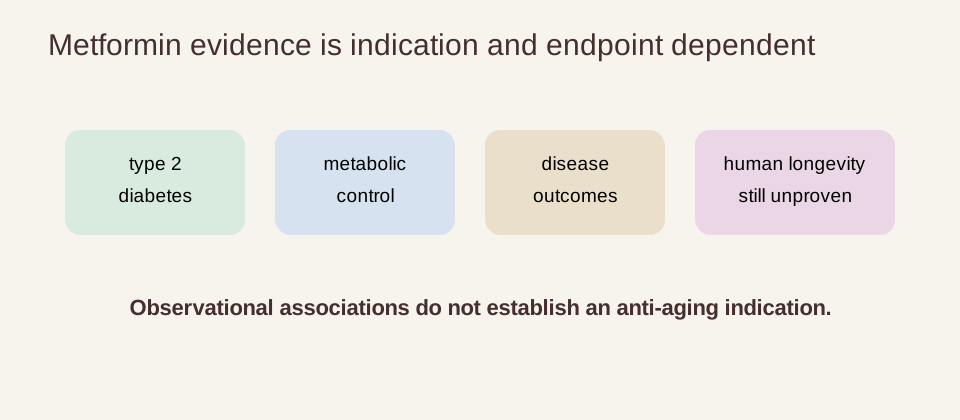
Several observational studies have associated metformin use with lower mortality or lower rates of some age-related diseases. These results are important signals, but they compare people living in real clinical systems rather than randomly assigning a longevity intervention to healthy adults.
People prescribed metformin may differ from nonusers in diabetes severity, access to care, body weight, smoking, kidney function, socioeconomic conditions, medication adherence and the intensity of preventive treatment. Researchers can adjust for measured variables, but residual confounding can remain. Treatment changes over time also make exposure categories difficult to interpret.
The comparator matters. Comparing metformin-treated people with the general population can create an apparently surprising survival advantage because the groups differ in baseline disease and healthcare contact. Comparing metformin with another diabetes medicine may be more informative, but treatment choice can still reflect clinical factors that are not fully recorded.
Healthy-user and immortal-time biases are additional concerns. A person must survive long enough and remain engaged in care to be classified as a user in some study designs. Better adherence to one medicine can also be a marker for broader adherence to screening, exercise, vaccination and other care.
Comparator design, target-trial thinking and the human evidence gap
A stronger observational analysis emulates a target trial: it defines new users, eligibility, time zero, an active comparator, follow-up, outcomes and treatment strategies before looking at results. It can reduce some biases, but it still cannot guarantee that all important confounders were measured or that the study population matches a longevity-seeking adult without diabetes.
Even a well-conducted cohort can answer a bounded question such as whether metformin initiators with diabetes have different outcomes from comparable users of another treatment. It cannot automatically answer whether metformin slows biological aging, prevents multiple diseases in healthy adults, or extends lifespan independent of glycemic control.
The most persuasive human evidence would combine randomized assignment with patient-important outcomes and a prespecified aging framework. Biomarkers may support interpretation, but a change in a laboratory measure is not a substitute for function, disease burden, quality of life, disability or mortality.
Small trials, exercise adaptation and what they do not prove
Trials in adults without type 2 diabetes have explored glucose regulation, inflammatory markers, body composition, physical function and other endpoints. These studies are useful for feasibility and safety, but many are small, short and not powered to detect a difference in age-related disease or lifespan.
Exercise interactions are a good example of why context matters. Metformin can affect metabolic signaling involved in training adaptation, and some studies have reported attenuation of selected exercise-related improvements while others have not. Differences in participants, training, endpoints, adherence and analytic choices make it premature to issue a universal rule.
A biomarker change after several weeks is not evidence of durable anti-aging benefit. Nor does a null result on one exercise or inflammatory endpoint disprove every possible geroscience effect. The appropriate conclusion is that the intervention needs larger, longer and better-targeted trials with clinically meaningful outcomes.
What the 2025 and 2026 reviews add
A 2025 critical review, Emerging uncertainty on the anti-aging potential of metformin, revisits influential experimental and epidemiological findings, replication attempts and clinical studies in people without diabetes. Its conclusion is not that metformin has no biological effects; it is that the anti-aging interpretation has become more uncertain as methodological limitations and inconsistent follow-up receive closer attention.
A 2026 review, Metformin at the convergence of aging and longevity, consolidates molecular, cellular and organismal evidence involving AMPK, mTOR, mitochondria, autophagy, epigenetic regulation, gut biology and inflammation. It presents a broad rationale for continued investigation and calls for more studies and trials. A narrative or mechanistic synthesis is not an efficacy trial.
The two perspectives can be read together. One maps why the hypothesis remains scientifically interesting; the other warns that biological plausibility and selected associations should not be mistaken for proof. Evidence-based communication needs both sides.
TAME: a proposed test of a composite aging outcome
The Targeting Aging with Metformin, or TAME, trial was designed to test whether metformin could delay the development or progression of several age-related chronic diseases. AFAR describes a planned six-year, multi-site study involving more than 3,000 adults aged 65–79 at 14 institutions, with heart disease, cancer and dementia among the outcomes of interest.
The appeal of this design is that aging is not one single disease endpoint. A composite outcome could test whether one intervention shifts the time to multiple age-related conditions, while secondary outcomes could examine function, safety and biological measures. A prespecified composite can be informative, but its component definitions, event counts and competing risks still need careful reporting.
Current status matters. AFAR’s official TAME resource says the study design has been prepared and that fundraising is needed to launch the multi-year, multi-site trial. That means TAME is a research proposal and launch effort, not a completed efficacy study. Public descriptions of the protocol should not be rewritten as results, enrollment or success.
| If the trial is conducted | Potential answer | Still requires caution |
|---|---|---|
| Composite endpoint | time to selected age-related diseases | component balance and clinical meaning |
| Older adults | effect in enrolled adults aged 65–79 | not automatic evidence for younger adults |
| Safety | benefit–harm balance under trial monitoring | generalizability to unselected users |
| Aging biology | evidence supporting or weakening the hypothesis | not proof that every aging pathway changes |
Safety boundaries: B12, gastrointestinal effects and kidney context
Metformin is widely used, but “widely used” does not mean risk-free or suitable for everyone. Gastrointestinal effects such as nausea, diarrhea and abdominal discomfort are common reasons for clinical review. Long-term use can be associated with vitamin B12 deficiency in some people, so clinicians may consider symptoms, risk factors and laboratory monitoring.
Kidney function is central to safe prescribing because reduced renal clearance changes exposure and may affect whether metformin is appropriate. Acute illness, dehydration, procedures involving contrast, liver or heart failure context and interacting medicines may require individualized instructions. Rare lactic acidosis is serious, particularly in settings of major physiologic stress or impaired clearance.
These points are safety context, not dosing advice. A person should not self-prescribe metformin, alter a prescribed regimen or use another person’s medicine to pursue longevity. The clinically appropriate decision depends on the indication, medical history, kidney function, concurrent medicines and qualified follow-up.
Metformin compared with rapamycin, SGLT2 inhibitors and GLP-1 drugs
Metformin is one candidate in a crowded geroscience discussion. Rapamycin acts more directly on mTOR-related signaling, while metformin is commonly framed around energy sensing and metabolic effects. Both have interesting biology, but neither is established as a general anti-aging therapy for healthy adults. The rapamycin and longevity page keeps its evidence and safety questions separate.
SGLT2 inhibitors have strong evidence for selected heart-failure and kidney outcomes, and GLP-1-based medicines have important metabolic indications. Their disease-specific benefits should not be converted into universal lifespan claims. See the SGLT2 aging page and GLP-1 longevity page for intervention-specific interpretation.
Class comparisons are only meaningful when population, indication, comparator, endpoint, duration and harms are aligned. Weight loss, glucose control, kidney protection or a change in one aging-related pathway cannot by themselves rank medicines as longevity therapies.
What future evidence should look like
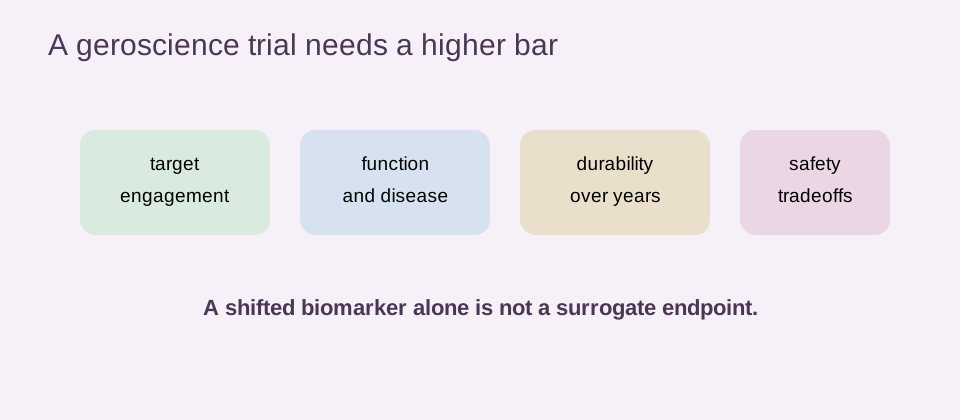
A credible aging trial would prespecify eligibility, randomization, comparator, duration, adherence, primary and secondary outcomes, safety monitoring and analysis of competing risks. It would report absolute effects and harms, not only relative associations. It would also make clear whether participants have diabetes or another condition that changes baseline risk.
Useful secondary measures might include physical function, cognition, disability, quality of life and carefully validated biomarkers. Those measures should support—not replace—patient-important outcomes. The trial would need enough follow-up to distinguish transient metabolic changes from durable reductions in age-related disease.
Replication matters too. A single positive study, especially with a composite outcome, should be interpreted with its component results, missing data, subgroup analyses and adverse events. A null study would also need careful reading: it could rule out a large effect in a specific population without ruling out every narrower benefit.
Evidence verdict
Metformin is an effective and important diabetes medicine. Its effects on AMPK, mTOR-related signaling, mitochondria, autophagy, inflammation and metabolism make it a reasonable candidate for geroscience research, and animal and human observational findings explain why the hypothesis remains active.
Those findings do not establish anti-aging efficacy in healthy adults. Diabetes cohorts can be confounded by indication, comparator choice, healthcare access and healthy-user behavior. Small trials can inform feasibility, safety and mechanisms without demonstrating fewer age-related diseases or longer life. TAME remains a prepared trial design and fundraising effort, not a completed result.
The responsible conclusion is use metformin for evidence-based clinical indications, while treating longevity claims as unproven research questions. The longevity clinical trials page explains the endpoint and design standards needed to move from a plausible pathway to a trustworthy human claim.
- separate diabetes treatment evidence from anti-aging evidence;
- treat AMPK and related pathways as mechanistic context, not proof;
- read observational comparators and confounding before accepting survival claims;
- describe TAME as designed and needing launch funding unless current evidence changes;
- include B12, gastrointestinal and kidney-safety context;
- do not provide self-directed longevity medication advice.