What SGLT2 inhibitors are and what they are used to treat
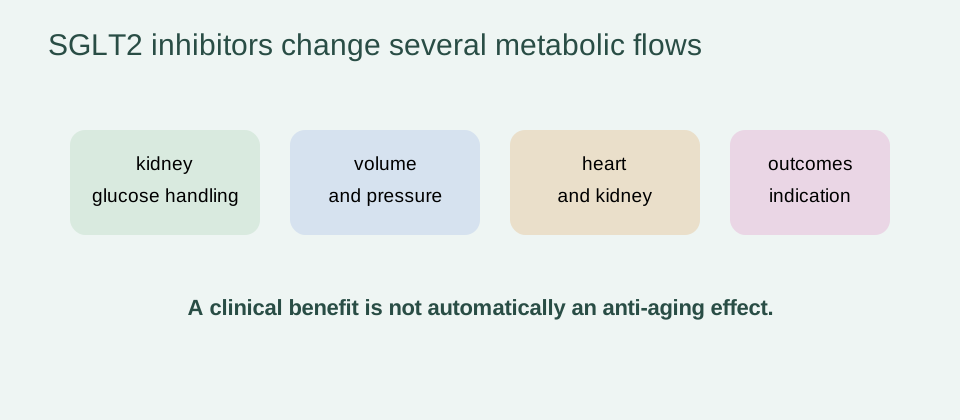
Sodium-glucose cotransporter 2 inhibitors reduce glucose and sodium reabsorption in the proximal kidney tubule. The resulting urinary glucose loss and natriuresis affect blood pressure, fluid handling, intraglomerular pressure and energy balance. Individual medicines have approved indications that vary by jurisdiction and patient condition.
Clinical use is not the same as longevity use. A medication may lower hospitalization or kidney-failure risk because it treats a disease pathway without slowing the underlying rate of human aging. The approved indication, patient selection, contraindications and monitoring requirements remain the foundation.
Why cardiorenal protection attracted geroscience interest
Heart failure, chronic kidney disease and type 2 diabetes become more common with age and share inflammation, vascular stress, metabolic dysfunction and impaired reserve. SGLT2 inhibitors influence several of those systems, prompting the question of whether their benefits reflect broader aging biology.
That question is reasonable but easy to overstate. Preventing a heart-failure admission is a meaningful clinical benefit, yet it does not prove that cells throughout the body age more slowly. Geroscience support would require validated aging endpoints and outcomes beyond disease-specific treatment.
| Evidence layer | What SGLT2 studies show | What remains unproven |
|---|---|---|
| Cardiorenal outcomes | reduced risk in indicated populations | whole-body slowing of aging |
| Metabolic effects | glucose and fluid-handling changes | reversal of biological age |
| Mechanisms | plausible cellular and fuel-signaling pathways | validated human geroprotection |
| Longevity | not a primary established indication | human lifespan extension |
Glucosuria, energy balance, ketones and fuel switching
Urinary glucose loss lowers available circulating glucose and can alter energy balance. SGLT2 inhibition may increase ketone availability and shift fuel use, especially during reduced insulin signaling or carbohydrate availability. These physiological changes are relevant to heart and kidney function but are not automatically beneficial in every person or situation.
Fuel switching is a mechanism, not an outcome. A metabolic change can coexist with dehydration, reduced intake or illness. The fact that a pathway resembles a nutrient-sensing intervention does not show that chronic pharmacologic manipulation extends life in healthy adults.
Changes in tubular sodium handling can also affect hemodynamics and fluid balance. A laboratory shift or weight change should be interpreted with kidney function, blood pressure, symptoms, concurrent medicines and the indication that motivated treatment.
Ketones are not a simple “clean fuel” signal. Their meaning depends on nutritional state, insulin availability, illness and the ability to maintain intake. Mechanistic enthusiasm should not obscure the clinical situations in which altered metabolism can become hazardous.
Autophagy, AMPK, mTOR, inflammation and oxidative stress
Preclinical and translational literature discusses links between SGLT2 inhibition, AMPK and mTOR signaling, autophagy, oxidative stress, mitochondrial function and inflammatory pathways. The AMPK-aging page and mTOR-aging page separate pathway plausibility from clinical proof.
Some signals are observed in animals, cells or secondary analyses of human trials. They can help explain a cardiorenal effect or generate hypotheses. They do not establish that a human taking an SGLT2 inhibitor has a younger immune system, fewer senescent cells or a slower biological-aging trajectory.
Heart-failure and chronic-kidney-disease outcome evidence
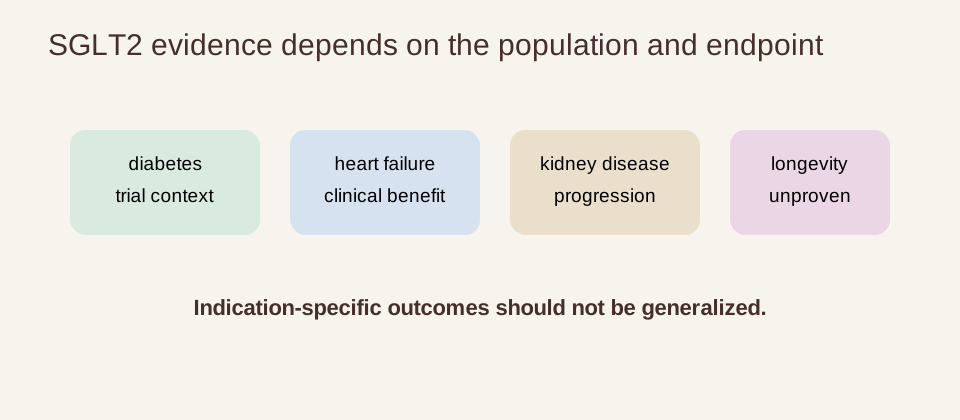
Randomized trials have established SGLT2 inhibitors as important therapies in several heart-failure and chronic-kidney-disease populations, including people with and without diabetes depending on the medicine and indication. Benefits commonly include lower risk of worsening heart failure or kidney disease, while the exact endpoints and eligible populations differ across trials.
These are high-value human outcomes. Their strength should not be diluted by relabeling them anti-aging evidence. Treating a disease can preserve function and life expectancy for that disease without proving a universal change in the rate of aging.
Benefits with and without diabetes, including adults aged 65+
A 2025 systematic review and meta-analysis examined 11 randomized trials with 79,370 participants and compared older adults aged 65 years or more with nonolder participants. The primary composite of cardiovascular death, acute myocardial infarction and stroke was reduced overall, with concordant results in older and nonolder groups and no evidence of a subgroup difference.
The same analysis reported reductions in the composite of cardiovascular death and heart-failure exacerbation in both age groups. This supports clinical efficacy across age strata for people with relevant risk or disease. It does not mean that healthy older adults should take the medicine for longevity, nor that subgroup similarity proves a geroscience mechanism.
| Question | Evidence status | Interpretation |
|---|---|---|
| Cardiorenal efficacy | supported in indicated trial populations | clinical treatment evidence |
| Frailty-specific safety | less certain and context-dependent | requires individual assessment |
| Longevity in healthy adults | not established | geroscience research question |
Frailty and the limits of subgroup evidence
Frail older adults may have altered volume status, low intake, falls risk, polypharmacy, reduced kidney reserve and more frequent acute illness. They are not always represented in the same way as healthier trial participants. A favorable average effect does not remove the need for individualized assessment.
Frailty is not simply chronological age. It describes vulnerability and limited recovery capacity, while heart failure, kidney disease and diabetes create their own treatment contexts. The absence of a large subgroup harm signal is reassuring but is not a guarantee for every frail patient.
2026 aging-mechanism reviews: hypothesis versus demonstrated benefit
Recent reviews describe unexpected or potentially geroscience-relevant effects of SGLT2 inhibitors on fuel use, inflammation, autophagy, mitochondrial biology and cellular stress. These reviews are valuable maps of the field, but they synthesize mechanisms and indirect evidence. They do not replace randomized trials designed to test aging outcomes.
A mechanistic review can correctly identify a plausible pathway while the clinical conclusion remains narrow. The current evidence supports using SGLT2 inhibitors for indicated cardiorenal care, not prescribing them to healthy people as anti-aging drugs.
Potential effects on senescence and mitochondrial function
Cellular senescence and mitochondrial dysfunction are plausible targets because they contribute to inflammation, impaired repair and organ stress. SGLT2 studies may report changes in oxidative stress or mitochondrial signaling, but such measurements are usually secondary or mechanistic rather than validated clinical surrogates.
A lower inflammatory marker or altered mitochondrial readout is not evidence that senescent cells were selectively removed, that all tissues improved or that mortality will fall in healthy people. The inflammaging page keeps this distinction explicit.
The same intervention can produce beneficial and adverse cellular effects in different tissues. A tissue-specific mechanism must be connected to a functional outcome and a safety signal before it can support a human geroscience claim.
Even a favorable biomarker panel can be downstream of improved hemodynamics or glucose control. Studies should identify whether the proposed aging pathway was directly engaged or whether the measure simply moved alongside successful disease treatment.
Biomarkers, adverse effects and safe clinical boundaries
A geroscience trial would need a prespecified aging biomarker with analytical reliability, a clinically meaningful outcome and a safety plan. It should distinguish disease treatment from prevention, report absolute benefits and harms, and test whether the biomarker adds value beyond standard measures.
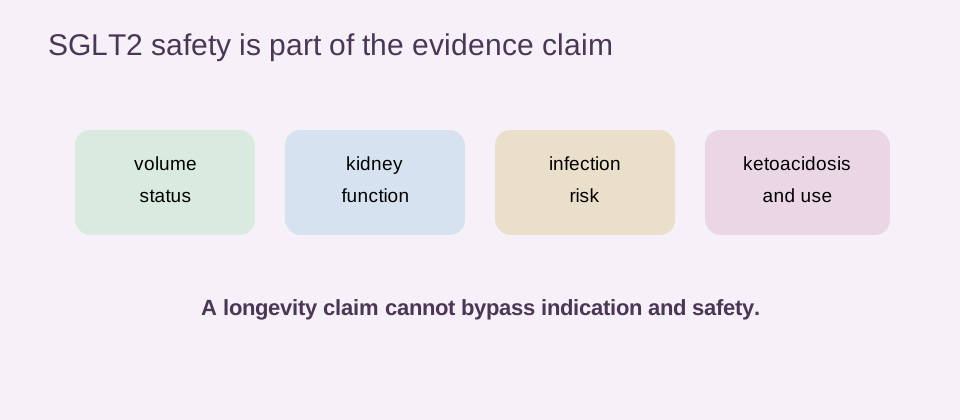
Known safety considerations include volume depletion, blood-pressure effects, genital infections and rare ketoacidosis, including situations where glucose is not extremely high. Acute illness, fasting, dehydration, surgery and medication interactions can change risk. These are reasons for clinician-directed monitoring, not reasons to provide dosing or medication-selection advice here.
SGLT2 inhibitors versus GLP-1 drugs as geroscience candidates
SGLT2 inhibitors and GLP-1-based medicines both attract aging research interest because they affect metabolic and cardiorenal disease, but they are not interchangeable. Their mechanisms, indications, trial populations, weight effects, adverse effects and clinical endpoints differ. Comparing them as generic “anti-aging drugs” discards those distinctions.
The GLP-1 longevity page and metformin longevity page keep intervention-specific evidence separate. A medicine’s success in reducing an age-related disease does not establish that it slows aging relative to another medicine or to no treatment.
Comparative effectiveness is also not the same as geroscience validation. If two treatments reduce an event through different routes, the more effective one for that event is not automatically the one that modifies a conserved aging pathway.
A fair comparison would prespecify the population, primary outcome, safety window and biological-aging measures. It would avoid inferring a whole-body benefit from weight, glucose, kidney or heart changes alone.
Both classes can be valuable when clinically indicated, but the existence of multiple effective metabolic therapies makes causal interpretation more demanding. A future comparison should report not only which event changed, but why it changed and whether the result generalizes beyond the treated disease.
What a true aging-targeted trial would need to show
A true geroscience trial would define the population, intervention, comparator, aging endpoint, disease outcomes, functional outcomes, follow-up and adverse events before analysis. It would show that the effect is not merely due to treating diabetes, heart failure, kidney disease, fluid status or weight.
It would also need evidence of durability and meaningful benefit in people without the treated disease, or a clearly bounded claim for a disease-specific population. Until such trials exist, the scientifically honest description is “cardiorenal therapy with geroscience hypotheses,” not “longevity drug.”
The design should also predefine how harms will be weighed against benefit. A modest biomarker improvement cannot justify a treatment if dehydration, infection, ketoacidosis or other adverse effects offset meaningful health outcomes.
It should distinguish all-cause mortality from disease-specific events and report absolute rather than relative effects. A therapy can improve survival in a high-risk clinical population by preventing a particular complication while leaving the underlying aging process unchanged. That is still valuable medicine, but it is a different scientific claim.
| Domain | Required signal | Why it matters |
|---|---|---|
| Biology | validated pathway or aging biomarker | tests the proposed mechanism |
| Function | patient-important outcome | shows real benefit |
| Safety | long-term harm monitoring | tests net clinical value |
Evidence verdict
SGLT2 inhibitors have strong human evidence for important heart-failure and kidney outcomes in appropriately selected patients, with evidence that benefits extend across older and nonolder trial groups. Their physiology and mechanistic literature justify further geroscience research.
The evidence does not show that they extend human lifespan as anti-aging drugs. Mechanistic effects on fuel use, autophagy, AMPK/mTOR, inflammation, senescence or mitochondria should not be presented as established human geroprotection, and cardiorenal event reduction should not be relabeled as slowed biological aging.
The responsible conclusion is use SGLT2 inhibitors for evidence-based clinical indications, while treating longevity claims as unproven research questions. Any future aging claim must be tested with validated biomarkers, patient-important outcomes and careful safety monitoring over adequate follow-up. This boundary protects both clinical value and scientific accuracy, especially for older adults and people with complex medical conditions in safe, real-world clinical care and practice overall properly.
- keep approved cardiorenal indications separate from longevity research;
- distinguish older-adult efficacy from frailty-specific evidence;
- label cellular mechanisms as hypotheses unless clinically demonstrated;
- include volume, infection and ketoacidosis context;
- do not provide a self-directed longevity medication recommendation.