What GLP-1 receptor agonists are
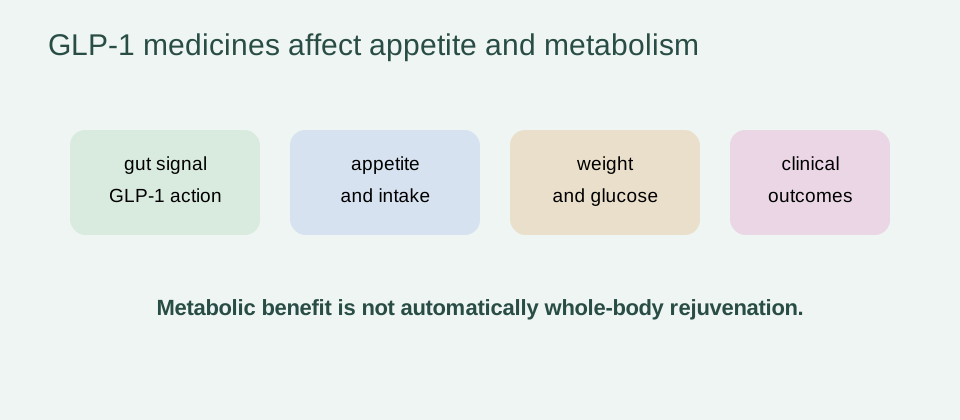
GLP-1 receptor agonists mimic or amplify signaling from glucagon-like peptide-1, a hormone involved in glucose regulation, appetite and gastrointestinal function. They can increase glucose-dependent insulin secretion, reduce glucagon signaling, slow gastric emptying and influence appetite through central pathways. Their approved uses, formulations and indications vary by medicine and jurisdiction.
Semaglutide and liraglutide are GLP-1 receptor agonists. Tirzepatide activates both GIP and GLP-1 receptors, so it is related but not interchangeable. Differences in molecular action, dose studied, trial population, duration, weight effect and adverse-effect profile matter when interpreting results.
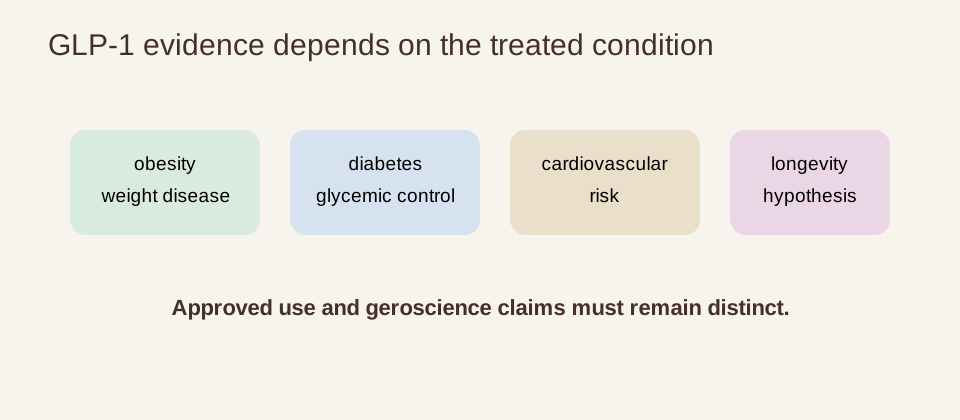
A medicine’s ability to lower glucose or body weight is clinically meaningful when it addresses a relevant disease. It is not automatically evidence that the medicine changes the underlying rate of aging. The metformin longevity page makes the same indication-versus-geroscience distinction for another metabolic candidate.
Weight loss, glycemic control and inflammation
GLP-1 therapies can reduce energy intake and improve glycemic control, with downstream effects on adipose tissue, insulin resistance, blood pressure and metabolic load. Loss of excess adiposity may reduce mechanical and inflammatory stress. These are plausible routes to better health in people with obesity or diabetes.
Inflammatory markers can also fall as metabolic disease improves. A 2026 review describes possible effects on NF-κB-related inflammation, immune signaling, mitochondrial function and autophagy. This is useful biological context, but the review also emphasizes translational uncertainty, inter-individual variability and the need for better long-term evidence. See the inflammaging page for how to interpret inflammatory changes.
Lower C-reactive protein, improved insulin sensitivity or weight reduction may be mediators of a clinical benefit, correlates of improved health, or both. None is by itself a validated measure of whole-body biological age. The causal chain has to be tested rather than assumed.
| Observed result | Reasonable interpretation | Claim that remains unsupported |
|---|---|---|
| Weight reduction | less adiposity and metabolic load in indicated patients | rejuvenation or slower aging in every tissue |
| Lower glucose | better diabetes control | lifespan extension independent of disease treatment |
| Lower inflammation | possible reduction in inflammatory burden | reversal of inflammaging as a validated endpoint |
| Epigenetic-clock shift | exploratory molecular signal | proven longer life or restored function |
Cardiovascular outcome evidence: SELECT and beyond
SELECT tested semaglutide in adults with overweight or obesity and established cardiovascular disease who did not have diabetes. It provided unusually important randomized evidence that a GLP-1 drug can reduce major cardiovascular events in an obesity population without diabetes. The result is clinically relevant because it tests more than a glucose-lowering indication.
That does not convert SELECT into a general anti-aging trial. Participants had defined cardiovascular risk, the primary endpoint was cardiovascular, and the intervention was evaluated over the study’s specified follow-up. Preventing myocardial infarction or stroke is valuable treatment; it is not the same endpoint as slowing aging across organs.
Major phase 3 studies of this class have commonly been sponsored by manufacturers. Sponsorship does not invalidate a randomized trial, but it makes prespecified outcomes, independent adjudication, complete reporting and replication especially important. Readers should distinguish the strength of the design from the source of funding.
Heart failure, function and cardiac remodeling
In STEP-HFpEF and related studies, semaglutide improved heart-failure symptoms, physical limitations, exercise function and body weight in people with obesity-related heart failure with preserved ejection fraction, with and without type 2 diabetes in the relevant programs. These are patient-important findings in a high-burden condition.
An echocardiography substudy included 491 of 1,145 participants and reported less progression of left-atrial remodeling and right-ventricular enlargement with semaglutide than placebo over 52 weeks. Such findings help explain how symptoms and function may improve, but a substudy with selected imaging participants is not a test of lifespan extension.
The same outcome can have several contributors: weight reduction, improved hemodynamics, reduced inflammation, better exercise tolerance and changes in comorbidity burden. A disease-modifying interpretation may be reasonable within HFpEF, while a universal geroprotection claim remains too broad.
FLOW, kidney protection and the 2026 pooled analysis
FLOW studied semaglutide in adults with type 2 diabetes and chronic kidney disease. Prespecified analyses reported lower cardiovascular death, nonfatal myocardial infarction or nonfatal stroke, as well as lower all-cause mortality, across important CKD risk strata. These results are bounded by the enrolled population and the trial’s diabetes-and-CKD clinical context.
A 2026 participant-level pooled analysis combined the SELECT, FLOW and SOUL randomized trials. The 30,787 participants had cardio-kidney-metabolic disease and a mean follow-up spanning roughly three to four years. The primary kidney composite occurred less often with semaglutide than placebo, with a hazard ratio of 0.84; a narrower kidney composite excluding cardiovascular death also favored semaglutide, with a hazard ratio of 0.80.
The pooled result strengthens the evidence that semaglutide protects kidneys and cardiovascular systems in selected high-risk populations, including people with and without diabetes depending on the trial. It does not establish a general biological-aging effect. The pooled analysis used different populations, routes and doses, and it was funded by Novo Nordisk; those details belong in the interpretation.
| Trial or analysis | Population context | Main evidence boundary |
|---|---|---|
| SELECT | obesity or overweight with cardiovascular disease, without diabetes | cardiovascular event reduction |
| FLOW | type 2 diabetes with chronic kidney disease | kidney, cardiovascular and mortality outcomes |
| Pooled 2026 analysis | SELECT, FLOW and SOUL cardio-kidney-metabolic populations | kidney protection across trials, not anti-aging proof |
All-cause mortality is still population-specific
All-cause mortality is closer to a longevity outcome than a single disease endpoint, but its meaning depends on who was enrolled and why. A reduction among adults with diabetes, CKD, obesity or cardiovascular disease can reflect prevention of disease complications in that high-risk population. It should not automatically be generalized to healthy adults without those conditions.
Absolute risk, follow-up time, competing risks, treatment adherence and the balance of benefits and harms all matter. A relative hazard ratio can sound universal even when the absolute benefit is concentrated in people with high baseline risk.
Long-term extension of life in a clinical disease population is worth studying. It remains different from demonstrating that GLP-1 drugs slow the biological processes of aging or extend life in low-risk adults.
Lean mass, muscle aging and sarcopenia
Weight loss can include fat mass and lean mass. The clinical meaning of a lean-mass change depends on the amount, its functional consequences, baseline muscle reserve, protein intake, resistance exercise, illness and the method used to measure body composition. A scale cannot distinguish these components reliably.
Older adults and people with frailty may have less reserve, so preserving strength and function is central. This does not mean that every GLP-1-associated lean-mass change is harmful, nor that weight loss is harmless in every context. The sarcopenia and muscle-aging page keeps muscle quantity separate from strength, power and functional capacity.
A longevity trial should prespecify changes in strength, gait, activities of daily living, falls, physical performance and nutritional status rather than relying on a single lean-mass percentage. The relevant question is net function over time, not whether a body-composition chart looks favorable.
Epigenetic aging: a promising but narrow signal
A 2026 Nature Communications paper reported a post-hoc analysis of a 32-week randomized trial in adults with HIV-associated lipohypertrophy. Among the analyzed participants, semaglutide was associated with changes in several blood-DNA-methylation clocks, including measures related to epigenetic age and pace of aging.
This is a notable human signal because the data came from a randomized, placebo-controlled parent trial rather than a simple observational association. It is still a small, special-population, post-hoc biomarker analysis with short follow-up. The source reports multiple clock outcomes and industry-linked conflicts among some contributors, including employees of a biomarker company; those facts should remain visible.
The result does not show that semaglutide rejuvenates tissues, reverses disease, improves cognition or extends life. DNA-methylation clocks are predictive or composite measures whose relationship to intervention-mediated healthspan is still being tested. The epigenetic-aging page explains why clock movement is not the same as demonstrated rejuvenation.
Preclinical mechanisms and possible brain applications
Cell and animal studies discuss GLP-1-related effects on mitochondrial stress, autophagy, inflammation, vascular biology, neuroinflammation and neuronal survival. These mechanisms are relevant to metabolic and age-associated disease research. They are not a single confirmed pathway to longer human life.
Brain and neurodegenerative applications remain under study. A biological rationale does not establish clinical benefit in dementia, Parkinson disease or other disorders, and effects may depend on disease stage, exposure, blood–brain barrier biology and the specific molecule. Mechanistic enthusiasm should not become a treatment recommendation.
Preclinical findings are strongest when they lead to a prespecified human test with a meaningful endpoint. Until then, they belong in the hypothesis layer of the evidence map.
Safety: gastrointestinal effects, gallbladder disease and clinical boundaries
Known adverse effects of GLP-1 medicines include gastrointestinal symptoms such as nausea, vomiting, diarrhea, constipation and reduced appetite. Gallbladder and biliary events, dehydration and kidney injury related to severe gastrointestinal illness can matter clinically. Risk varies by medicine, patient, dose studied and indication.
People with diabetes, heart failure, CKD, frailty or multiple medicines may have especially important monitoring considerations. Persistent vomiting, inability to maintain hydration, severe abdominal symptoms or other acute changes require medical assessment. This page does not provide medication-selection, titration or off-label longevity dosing advice.
Safety is part of the aging question. A therapy cannot be called geroprotective based on a biomarker if the net effect on falls, nutrition, strength, gallbladder events, kidney function or quality of life is unknown.
Why clinical benefits do not automatically equal geroprotection
GLP-1 trials now show an impressive range of benefits: cardiovascular event reduction, better heart-failure symptoms and function, kidney protection, improved glycemic control and weight reduction in selected populations. It is tempting to call this proof that the class slows aging because the diseases are age-related.
But disease treatment and geroscience are overlapping, not identical, categories. A treatment may prevent a heart attack by modifying atherosclerotic risk, reduce kidney events by changing hemodynamics and metabolic stress, and improve function by reducing obesity-related load. Those effects are valuable without requiring a universal change in biological age.
A true longevity claim would need prespecified aging and functional outcomes, adequate duration, safety monitoring and replication across populations. The longevity clinical trials page describes that evidentiary threshold.
What a longevity-focused GLP-1 trial would need to show
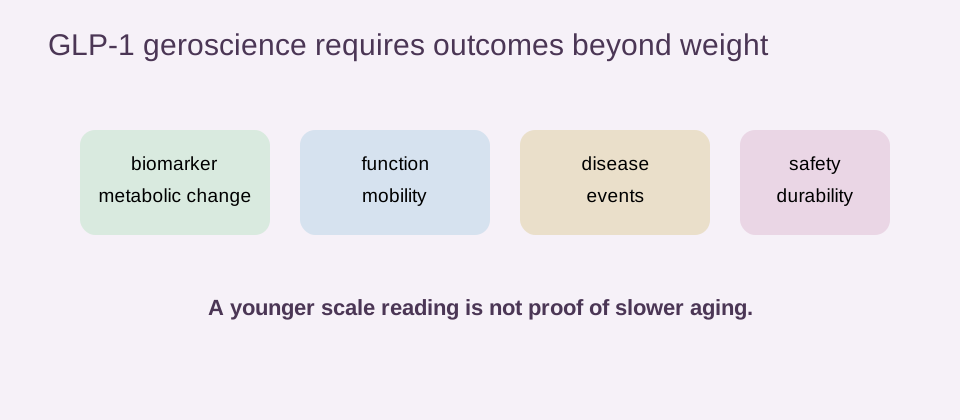
The trial would define the target population, comparator, intervention, duration, adherence and primary outcome before analysis. It would report major age-related diseases, all-cause mortality, physical and cognitive function, quality of life, body composition, nutrition, falls and adverse events. It would also show whether effects persist after accounting for weight loss and glycemic improvement.
Biomarkers could help test mechanism, but they should be validated, prespecified and linked to patient-important outcomes. Epigenetic-clock improvement would be stronger evidence if it replicated across independent cohorts and accompanied durable functional or disease benefits.
Comparisons with SGLT2 inhibitors and other metabolic therapies should be indication-matched. A more effective treatment for one endpoint is not automatically a broader geroprotector. Trials should make absolute effects and harms legible to patients and clinicians.
Evidence verdict
GLP-1 receptor agonists have unusually broad randomized evidence across obesity, diabetes, cardiovascular disease, heart failure and chronic kidney disease. The 2026 pooled SELECT/FLOW/SOUL analysis strengthens the kidney-outcome evidence, and semaglutide’s cardiovascular, heart-failure and CKD findings are clinically important in their enrolled populations.
Mechanistic reviews and the 2026 randomized methylation analysis add serious geroscience interest. They do not establish lifespan extension, whole-body reversal of biological aging or a benefit for healthy adults. Weight loss, lower inflammation, organ protection and clock movement each answer narrower questions.
The responsible conclusion is use GLP-1 medicines for evidence-based indications, while treating longevity claims as unproven research questions. Future work must include function, muscle, nutrition, safety and durable age-related outcomes rather than relying on weight or a molecular clock alone.
- separate disease-specific randomized outcomes from aging hypotheses;
- keep related molecules and trial populations distinct;
- treat epigenetic-clock findings as exploratory biomarker evidence;
- interpret lean mass through strength, function and nutritional context;
- disclose sponsorship and relevant conflicts when summarizing major trials;
- do not provide off-label longevity dosing or individualized medical advice.