Why people compare CoQ10 and omega-3
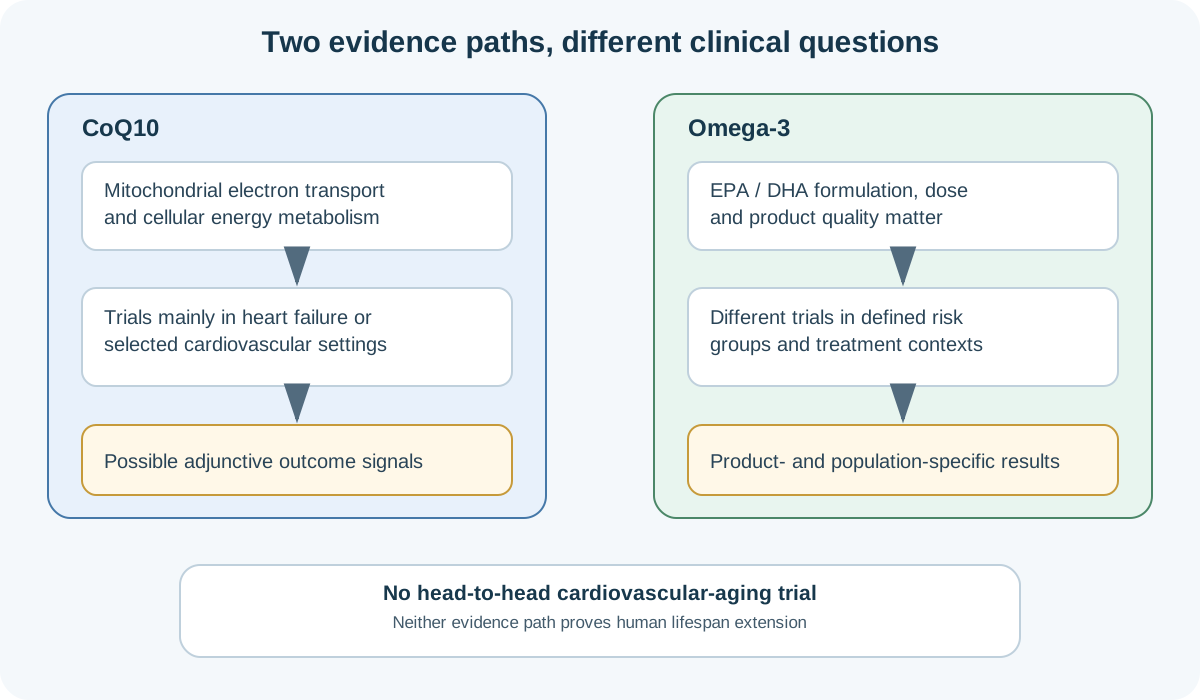
Coenzyme Q10 (CoQ10) and long-chain omega-3 fatty acids are commonly sold as supplements and are often discussed in relation to heart health. That consumer overlap can make them sound interchangeable. They are not. CoQ10 is a lipid-soluble compound involved in mitochondrial electron transport and cellular energy metabolism. EPA and DHA are fatty acids that influence triglyceride-rich lipoproteins, membrane composition and other signaling pathways. Their mechanisms, trial histories and clinical uses differ.
The phrase “cardiovascular aging” also combines several distinct questions. It might mean preventing a first heart attack in a healthy person, reducing repeat events in someone with established coronary disease, treating heart failure, lowering high triglycerides, or changing an intermediate measure such as blood pressure or a biomarker. Evidence for one of these outcomes cannot automatically answer the others.
A fair comparison therefore asks what each intervention was tested for, in whom, alongside which background treatment, and against what outcome. It also separates prescription medicines from retail supplements. A trial result for one standardized prescription formulation is not evidence that every product with a similar label has the same composition, dose, quality or effect.
What CoQ10 does—and what its cardiovascular trials test
CoQ10, also called ubiquinone in its oxidized form, participates in the mitochondrial electron-transport chain and helps transfer electrons used in ATP production. It also has antioxidant functions in membranes. These roles provide a biological rationale for study in heart muscle, which has high energy demands. A plausible mechanism, however, is a reason to run a clinical trial; it is not itself proof that taking a supplement prevents cardiovascular disease.
CoQ10 trials have often enrolled people who already have cardiovascular disease, especially heart failure, and tested the supplement as an addition to standard care. A 2024 meta-analysis pooled 33 randomized studies in heart failure. It reported lower all-cause mortality and heart-failure hospitalization in the CoQ10 groups, grading those outcomes as moderate certainty, while some functional and biomarker outcomes were rated lower certainty. The number of included studies does not erase differences in trial size, methods, background treatment, duration or risk of bias. The result applies to a heart-failure evidence base, not automatically to healthy adults seeking prevention.
A Cochrane review focused on heart failure judged that CoQ10 probably reduces heart-failure-related hospitalization, based on two studies with 1,061 participants, but emphasized the limited evidence base for other clinical outcomes. Systematic reviews can reach different estimates because they search different dates, include different trials and use different eligibility criteria. Their results should be read alongside the underlying trials and not treated as independent replications when they reuse many of the same participants.
A separate review of randomized and crossover studies in older adults with cardiovascular disease or hypertension included 14 studies and 1,067 participants. The studies covered heart failure, hypertension, ischemic heart disease and preoperative cardiac surgery. The authors described positive findings in some settings, but also noted mixed, often underpowered evidence for major outcomes and inconclusive hypertension findings. This breadth is useful for mapping research; it does not establish a single effect in all older adults.
A 2026 double-blind randomized trial adds a useful counterweight for healthy-aging claims. Forty robust, community-dwelling adults around age 74 received 400 mg/day CoQ10 or placebo for 12 weeks. Plasma CoQ10 rose, but muscle and mitochondrial CoQ10 levels, mitochondrial respiratory capacity, glucose homeostasis, VO2max and body composition did not differ between groups. The study is small and short, yet it directly shows why a higher blood level cannot stand in for a functional benefit in older adults.
The practical boundary is important: a possible adjunctive role in a diagnosed condition is different from a supplement recommendation for the general public. The studies do not establish that CoQ10 prevents a first heart attack, reverses arterial aging, reduces mortality in healthy people or adds lifespan. Anyone being treated for heart failure should follow their prescribed care plan and discuss any supplement with the treating clinician, including possible interactions and product-specific considerations.
- Heart failure: adjunctive treatment evidence, not primary prevention.
- Hypertension and ischemic disease: smaller and mixed study sets.
- Healthy aging: no established event-reduction or lifespan result.
Omega-3 is a family of products, not one intervention
Omega-3 refers to several fatty acids, including alpha-linolenic acid (ALA) from some plant foods and the long-chain fatty acids EPA and DHA found in seafood and many supplements. Cardiovascular outcome trials commonly study a defined pharmaceutical preparation containing EPA alone or a specified EPA/DHA combination. Retail fish-oil products vary in EPA and DHA content, chemical form, manufacturing and dose. A capsule’s total oil weight is not the same as its EPA-plus-DHA dose.
The large REDUCE-IT trial tested prescription icosapent ethyl, a purified EPA product, at 4 grams per day in statin-treated adults with elevated triglycerides who had established cardiovascular disease or diabetes with additional risk factors. The trial reported fewer events on its composite cardiovascular endpoint than placebo over a median 4.9 years. This is evidence for a particular prescription medicine used in a defined high-risk population, on top of statin therapy. It is not a trial of ordinary fish-oil supplements in low-risk adults.
Other trials have produced different results. STRENGTH tested a high-dose prescription EPA/DHA carboxylic-acid formulation in high-risk patients and did not show a cardiovascular benefit; the trial stopped early for futility and reported more atrial fibrillation in the active-treatment group. Differences among trials may reflect formulation, achieved fatty-acid levels, comparator, participant risk, background treatment, adherence or chance. A positive result for one product cannot be generalized to all omega-3 products, and a null result for another does not erase the tested product’s result.
A 2024 meta-analysis of 12 randomized trials of prescription omega-3 preparations, involving 99,830 participants, reported reductions in cardiovascular events, cardiac death, myocardial infarction and revascularization. Its search covered studies through September 2023, and it combined products and settings that were not identical. The pooled estimate summarizes a heterogeneous prescription-drug literature; it does not establish that any over-the-counter supplement prevents events. Current U.S. labeling for icosapent ethyl specifies use alongside maximally tolerated statin therapy in adults with elevated triglycerides and either established cardiovascular disease or diabetes plus additional risk factors.
Dietary fish, prescription EPA and retail fish-oil supplements are separate exposures. Eating fish as part of a dietary pattern is not equivalent to taking a high-dose capsule, and neither dietary guidance nor observational association substitutes for a randomized trial of a specific product. This article compares supplement evidence and does not advise readers to start or stop a prescription medicine.
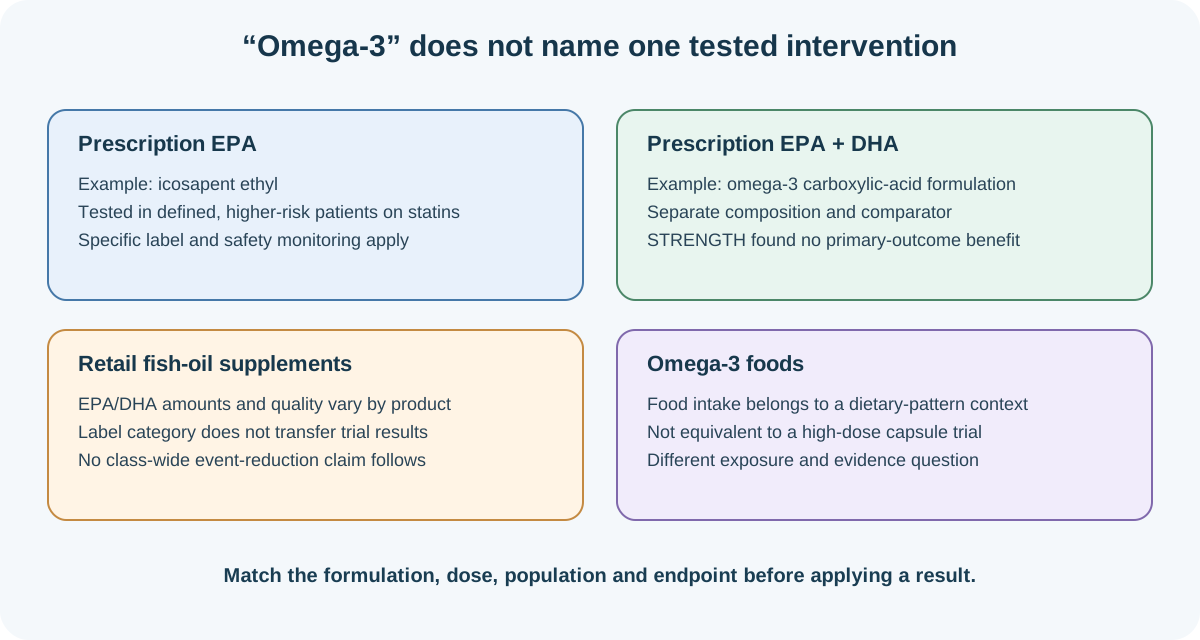
| Intervention tested | Example evidence context | Translation limit |
|---|---|---|
| Prescription EPA | Icosapent ethyl in statin-treated adults with elevated triglycerides and high cardiovascular risk | Does not establish benefit for low-risk adults or arbitrary fish-oil capsules |
| Prescription EPA + DHA | High-dose defined combination in high-risk trials such as STRENGTH | Not the same compound mixture as purified EPA; outcome results can differ |
| Retail fish-oil supplement | Product-specific content and quality; often no clinical-outcome indication | Label category alone does not establish equivalent dose, purity or event reduction |
| Fish as food | Dietary pattern and food exposure rather than a standardized capsule trial | Cannot be treated as a randomized test of a high-dose supplement |
- Identify EPA versus EPA/DHA and the exact formulation.
- Check dose, duration, comparator and background statin therapy.
- Read atrial-fibrillation and bleeding outcomes alongside event results.
Endpoints matter more than a broad “heart health” label
Studies can measure triglycerides, inflammatory markers, ejection fraction, exercise capacity, hospitalization, heart attack, stroke or death. These outcomes sit at different levels. Changing a laboratory marker can be useful, particularly when the marker is part of a recognized treatment indication, but it does not guarantee fewer clinical events. Likewise, a change in ejection fraction or walking distance in a heart-failure trial cannot be translated directly into longer lifespan for people without heart failure.
Composite outcomes require careful reading too. They combine several events, which can improve statistical efficiency, but the components differ in severity and frequency. A reduction in a composite does not necessarily mean every component fell or mortality improved. In REDUCE-IT, for example, the primary composite event rate was lower, while all-cause mortality was not significantly different in the trial’s reported results. Each endpoint should be described separately when the distinction affects interpretation.
Study duration also sets a limit. A trial lasting months can test a short-term physiologic outcome or safety signal. It generally cannot establish effects on decades-long aging trajectories. Neither CoQ10 nor omega-3 cardiovascular trials have shown that treatment resets an aging process, slows a validated measure of biological aging with confirmed clinical meaning, or extends human lifespan.
| Measure or endpoint | What it can show | What it cannot establish on its own |
|---|---|---|
| Triglyceride level | Whether a product changed a lipid measure over a defined period | That every formulation prevents heart attacks or that a retail supplement matches a prescription drug |
| CoQ10 blood level or oxidative marker | That exposure or a biochemical pathway changed | Fewer clinical events, slower aging or longer life |
| Ejection fraction or exercise capacity | A physiologic or functional result in a specified heart-failure population | Primary prevention in healthy adults or a general longevity effect |
| Heart attack, stroke, hospitalization | Patient-important events in the trial population and treatment context | Equivalent effects for untested populations, doses or products |
| Composite cardiovascular outcome | A prespecified combination of events for statistical analysis | That each component or all-cause mortality improved equally |
Why separate trial results cannot pick a winner
There is no direct randomized trial comparing CoQ10 with a defined omega-3 preparation for cardiovascular aging. A comparison across separate studies is indirect. Participants in CoQ10 heart-failure trials may differ substantially from participants in an omega-3 prevention trial: they may have different diagnoses, baseline event risks, medicines, ages, follow-up and outcome definitions. Comparing relative risk numbers across such trials can create a false ranking.
Even “omega-3” is not a single treatment arm. Purified EPA, prescription EPA/DHA, concentrated retail fish oil, lower-dose supplements and dietary intake are not interchangeable. Similarly, CoQ10 trials may differ in formulation, dose, duration, heart-failure severity, background medication and how outcomes are measured. The product and context belong in the headline of any evidence claim, not in a footnote.
To establish a comparative effect, a trial would need a clearly defined target population, consistent background guideline-directed care, quality-controlled interventions, adequate follow-up and prespecified outcomes. If the question were prevention in healthy adults, the study would need enough participants and years of follow-up to assess clinical events and harms. If the question concerned heart failure, the population, standard treatment and endpoints should be specific to that diagnosis. A biomarker-only comparison would not settle which intervention improves healthspan.
Safety, medicines and product quality
Safety depends on the product, dose, duration, patient and concurrent treatment. High-dose prescription omega-3 therapy has a recognized atrial-fibrillation or flutter signal in some trials. The 2026 updated meta-analysis of 35 trials examined this risk across more than 114,000 participants; only the high-risk participants receiving more than 1,500 mg/day of EPA plus DHA had a statistically significant increase in new-onset AF (odds ratio 1.43, 95% CI 1.14-1.79; absolute risk difference 0.8%). The other dose-risk groups did not show statistically significant increases, so this subgroup result should not be applied to ordinary dietary intake. The current U.S. icosapent ethyl label warns of atrial fibrillation or flutter requiring hospitalization and bleeding, with greater bleeding incidence among patients using antithrombotic medicines.
That label is specific to prescription icosapent ethyl and does not quantify the risk of every fish-oil supplement. The National Institutes of Health Office of Dietary Supplements notes that high-dose omega-3 products warrant discussion with a health professional, particularly with anticoagulants; trial and product information differ in how clinically important bleeding risk is characterized. Readers should not stop anticoagulants, antiplatelet medicines or prescribed lipid treatment based on a supplement article.
CoQ10 is generally described as tolerated in many short studies, but trial reporting and long-term follow-up are limited. Case reports and interaction references raise a possible CoQ10-warfarin interaction, although the size and clinical importance are uncertain; evidence for effects on blood pressure or glucose is also variable. People using prescription medicines should check the exact product with a pharmacist or clinician. Product labels, purity, oxidation, storage and actual EPA/DHA or CoQ10 content can vary. Third-party quality testing may help assess product identity, but it does not prove a product prevents cardiovascular disease.
These considerations are particularly relevant for older adults, who are more likely to use several medications and to have atrial fibrillation, cardiovascular disease or bleeding risk. “Natural” does not mean interaction-free. The decision to use a supplement should account for the diagnosis, the treatment goal, the exact product and the person’s medicine list. This page does not provide an individualized dose or replace a medication review.
What the evidence supports—and what it does not
For CoQ10, randomized and pooled evidence offers a possible adjunctive signal in heart failure, especially for hospitalization and selected functional measures. That signal deserves accurate reporting and further study. It does not authorize a broad claim that CoQ10 prevents cardiovascular disease in healthy adults or delays aging.
For omega-3, some defined prescription products have reduced events in selected populations, while others have not. The clinical question is therefore which formulation, for which patient, with what baseline risk and background therapy. Regulatory labeling for prescription EPA defines one such use. A retail supplement with a different composition and no equivalent indication should not inherit that result.
For a direct consumer comparison, the most accurate conclusion is that the interventions have different evidence footprints and neither is a universal cardiovascular-aging winner. A person with heart failure, elevated triglycerides or established vascular disease needs individualized evidence-based care. A person without those conditions cannot infer preventive or longevity benefit from these disease-specific trials.
Related context is available in our CoQ10 evidence overview, omega-3 evidence overview, biological-age testing overview, muscle-aging evidence overview and current longevity research tracker, the supplements hub, biological-age testing overview and current longevity research tracker. Those pages address their own topics; they do not change the indirect nature of this comparison.