Best Baby Teething Toys: How to Choose a Safe Teether That Actually Helps
Updated October 2026
Safety guidance: FDA and American Academy of Pediatrics
If your baby has suddenly decided that fingers, sleeves, toys and possibly your shoulder are all excellent things to chew, welcome to teething season. A good teether is wonderfully simple: it gives sore gums something safe to press against. It does not need medication, magic beads or a complicated “tooth eruption” technology.
The best baby teethers are easy for small hands to hold, comfortable to chew, easy to clean and sturdy enough for repeated gnawing. Some can also be chilled in the refrigerator for extra soothing.
And despite what older teething advice sometimes suggested, teethers do not make teeth erupt faster. Their job is comfort.
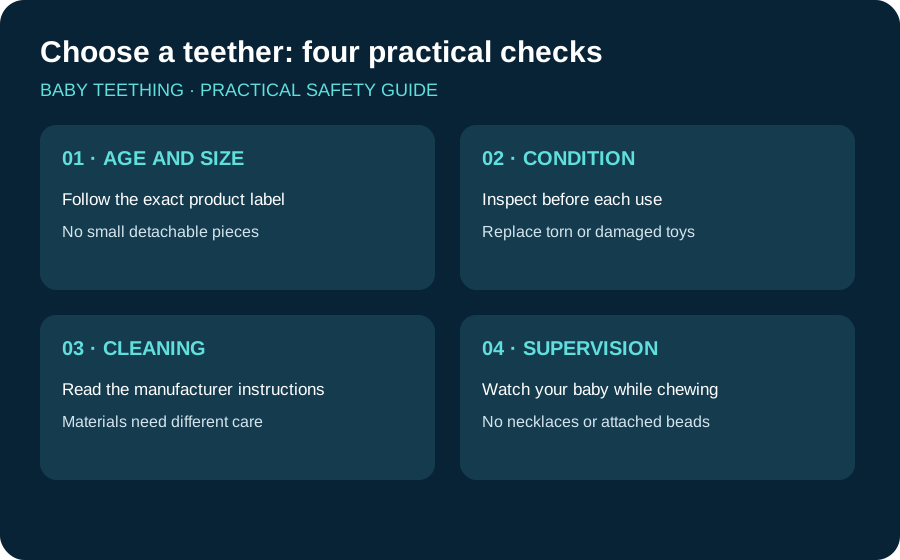
Choose an age-appropriate, intact teether you can clean as directed. Follow its label and supervise every use.
Lightweight natural rubber with many easy-to-chew shapes
See product section below
Solid chilled teething ring
Best simple cooling option
Inexpensive, easy to chill and straightforward to clean
Choose a current age-appropriate model
Cool damp washcloth
Best free option
Soft, cool and surprisingly useful
No purchase needed
There is no single teether every baby will love. Babies can be remarkably opinionated for people who cannot yet say the word “teether.”
The trick is choosing a safe design and then seeing which texture and shape your baby actually prefers.
Best overall: Comotomo Silicone Baby Teether
The Comotomo Silicone Baby Teether is our best all-around pick because there simply is not much to go wrong with it.
Its finger-like chewing points give babies several surfaces to bite while the open center is easy for small hands to grab. The one-piece silicone construction is also a big practical advantage for parents: fewer seams, fewer hidden corners and no liquid-filled chamber.
Why we like it:
simple one-piece silicone construction;
easy for small hands to grip;
several chewing surfaces;
easy to wash;
no liquid-filled section to leak;
compact enough to keep in a diaper bag.
What could be better: It is intentionally simple. If your baby expects every toy to flash, sing and qualify as a small amusement park, this is not that. Best for: parents who want one uncomplicated everyday teether.
Best budget pick: Nuby Silicone Carrot Tube Teether
You do not have to spend much on a useful teether. The Nuby Silicone Carrot Tube Teether uses a long hollow shape that is easy to grab and offers multiple surfaces for chewing. That matters more than it sounds: a fantastic teether sitting six inches away on the floor is not doing much for anyone.
Amazon currently identifies ASIN B0CWVTFK4X as the Nuby Silicone Carrot Hollow Teether Tube, with the Carrot Tube Teether variation selected.
Why we like it:
affordable;
soft silicone;
easy-grip shape;
multiple chewing surfaces;
useful for babies still mastering their grip.
What could be better: Some families may prefer the chunkier shape of a classic ring, and all narrow or elongated toys still need normal adult supervision. Best for: getting a practical silicone teether without paying a premium.
Few baby products have achieved the strange level of celebrity enjoyed by a rubber giraffe. Sophie la Girafe remains a popular natural-rubber option because the long legs, ears, neck and head create several easy-to-grab and easy-to-chew shapes. The biggest difference from our silicone picks is cleaning. The manufacturer instructs owners to clean Sophie’s surface with a damp cloth and soapy water rather than submerging the toy. That makes Sophie charming and very chewable, but not our first choice if your product philosophy is:
“Can I throw this in the dishwasher and forget about it?”
Why we like it:
natural-rubber construction;
lightweight;
many easy-to-chew shapes;
easy for small hands to hold;
established product with a long market history.
What could be better: usually costs more than a basic silicone teether; requires more careful cleaning; should not be submerged according to manufacturer instructions.
Best for: families who specifically want a natural-rubber teether.
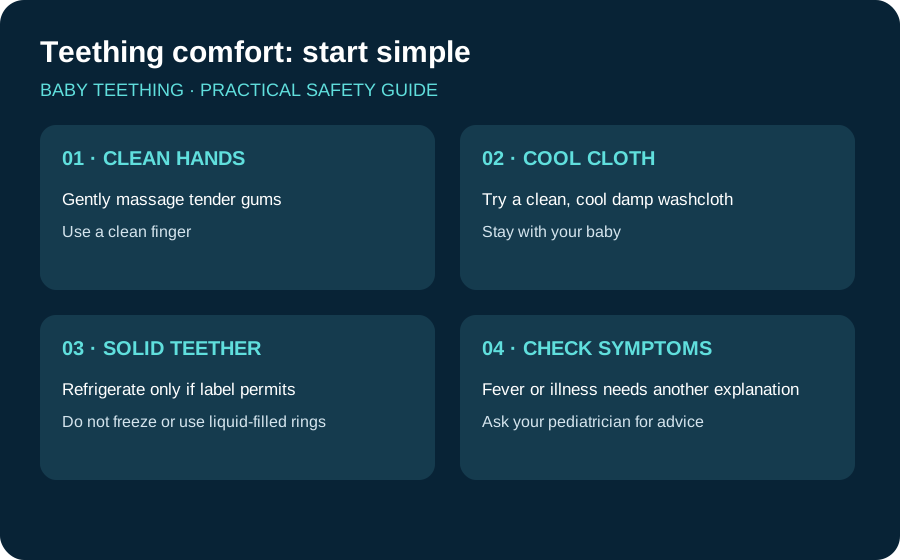
Cool temperatures can feel good on tender gums. But cool is not the same thing as frozen solid.
The FDA recommends firm rubber teethers and warns against freezing a teether until it becomes very hard because an overly hard surface can hurt a baby’s gums.
Our preference is uncomplicated:
choose a solid teether that the manufacturer says may be chilled;
cool it in the refrigerator;
give it to your baby under supervision.
You do not need to turn it into a tiny hockey puck.
The surprisingly good free teether: a cool washcloth
Before buying your fourth specialized piece of baby gear, try this: Wet a clean washcloth, cool it and let your baby chew on it while supervised. Gentle gum massage with a clean finger is another simple option.
The FDA and American Academy of Pediatrics both recommend straightforward measures such as gum massage and appropriate teething rings for ordinary teething discomfort.
Sometimes the zero-dollar option competes remarkably well with the expensive one.
How to choose a baby teether
Buying check
What to know
1. Can your baby actually hold it?
A teether’s theoretical gum-soothing brilliance means very little if it repeatedly falls out of your baby’s hands.
For younger babies, useful features include:
loops;
open centers;
thin gripping sections;
handles;
several different places to grab.
As coordination improves, more elaborate shapes become practical.
2. Is it easy to clean?
This is one of our biggest buying criteria.
A simple silicone teether that can be thoroughly washed is hard to beat.
Check:
the manufacturer’s cleaning instructions;
seams and crevices;
internal cavities;
holes that can allow water inside;
whether the exact product can be boiled, sterilized or placed in a dishwasher.
Never assume two teethers can be cleaned the same way simply because they look similar.
3. Is the material comfortable for sore gums?
The goal is a surface firm enough to provide counter-pressure without becoming dangerously hard or brittle. Silicone and natural rubber are common options because they can combine flexibility with enough resistance to chew.
Whatever the material, inspect the toy regularly.
If it becomes cracked, torn, sticky, badly worn or develops pieces that could break away, replace it.
4. Is the shape age-appropriate?
Avoid small detachable pieces.
The toy should be large enough that it cannot become a choking hazard and should be used according to the manufacturer’s age instructions.
Supervision still matters even with a well-designed teether.
5. Does it need liquid inside?
Usually, no.
Older teethers often relied on liquid-filled chambers for cooling. Modern solid silicone and rubber designs make that complexity unnecessary.
The FDA recommends a firm, not liquid-filled teether.
6. Does it promise something a teether cannot really do?
Be skeptical of claims that a teether:
speeds up tooth eruption;
prevents dental disease;
changes jaw development;
provides medicinal pain relief;
has therapeutic powers because of a gemstone or necklace material.
A teether mainly provides a safe chewing surface and pressure against tender gums.
That is enough.
Teething products we would skip
Product to avoid
What to know
Amber teething necklaces
We would not recommend amber teething necklaces. There is no good evidence that wearing amber around the neck relieves teething pain, and necklaces introduce choking and strangulation risks.
The FDA has received reports of serious injuries and deaths involving teething jewelry.
This is one place where the old version of this DentalsReview article needed a complete reversal.
Benzocaine teething gels
Skip them.
The FDA warns against benzocaine products for teething because benzocaine can cause methemoglobinemia, a rare but potentially life-threatening condition that reduces the blood’s ability to carry oxygen.
Lidocaine teething products
These should also not be used as routine teething remedies for infants and young children.
The FDA warns that oral viscous lidocaine used for teething can cause serious toxicity, including seizures, brain injury, heart problems and death.
Homeopathic teething tablets and gels
These are not our preferred alternative either.
The FDA warns parents against relying on homeopathic teething products and recommends simpler non-drug soothing methods instead.
What does normal teething look like?
The first teeth commonly start appearing during infancy, but timing varies significantly from baby to baby. Common signs can include: wanting to chew; drooling; tender or swollen gums; mild irritability. Many babies barely seem bothered. What parents should not automatically blame on teething is a true fever or a child who appears genuinely ill.
The American Academy of Pediatrics notes that a temperature over 100.4°F (38°C) is not considered a normal result of teething and should prompt you to consider another cause.
If something feels wrong, contact your child’s pediatrician rather than trying increasingly elaborate teething remedies.
Comfort measures do not treat fever or illness. Keep teethers refrigerator-cool rather than frozen and contact your pediatrician when symptoms concern you.
What if the teether is not enough?
Most ordinary teething discomfort does not require medication. Start with: a safe teether; a chilled solid teething ring; a cool washcloth; gentle gum massage.
If your baby still seems uncomfortable enough that you are considering pain medication, ask your pediatrician about the appropriate medication and dose for your child’s age and weight.
Do not substitute a topical numbing gel simply because it is sold next to baby products.
Once the first tooth arrives, the job changes
A teether helps with comfort before and during eruption. Once that tiny first tooth appears, it is time to start taking care of it. The American Dental Association recommends brushing as soon as the first tooth erupts. Children younger than 3 should use a smear of fluoride toothpaste roughly the size of a grain of rice, and brushing should be done twice daily with caregiver help.
The first dental visit should also be scheduled by the child’s first birthday.
That is a major correction from the old article, which delayed parts of the brushing routine much longer than current guidance supports.
So, which teether should you buy?
If you want the shortest possible answer: For most families: start with the Comotomo Silicone Baby Teether. It is simple, easy to grip and easy to clean. For a lower-cost option: the Nuby Silicone Carrot Tube Teether gives you plenty of chewable surface without much expense. If you prefer natural rubber:Sophie la Girafe remains the classic option, but follow its more restrictive cleaning instructions. For extra soothing: chill an appropriate solid teether rather than freezing it rock hard. And if your baby ignores the carefully researched teether you bought and happily chews a cool washcloth instead?
That is also completely normal.
The best teether is ultimately the safe one your baby will actually use.
FAQ
Do teethers make teeth come in faster?
No. A teether can provide pressure and comfort to tender gums, but it does not meaningfully accelerate normal tooth eruption.
Should I freeze a baby teether?
Do not freeze a teether until it becomes rock hard. The FDA warns that an overly hard frozen teether can injure tender gums. Refrigerator-cool is the safer default unless the manufacturer gives specific instructions.
Are liquid-filled teethers better?
We do not consider liquid filling an advantage. The FDA recommends firm, non-liquid-filled teethers.
Are amber necklaces safe for teething?
We do not recommend them. Teething jewelry has no established pain-relief benefit and can create choking or strangulation hazards.
Can I use Orajel or another benzocaine gel?
Benzocaine products should not be used for teething pain in young children. The FDA warns of potentially serious toxicity.
When should I start brushing my baby’s teeth?
Start as soon as the first tooth erupts. Use a rice-grain-sized smear of fluoride toothpaste for children younger than 3 and brush twice daily with caregiver help.