Safety note: This explainer cannot diagnose adrenal disease or interpret an individual result. Do not start, stop or change prescription glucocorticoids or DHEA based on this article. Suspected adrenal crisis is an emergency; urgent medical assessment is appropriate for severe illness with collapse, confusion, persistent vomiting or very low blood pressure.
What the adrenal glands and HPA axis do
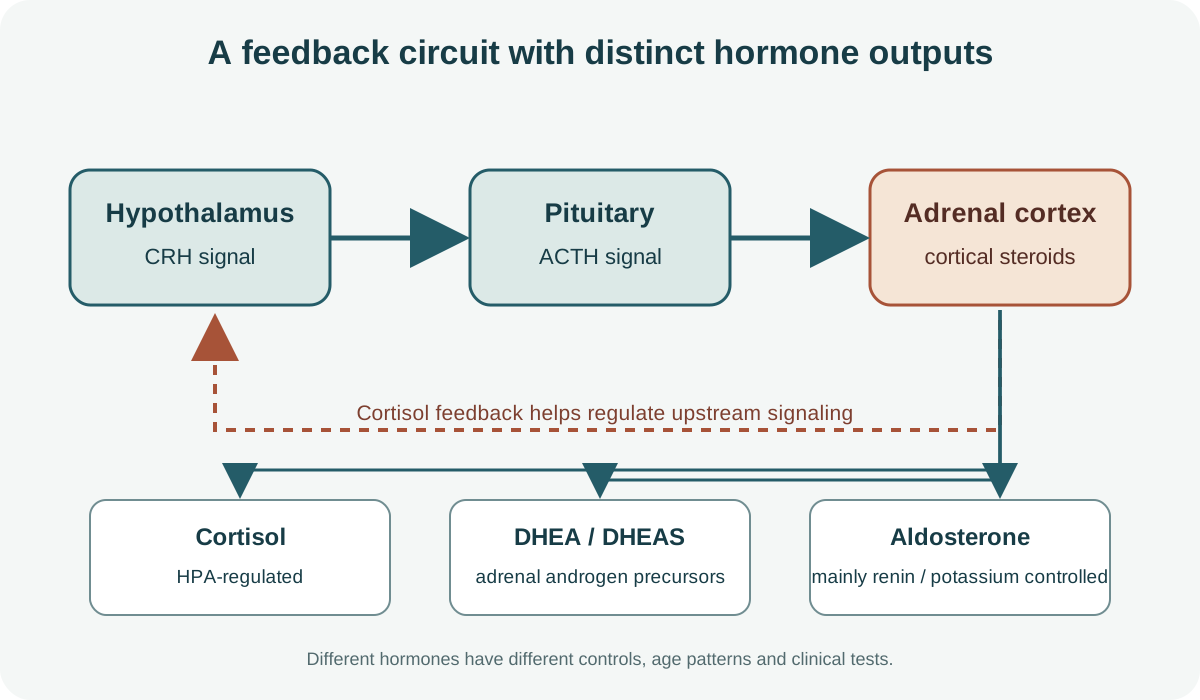
The adrenal glands sit above the kidneys, but their different regions make different hormones. The outer cortex produces glucocorticoids such as cortisol, mineralocorticoids such as aldosterone, and adrenal androgen precursors including DHEA and DHEAS. The inner medulla produces catecholamines such as epinephrine and norepinephrine as part of sympathetic nervous system signaling. “Adrenal aging” most often refers to cortical steroid physiology and HPA regulation; it should not blur these separate tissues into one process.
Cortisol production is regulated chiefly through the HPA axis. In response to circadian timing and many forms of stress, the hypothalamus releases corticotropin-releasing hormone (CRH), which stimulates the pituitary to release adrenocorticotropic hormone (ACTH). ACTH signals the adrenal cortex to produce cortisol. Cortisol then feeds back to the hypothalamus and pituitary, helping regulate further signaling.
That loop is not a simple “more stress equals exhausted glands” system. It responds to sleep-wake timing, inflammation, acute illness, energy balance and medication, among other influences. A single measurement captures one moment in a dynamic process. Read the research hub for evidence methods. The body also uses cortisol for normal functions including glucose availability, vascular responsiveness and immune regulation; the goal is not to suppress or raise it without a medical reason; see our systems hub.
Aldosterone is controlled differently, mainly by the renin-angiotensin system and blood potassium, with ACTH having a smaller and more transient influence. It helps regulate sodium, potassium, fluid balance and blood pressure. DHEA and DHEAS are adrenal androgens, with DHEAS circulating in a larger pool; their production and downstream conversion differ by sex and life stage. These hormones do not move together as a single “adrenal output.” See the biology hub.
Why age-related changes are not one “adrenal age”
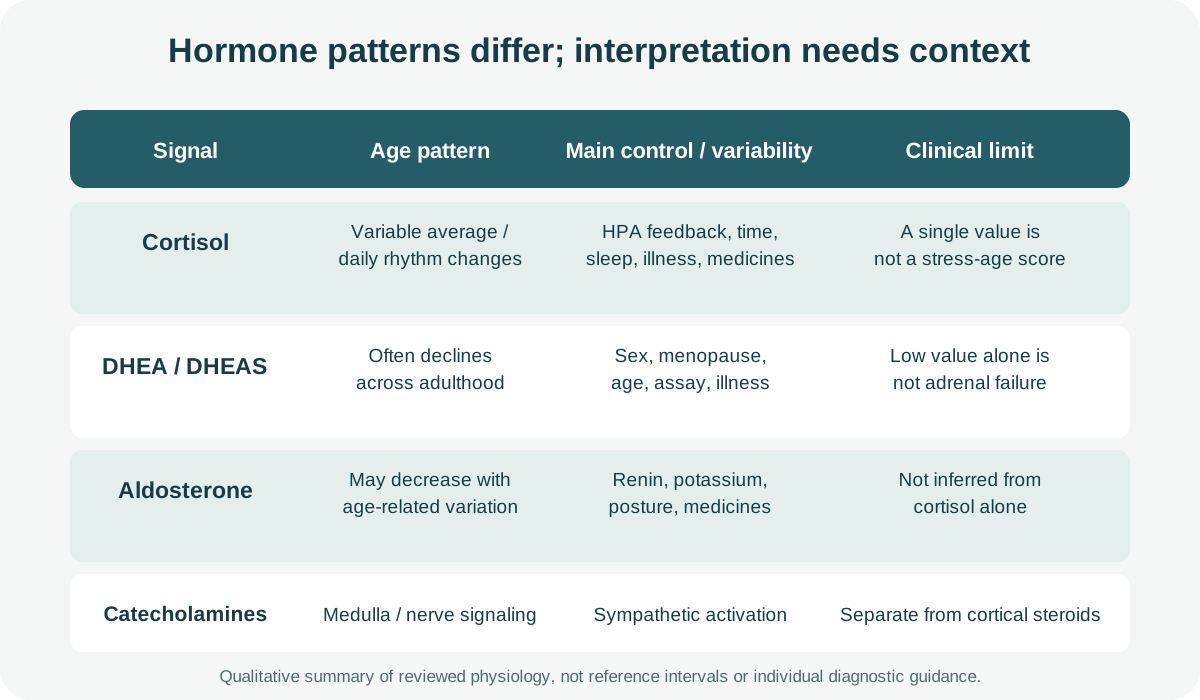
Reviews describe age-associated shifts in adrenal steroid physiology, but the size and meaning of those changes differ by hormone, person and study. DHEA and DHEAS commonly decline from young adulthood into later life. Aldosterone secretion may also decrease, while kidney function, salt intake, blood pressure and renin signaling change. Cortisol findings are more variable: some studies report higher average levels, altered feedback or a flatter day-night pattern, but no single trajectory applies to every older adult.
A 2025 review asked whether “adrenal cortex senescence” should qualify as an aging-related pathology. It discusses reduced DHEA/DHEAS and possible links to function, but frames the classification question rather than establishing a clinical disease that every older person has. Age-related physiology is not automatically pathology. The research hub explains evidence limits. A change may be measurable without proving that it causes symptoms, predicts an individual’s outcome or should be treated; biomarkers need context.
Small human physiology studies also caution against treating all steroids alike. In one study comparing 35 healthy postmenopausal women aged 55–68 with 30 regularly menstruating women aged 20–25, baseline DHEA, DHEAS and androstenedione were lower in the older group, while basal cortisol was similar. Responses to ACTH differed by steroid and endpoint; maximal cortisol after stimulation was higher in the older group in that protocol. This selected, modest sample cannot define reference ranges for every sex or age, but it illustrates why one hormone cannot stand in for the whole cortex.
Researchers have proposed links between these hormonal shifts and immune function, metabolism, bone, cognition and body composition. Such links can be biologically plausible and useful to investigate; see our immune-aging evidence review. Yet they do not establish that an age-associated hormone change is the cause of a disease. Chronic illness can itself alter hormones, activity, sleep and test results, creating reverse causation and confounding in observational studies.
Separate observation, association and evidence that changing a hormone improves a patient-important outcome.
- Observed differences between age groups.
- Associations with symptoms or later outcomes.
- Results of a defined intervention.
Sex, menopause, timing, illness and medication change the picture
Age is only one source of variation. Menopause changes ovarian sex-steroid production, while adrenal androgen production continues but does not replace ovarian estrogen. Studies that compare older and younger women can therefore mix chronological age with menopausal status, cohort differences, hormone therapy and changes in body composition. In men, adrenal DHEA/DHEAS are also distinct from testicular testosterone. Sex-specific and age-specific reference data matter, and assays are not interchangeable across laboratories. See the biomarkers hub.
Cortisol also follows a daily rhythm, generally rising toward the morning and reaching lower levels overnight. Sleep timing, shift work, jet lag, acute pain, infection, emotional stress and hospitalization can shift or flatten observed patterns. A morning serum cortisol ordered to evaluate adrenal insufficiency answers a different question from a late-night salivary cortisol test used in a workup for cortisol excess. A random value cannot be read as a general stress or aging score; see the interventions hub.
Medication history can be decisive. Prescribed glucocorticoids—including tablets, injections, inhaled or topical forms in some settings—can suppress HPA signaling depending on exposure, formulation, duration, dose and individual susceptibility. Estrogen can alter cortisol-binding globulin and total cortisol measurements. Some medicines affect steroid metabolism, and drugs that influence renin or aldosterone can complicate mineralocorticoid assessment. Clinicians need to know about prescriptions, recent injections, supplements and timing before interpreting a test.
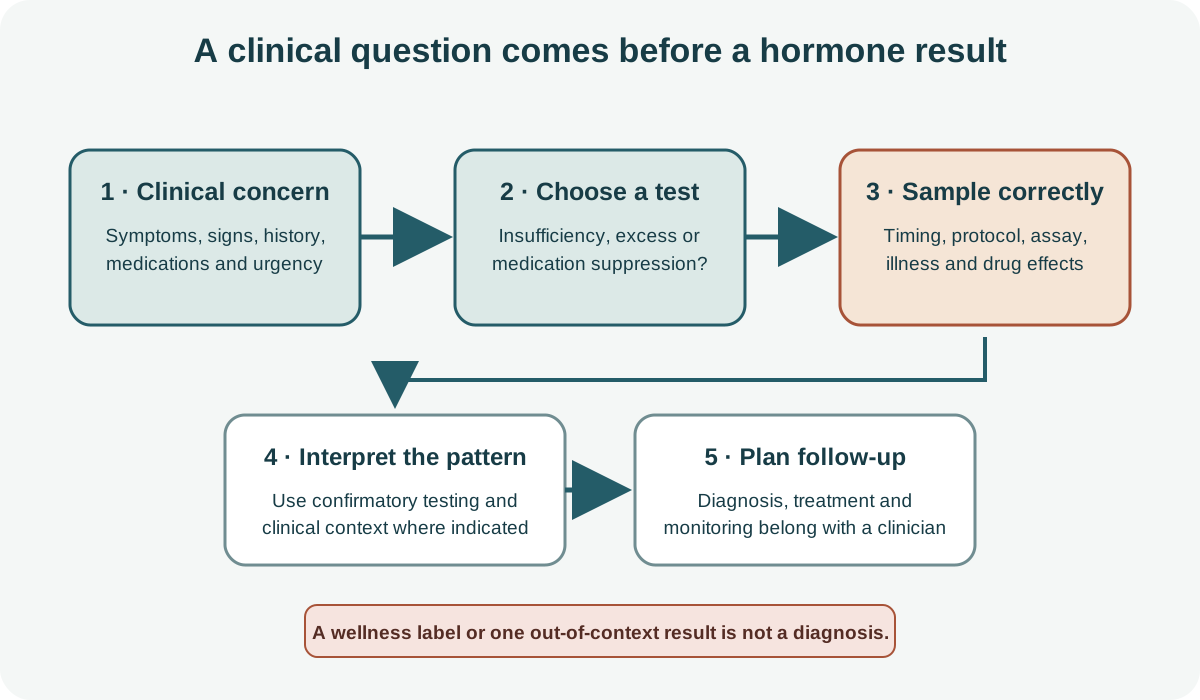
These sources of variation do not mean that endocrine tests are useless. They mean results need an explicit clinical question and appropriate sampling conditions. A value slightly outside a population reference interval may need context or repeat testing, while a person with concerning signs may need evaluation even if one result appears borderline.
Normal variation versus adrenal disease
Adrenal insufficiency means the body cannot produce adequate cortisol for its needs. Primary adrenal insufficiency involves damage or dysfunction in the adrenal glands and may also impair aldosterone production. Secondary or tertiary forms arise when pituitary or hypothalamic signaling is inadequate; aldosterone is often preserved because its main regulation is different. Glucocorticoid-induced adrenal insufficiency can occur when prescribed steroid exposure suppresses the HPA axis.
Possible features—depending on cause and severity—include fatigue, weakness, weight loss, low blood pressure, nausea, abdominal symptoms, low sodium or other electrolyte changes. These symptoms are not specific to adrenal disease. In people with known or suspected adrenal insufficiency, severe illness, dehydration or inability to keep medicines down can lead to adrenal crisis, which needs emergency treatment. Do not use this article to self-diagnose or delay urgent care.
Cortisol excess is a different problem. Cushing syndrome refers to prolonged excessive glucocorticoid exposure from endogenous disease or, more commonly, medication. It can affect blood pressure, glucose, muscle, bone and infection risk. Screening uses validated tests selected for the clinical context; a high random cortisol after stress does not diagnose Cushing syndrome.
Clinical evaluation may include history, examination, medication review and targeted biochemical testing. For suspected primary adrenal insufficiency, Endocrine Society guidance recommends confirmatory corticotropin stimulation testing when circumstances allow, along with ACTH to help establish the cause; renin and aldosterone can assess mineralocorticoid deficiency. Cutoffs depend on assay and protocol. A clinician interprets the pattern rather than treating a single lab flag in isolation.
Why “adrenal fatigue” is not a medical diagnosis
The Endocrine Society states that there is no scientific proof for “adrenal fatigue” as a true medical condition and no test that detects it. The symptoms often attributed to it—tiredness, difficulty sleeping, low mood, cravings or relying on caffeine—are common and can arise from many causes. Calling them adrenal fatigue can distract from evaluating sleep disorders, anemia, medication effects, depression, thyroid disease, adrenal insufficiency or other conditions as appropriate.
Commercial saliva panels that claim to diagnose “adrenal fatigue” or map a personal daily cortisol curve are not equivalent to validated endocrine testing. Salivary or urinary cortisol can be appropriate for specific clinical indications with validated collection and interpretation, but the existence of a legitimate test does not validate every wellness panel or its diagnosis.
There is a real difference between rejecting an unsupported label and dismissing symptoms. Persistent or severe symptoms deserve thoughtful evaluation. The safe path is to describe symptoms and exposures, ask what diagnoses are being considered, and use tests that are validated for those questions.
What DHEA supplements and “cortisol balancing” can—and cannot—do
DHEA is a steroid hormone precursor, not a harmless vitamin. DHEA supplementation can raise circulating DHEA/DHEAS and may affect downstream sex steroids. A rise toward a younger laboratory value is a biochemical change; it does not demonstrate improved function, prevention of disease or longer life. Trials in generally healthy older adults have not established a broad anti-aging benefit, and studies differ in participants, duration and outcomes. The DAWN randomized trial is one example.
Potential concerns include androgenic effects such as acne or unwanted hair, changes in hormone-sensitive tissues, interactions with other products and uncertainty about long-term safety. Product quality and labeling may vary. People with hormone-sensitive conditions, those who take interacting medicines, and those considering DHEA for symptoms should discuss it with a qualified clinician. See the supplements hub. This page does not recommend a dose or a self-treatment trial. Visit the oral longevity hub.
DHEA may be considered in selected clinical contexts, such as some patients with diagnosed adrenal insufficiency and persistent symptoms despite standard replacement, under specialist supervision and with monitoring. That narrow clinical question is not the same as using DHEA to treat normal aging or a low result in an otherwise healthy person. Professional guidelines have cautioned against routine DHEA use for women with low androgen levels because evidence for benefit and long-term safety is limited.
Likewise, trying to “balance cortisol” is not a single medical intervention. Cortisol can be inappropriately low, appropriately responsive to a stressor, or pathologically high; each situation has different causes and treatments. Prescription glucocorticoids can be lifesaving in adrenal insufficiency and harmful when used without indication. Supplements marketed to suppress or boost cortisol should not substitute for diagnosis, and hormone adjustments should be clinician-led.
A 2024 joint Endocrine Society/European Society of Endocrinology guideline addresses adrenal suppression from prescribed glucocorticoids. It notes that risk depends on dose, duration, potency, route and individual susceptibility, and that recovery varies. Its recommendations are for clinicians managing people who need or are tapering prescribed treatment—not a do-it-yourself taper schedule. If you use glucocorticoids, ask the prescriber how to manage dose changes, illness and procedures.
Evidence-aware questions for a clinical discussion
If an adrenal test or supplement claim has raised concern, practical questions can make the conversation more specific:
- What condition is being considered, and which symptoms or signs support evaluating it?
- Was the sample collected at a time and under conditions appropriate for this test?
- Could illness, sleep timing, menopause, binding proteins, a prescription, injection or supplement affect the result?
- Does the result need confirmation with a validated stimulation or suppression test, or another method?
- What would a confirmed diagnosis change about care, and what are the risks of unnecessary hormone treatment?
- If I take glucocorticoids, who should guide changes, stress coverage or recovery testing?
These questions do not diagnose adrenal disease. They help distinguish a clinically useful evaluation from a broad promise to optimize hormones for longevity. A low DHEAS number, fatigue or a flattened curve alone cannot determine whether someone has an adrenal disorder. See the systems hub.