What partial reprogramming means
Cellular reprogramming uses regulatory factors or other interventions to change a differentiated cell’s gene-expression and epigenetic state. Full reprogramming aims for induced pluripotency, creating a cell capable of generating many lineages. Partial or transient reprogramming instead applies a controlled pulse intended to recover selected youthful properties while allowing the cell to remain in its original lineage.
The classic factors are Oct4, Sox2, Klf4 and c-Myc, often abbreviated OSKM. Other strategies omit c-Myc, use OSK, deliver factors to a particular tissue or replace genetic factors with chemical programs or engineered control circuits. Each modality changes the balance between potency, controllability, delivery and safety.
The partial cellular reprogramming page covers the wider field. The practical question here is what would have to be demonstrated before “rejuvenation” could responsibly describe a human therapy.
Full pluripotency versus partial or transient programs
Full pluripotency is powerful because it resets cell state broadly, but that same plasticity can produce teratomas or loss of lineage identity if cells are not controlled and redifferentiated correctly. Partial programs seek a narrower window. The hope is to obtain epigenetic and regenerative benefits before cells cross into an unstable state.
“Partial” is a biological objective, not a guarantee. A factor pulse can be too short to produce a useful change, long enough to impair identity, or uneven across a tissue. The dose, schedule, delivery vehicle, cell type and age of the tissue all influence where cells land on that continuum.
| Question | Evidence needed | Why a molecular clock is insufficient |
|---|---|---|
| State | lineage identity and tissue architecture preserved | an age score can improve while identity is lost |
| Safety | genomic stability, tumor surveillance and abnormal growth monitoring | short studies may miss delayed harm |
| Function | durable, tissue-relevant performance improvement | methylation change is not restored physiology |
| Delivery | controlled exposure in the intended cells and organs | off-target exposure can change the risk balance |
What preclinical rejuvenation has actually shown
Reviews describe preclinical findings across nervous, metabolic, musculoskeletal and craniofacial systems. Reported effects include younger molecular profiles, improved tissue repair, restored regenerative capacity and changes in age-associated gene expression. Some studies use disease or accelerated-aging models, while others use older animals or cultured human cells.
Those results are encouraging but heterogeneous. A tissue can repair more effectively because of stem-cell activation, altered inflammation, proliferation or changes in homeostatic regulators—not necessarily because the whole organism has been rejuvenated. The causal mechanism and the durability of the benefit require separate tests.
A 2026 review in Trends in Molecular Medicine summarizes genetic and chemical strategies and emphasizes tissue-specific effects, delivery and temporal control. An Ageing Research Reviews synthesis similarly proposes a translational checklist centered on schedule, delivery and safety pharmacology. Reviews organize evidence; they do not convert preclinical results into human efficacy.
Epigenetic-age reversal versus functional rejuvenation
DNA methylation and transcriptomic age measures are useful tools for asking whether a program changes molecular state. They can help compare schedules, tissues and doses. They are not literal clocks that measure every dimension of aging, and they are not automatically validated surrogate endpoints for disease, disability or mortality.
A stronger preclinical package would pair molecular measures with tissue architecture, cell identity, organ function, physical performance, pathology, adverse events and durability after the program stops. A human study would need the same discipline, adapted to a safe and clinically meaningful indication.
The epigenetic aging page and biological-age test page explain why responsiveness, prediction and causal validation are different evidentiary steps.
The therapeutic window: schedule, identity and tumor risk
Reprogramming is a time-dependent intervention. Too little exposure may produce no meaningful change; too much may drive dedifferentiation, abnormal proliferation or loss of tissue organization. The useful window may differ by organ, cell type, age and disease state.
Tumorigenicity is not a footnote. c-Myc and other factors can affect proliferation, and a therapy that changes cell fate must be monitored for abnormal clones, genomic instability and delayed lesions. A short observation period cannot establish that a transient intervention has no long-term cancer risk.
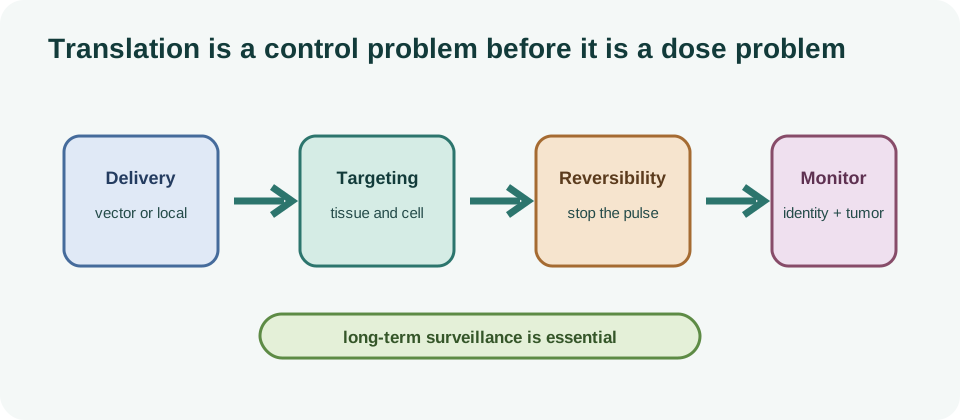
Reversibility matters as well. Investigators need an operational way to stop exposure, neutralize the program or remove affected cells if a safety signal appears. This is more demanding than demonstrating a favorable molecular assay after treatment.
Delivery, immune surveillance and tissue heterogeneity
Systemic delivery may expose organs that were not intended to receive a reprogramming signal, while local delivery may not reach every relevant cell. Viral vectors, mRNA, proteins, small molecules and CRISPR-based circuits each have different persistence, targeting, manufacturing and immune considerations. A tissue-specific result cannot be generalized to the whole body without evidence.
Immune surveillance can remove abnormal cells, modify the response or create inflammatory toxicity. Age, prior infection, antibodies to a vector, comorbidity and concurrent treatment could all change the risk. A first indication may therefore be a localized or serious disease with measurable tissue function, not a preventive therapy for healthy people.
The 2026 reviews emphasize this heterogeneity. Cellular reprogramming beyond pluripotency highlights tissue-specific effects and the need for safety, delivery and temporal control. Those are practical development constraints, not merely academic details.
Why animal lifespan extension is not enough
An animal lifespan result would be important, especially if replicated across sexes, sites, doses and treatment ages. It would still not establish a human preventive therapy. Human delivery, immune biology, cancer risk, organ heterogeneity and clinical monitoring are different constraints.
Even a long-lived mouse can have a trade-off: better regeneration with an increase in pathology, or benefit in one tissue with harm in another. A translation-ready program needs the full benefit–harm profile, not only the most favorable survival curve.
What the first human study is testing—and what it is not
That clinical step has now begun. Life Biosciences announced that the first participant received ER-100 in a Phase 1 study on June 9, 2026. ER-100 uses AAV2 to deliver OCT4, SOX2 and KLF4 (OSK) and is being evaluated in people with open-angle glaucoma or non-arteritic anterior ischemic optic neuropathy. The ClinicalTrials.gov record describes a single-dose safety and tolerability study, with visual-function measures and follow-up extending up to five years.
This is a defined ocular-disease program, not a trial of systemic treatment, healthy aging or lifespan extension. Its primary contribution at this stage is human safety and feasibility information; the registry lists no efficacy results. The trial also does not resolve delivery, identity-preservation, genomic and tumor surveillance, immune monitoring, stopping rules or manufacturing controls for other tissues and approaches. The organ-specific biological age page is relevant because tissue-specific signals should remain tissue-specific in interpretation.
2026 translational checklist and evidence verdict
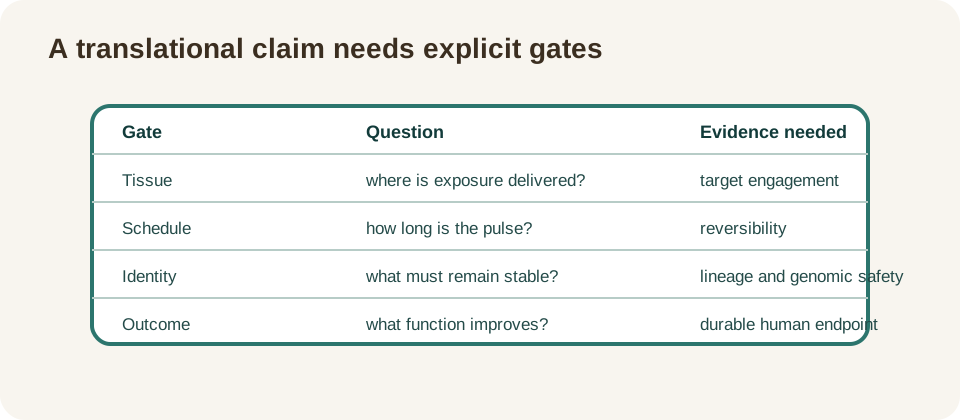
Partial reprogramming deserves serious research because it targets cellular state rather than only one downstream symptom of aging. The current reviews add useful structure: identify the factor or modality, define the therapeutic window, deliver it to the intended tissue, show that lineage identity is preserved, monitor tumor and immune risks, and connect molecular signals to durable function.
The responsible conclusion is partial reprogramming is a promising platform with one narrowly scoped human safety trial; general human rejuvenation remains unproven. A convincing future result would need a reproducible, clinically meaningful benefit with transparent harms and long-term surveillance. The longevity clinical trials page describes the endpoint standards needed to move from an exciting mechanism to a trustworthy human claim.
- define partial and transient exposure operationally;
- separate OSKM, OSK, chemical and CRISPR modalities;
- preserve cell identity and tissue architecture;
- test delivery, biodistribution and reversibility;
- monitor genomic stability, abnormal growth and immune effects;
- pair biological-age measures with function, pathology and durability;
- treat animal lifespan findings as preclinical evidence;
- choose a bounded initial indication rather than a vague anti-aging promise.