Safety note: This evidence explainer is not a personal nutrition or constipation plan. Do not rapidly increase fiber or start a supplement if you have difficulty swallowing, a known or suspected bowel narrowing or blockage, severe abdominal symptoms, or a condition requiring a modified diet without first asking a qualified health professional. Follow product labeling and ask a pharmacist about medication timing.
What dietary fiber means
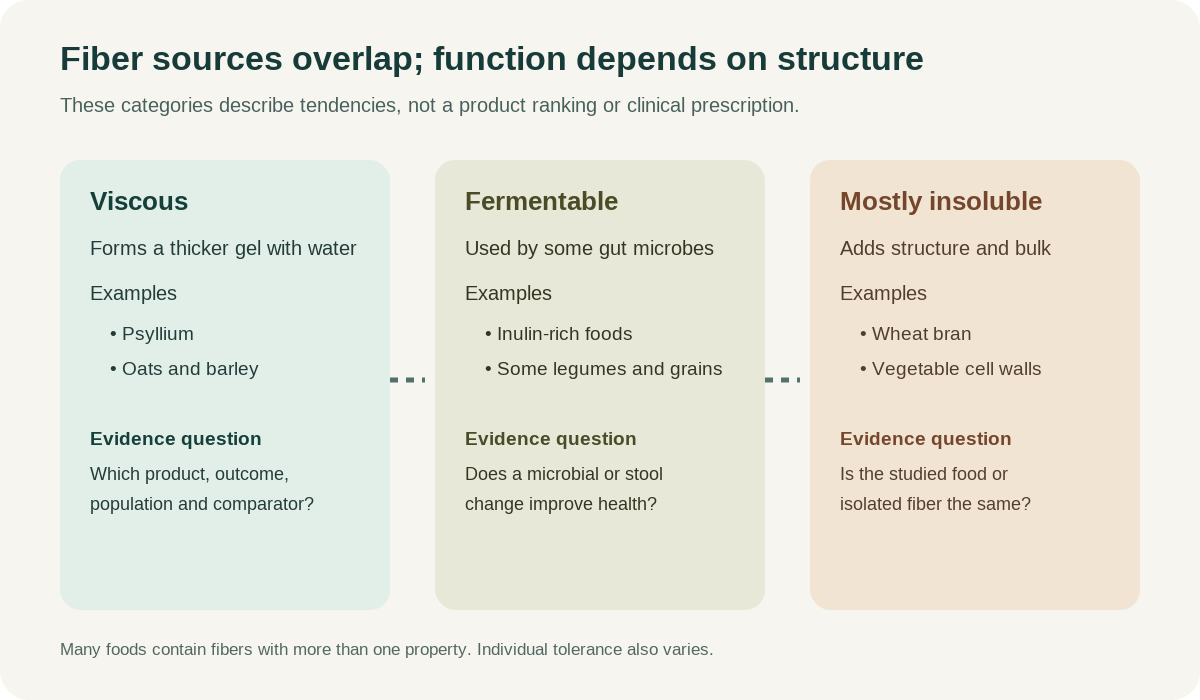
Dietary fiber refers to carbohydrate structures that are not fully digested and absorbed in the small intestine. The term covers a wide range of plant-derived compounds. Their effects depend on structure, food matrix, dose, the rest of the meal and the person consuming them. “More fiber” is therefore an incomplete description of an intervention.
Some fibers form viscous gels when mixed with water. Psyllium is one example, and oats and barley provide beta-glucans. Other fibers are readily fermented by gut microbes; inulin and some oligosaccharides are examples. Many plant cell-wall fibers contribute bulk and hold water, but fermentability and viscosity do not divide neatly into separate boxes. A single food can supply multiple fibers along with water, minerals, polyphenols and other nutrients.
Whole grains, beans and lentils, vegetables, fruit, nuts and seeds can each contribute fiber in different forms. Isolated ingredients such as psyllium, inulin or resistant starch are not interchangeable with one another or with a whole food. A microbiome response to one substrate does not tell us that every person needs that ingredient or that a measured microbial change will improve a clinical outcome.
Food labels and research studies also use different definitions and measurement methods. Total fiber may combine naturally occurring fiber and added or isolated fibers, while some studies focus on a particular fiber class or food group. Dietary questionnaires ask people to recall what they ate; those estimates contain error. This makes comparisons across cohorts and trials more complicated than a headline that treats all fiber exposure as identical.
Why fiber may affect the gut and other systems
In the digestive tract, fibers can change stool water content, bulk, transit and texture. Viscous fibers can alter the physical environment of digestion. Fermentable fibers can be used by some gut microorganisms, producing short-chain fatty acids and other metabolites. These are plausible pathways for effects on bowel habits and some metabolic measures, but mechanisms do not establish that a specific food or supplement prevents disease.
Microbes also differ between people and respond to diet, medicines, health conditions, environment and prior exposures. The same fiber can be tolerated differently or produce different gas and bowel effects. Studies that identify a shift in microbiota composition or a metabolite have not automatically established better health, slower aging or longer life. Microbial markers need validation against outcomes that matter to people.
Fiber may also travel with other features of a dietary pattern. People who eat more whole plant foods may differ in physical activity, smoking, income, health care access, total diet quality and other factors. Statistical adjustments reduce some measured differences, but cannot reliably eliminate every source of confounding or measurement error.
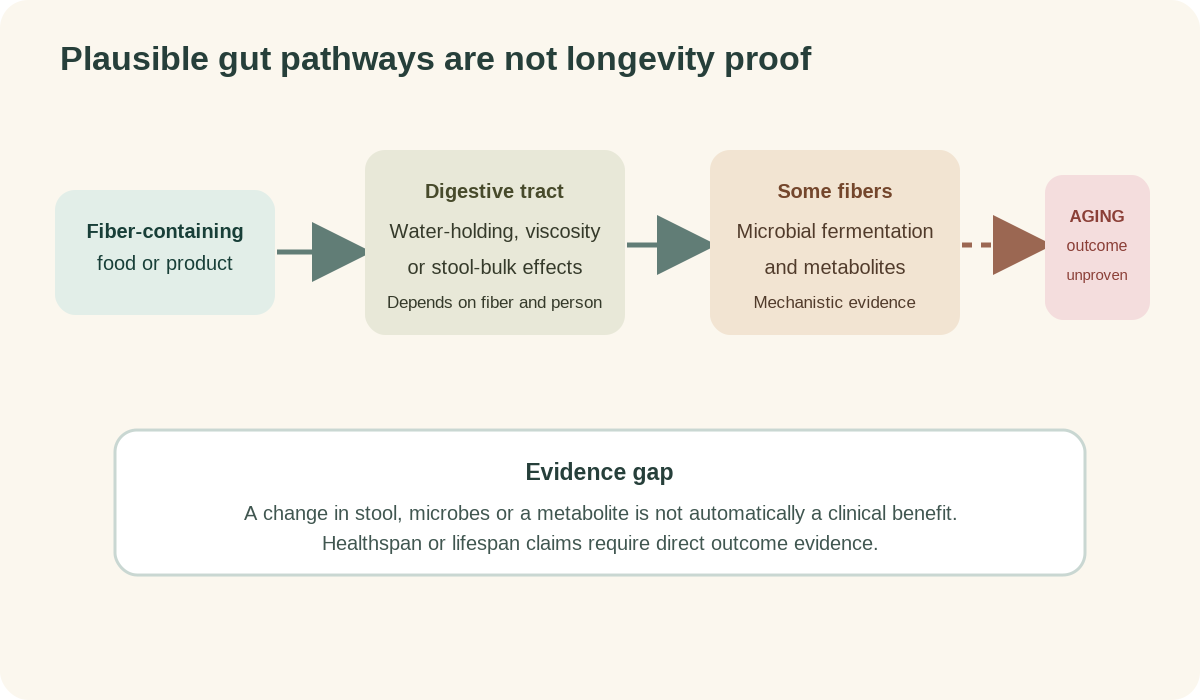
These limits explain why mechanism research, observational cohorts and clinical trials answer different questions. Laboratory work can explain how a fiber might behave; a cohort can show whether intake is associated with later outcomes; and a randomized trial can test a defined intervention. None should be described as another design’s result.
What large observational reviews can and cannot tell us
A 2025 umbrella review synthesized 33 meta-analyses covering 38 health outcomes and more than 17 million people. Most included outcome syntheses reported inverse associations between higher fiber intake and disease risk. Using the review’s prespecified credibility system, it classified evidence as convincing for cardiovascular-disease mortality, pancreatic cancer and diverticular disease; highly suggestive for all-cause mortality and several cardiovascular outcomes; and weaker for many other endpoints. The authors also found that only a subset of the included meta-analyses had high methodological quality.
Those classifications summarize the strength and consistency of observational associations. They do not mean that fiber was randomly assigned to millions of participants, that every fiber exposure produced the same effect, or that the review proved causation. People eating more fiber may also eat differently in other ways or have other characteristics that affect health. The study itself notes methodological limitations, and the underlying reviews can overlap in their original cohorts.
An association with lower mortality is not equivalent to evidence that adding a supplement will reduce an individual’s mortality risk. Nor does a relative association reveal an individual’s absolute benefit without a well-defined baseline risk, exposure contrast and causal estimate. The umbrella review is useful for mapping where observational evidence is extensive and where it is less credible; it is not a dosing guide or proof of an anti-aging treatment.
Different outcomes also need separate interpretation. Evidence about cardiovascular mortality cannot be carried over to cognition, frailty or constipation. Evidence for a specific fiber-rich food pattern cannot be assigned to an isolated powder. Each claim needs its own population, exposure, comparator, outcome and study design.
What randomized trials in older adults show about constipation
For older adults with chronic constipation, a 2025 systematic review and meta-analysis identified seven randomized trials with 187 participants. The pooled analysis did not find a statistically significant improvement in stool frequency. It reported lower laxative or enema use and higher fecal bifidobacteria concentrations, while the authors emphasized the need for larger, clearer trials to determine appropriate interventions and duration.
A 2026 network meta-analysis broadens the constipation evidence to 17 trials and 1,423 adults with chronic idiopathic constipation, but it is not an older-adult-specific analysis. It found that viscous soluble fiber was associated with improvement in selected symptoms versus placebo, while some rankings for insoluble fiber were supported by very-low-certainty evidence. This newer result can inform fiber-type research; it does not overturn the smaller older-adult review or establish a universal choice for older people. See the 2026 fiber-subtype network meta-analysis.
This is a small evidence base. The studies used different fiber products and outcomes, and the total sample was limited. A change in laxative use or a stool measure is clinically relevant to the participants studied, but it does not demonstrate lower mortality, prevention of frailty or better healthspan. A microbiota outcome is a biological measurement, not a substitute for a patient-important outcome.
Older adults are not one uniform group. Constipation can relate to medicines, mobility, fluid intake, pelvic-floor function, medical conditions and changes in routine, among other causes. Some people may benefit from a gradual dietary change or a clinician-guided product, while others need assessment of a different cause. Persistent symptoms, a sudden change in bowel habits, blood in stool, severe pain, vomiting or inability to pass stool or gas warrant medical attention rather than simply adding fiber.
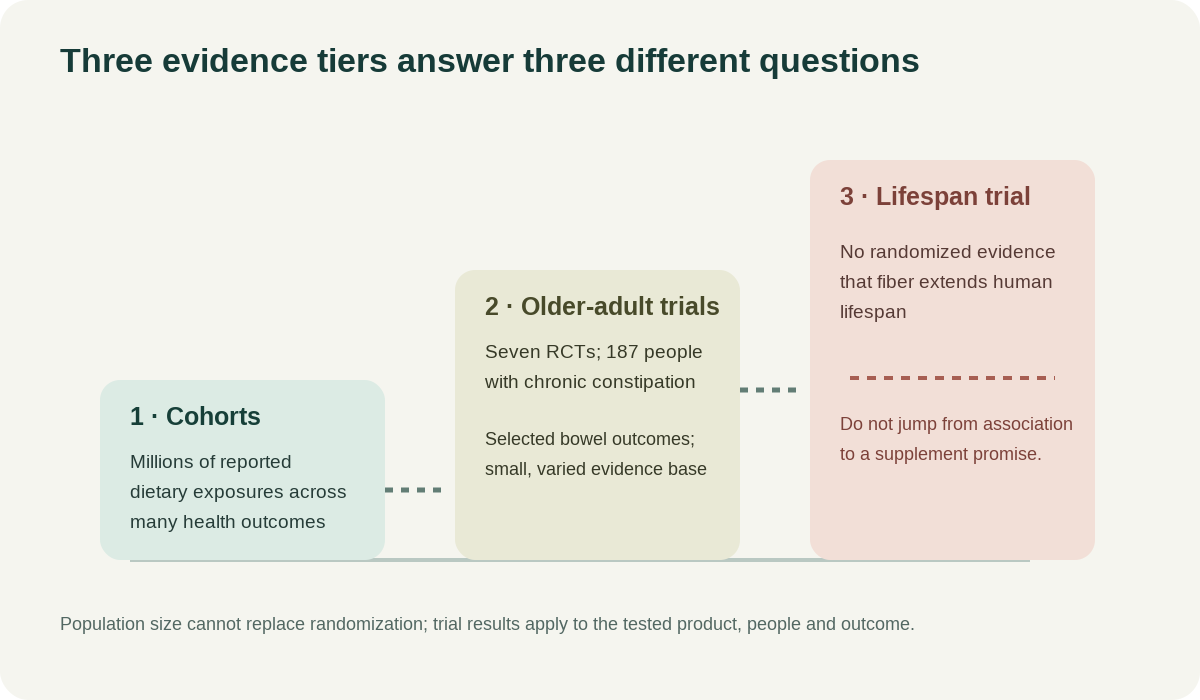
The trial synthesis should not be oversold in either direction. It does not show that fiber is ineffective for every person with constipation; it shows that this small older-adult trial set did not establish a clear average improvement in stool frequency. Individual trials, different fiber types and different clinical circumstances may yield different results. The responsible conclusion is uncertainty about which interventions help which older adults and how consistently.
Food patterns and isolated supplements are different interventions
A fiber-rich dietary pattern usually includes a mix of foods, not a single ingredient. Beans, oats, fruit, vegetables, nuts and whole grains each supply distinct fibers and other nutrients. If a person wants to change their food pattern, practical questions include what they currently eat, what they tolerate, their appetite and chewing or swallowing ability, access to food, and any disease-specific diet instructions.
- Compare a food pattern with the exact supplement or ingredient studied.
- Consider appetite, chewing, swallowing, access and usual tolerance.
- Keep disease-specific dietary instructions in view.
An isolated supplement is more specific. Psyllium, inulin and other products differ in how they absorb water, ferment and affect symptoms. Trial results for one ingredient do not establish effects for every product sold as “fiber.” Labels can also differ in serving sizes and included additives. A supplement that changes stool consistency has not thereby been proven to prevent aging-related disease.
Research on fiber-rich patterns may be especially vulnerable to attribution errors. If a cohort observes that a whole-grain intake is associated with a health outcome, the relevant exposure is not necessarily fiber alone. If an intervention changes both food intake and other behaviors, the effect cannot be assigned solely to one component unless the study design supports that claim.
For the same reason, current public-health dietary guidance is not an individualized prescription. The 2025–2030 U.S. Dietary Guidelines emphasize a diet built around nutrient-dense foods, including vegetables, fruits and whole grains, but that broad framework does not determine an appropriate fiber supplement for a person with swallowing difficulty, a bowel narrowing, low fluid intake or a complex medication schedule.
For a wider view of food-pattern evidence, compare this article with our research hub and the interventions hub. They provide evidence context; neither hub turns population-level dietary guidance into a personal treatment plan.
The systems hub and oral longevity hub cover additional aging topics while keeping the distinction between general evidence and a specific intervention.
Tolerance, hydration and bowel safety
Increasing fermentable fiber quickly can cause gas, bloating or abdominal discomfort. A sudden large change can be difficult to tolerate, particularly for someone with a sensitive gut or a history of symptoms after particular foods. Gradual food changes may be easier for some people, but this is not a universal plan and may be inappropriate when a clinician has recommended a restricted or modified diet.
Water-holding products need fluid to be used as directed. Psyllium and similar bulk-forming products can swell; product labeling warns about choking or blockage if taken without enough liquid or when a person has difficulty swallowing. Someone who has dysphagia, an esophageal narrowing or trouble safely following the fluid instructions should not assume a powder or capsule is a harmless substitute for food.
- Check the product-specific mixing and fluid directions.
- Do not start a bulking product when swallowing safety is uncertain.
- Ask a clinician about a history of bowel narrowing, surgery or obstruction.
Known or suspected bowel obstruction, severe abdominal pain, vomiting, marked distension, or inability to pass stool or gas are reasons for urgent medical assessment, not a signal to add a bulk-forming product. People with bowel strictures, prior gastrointestinal surgery, severe motility disorders or disease-specific dietary restrictions should ask the clinician managing that condition before changing fiber intake.
Hydration deserves individual context. Many people can drink according to thirst and usual guidance, but fluid needs and limits vary. Heart failure, kidney disease, swallowing problems, diuretics, heat exposure and frailty can all change the situation. “Drink more water” is not universally safe or sufficient; follow the care plan given for the person’s medical circumstances.
Medication timing and clinical context
Bulk-forming products can affect how some medicines are absorbed or how they move through the digestive tract. The relevant timing instructions depend on the product and medicine. For example, U.S. MedlinePlus psyllium information provides specific spacing advice for certain named medicines and recommends telling a clinician or pharmacist about all prescription drugs, nonprescription products and supplements. Do not turn one product’s instructions into a universal “two-hour rule”; check the actual label and ask a pharmacist when the regimen is complex.
Medication review matters in older adults because a new constipation symptom can sometimes follow a medication change, and people may take several medicines with different timing requirements. Do not stop, delay or reschedule a prescription to accommodate a supplement without professional advice. If a product label is unclear, a pharmacist can help identify a safe schedule based on the exact product and medication list.
The NIDDK overview of constipation symptoms and causes notes that medicines and other health conditions can contribute. A sudden or persistent bowel change deserves attention to those possible causes, not only a change in fiber.
People with diabetes, kidney disease, gastrointestinal disorders, swallowing difficulty, recurrent constipation or unintentional weight loss may need advice tailored to their overall care. The goal is not to maximize a number on a nutrition label; it is to address the relevant nutritional or bowel concern without worsening another condition.
Does fiber improve frailty, cognition or longevity?
Evidence about fiber and frailty, cognition and biological aging is less direct than the literature on broad dietary associations and some bowel outcomes. Nutrition interventions in older adults often change several things together, such as counseling, meal quality, protein intake, exercise or social support. When outcomes differ across small, varied studies, a pooled conclusion may not be possible.
Microbiota-focused reviews propose ways that fermentable fibers could influence inflammation, metabolism or communication between organs. Those mechanisms are scientifically relevant, but translation into clinically meaningful aging outcomes remains limited. Many studies are small, heterogeneous and centered on intermediate biomarkers. A proposed pathway is a reason for further testing, not evidence that a supplement slows human aging.
No randomized trial has established that a particular fiber product extends human lifespan. The observational mortality associations are hypothesis-supporting, not intervention proof. Similarly, a change in a microbiome test, bowel habit or metabolic marker cannot be called rejuvenation unless it has been validated as a meaningful outcome and linked to an intervention that improves it.
For context on neighboring questions, see the biology hub for gut mechanisms, the supplements hub for product evidence, the biomarkers hub for measurement limits, the interventions hub for dietary patterns, and the oral longevity hub for related aging questions. These related topics should not be collapsed into a single “fiber reverses aging” claim.
Use outcomes people can feel or experience
Changes in appetite, bowel symptoms, comfort and function matter more than a marketing claim about a microbiome score. Even so, the right outcome depends on why a person is considering a change and what else is happening in their health.
A careful way to assess a fiber claim
Before accepting a headline, ask what exposure was studied: total fiber, a food group, a particular fiber type or a commercial supplement. Then ask who participated, what comparison group was used, how long the study lasted, and whether the endpoint was an association, a bowel measure, a laboratory marker, a diagnosis or mortality.
Look for the full outcome, not only the result that sounds favorable. In an older-adult constipation review, for example, bowel frequency, laxative use, microbiota and adverse events are separate outcomes. A significant result for one does not erase a null result for another, and multiple outcomes can make selective emphasis tempting.
A lower risk in a cohort is an association. A product tested in a trial is a defined intervention. A stool measure is not a lifespan outcome. A microbiome marker is not automatically a validated health target.
- Identify the exact fiber or food pattern that was studied.
- Separate association from a randomized treatment effect.
- Check whether the measured outcome matters to patients.
- Read the safety and adverse-event information with the benefit claim.
Check how large the evidence base is and how certain its methods are. Millions of observational participants can produce precise estimates while still leaving confounding. A randomized trial can address some confounding but be too small or short to answer a mortality question. Meta-analyses can improve precision when studies are comparable, but pooling highly different fibers, populations and outcomes can produce a number with limited clinical meaning.
Finally, distinguish population guidance from personal care. A generally healthful eating pattern does not remove individual safety considerations. Anyone considering a new bulk-forming supplement should check the product label, swallowing and fluid requirements, bowel history and medication timing, and ask a pharmacist or clinician if there is any uncertainty.