What magnesium does biologically and why deficiency matters
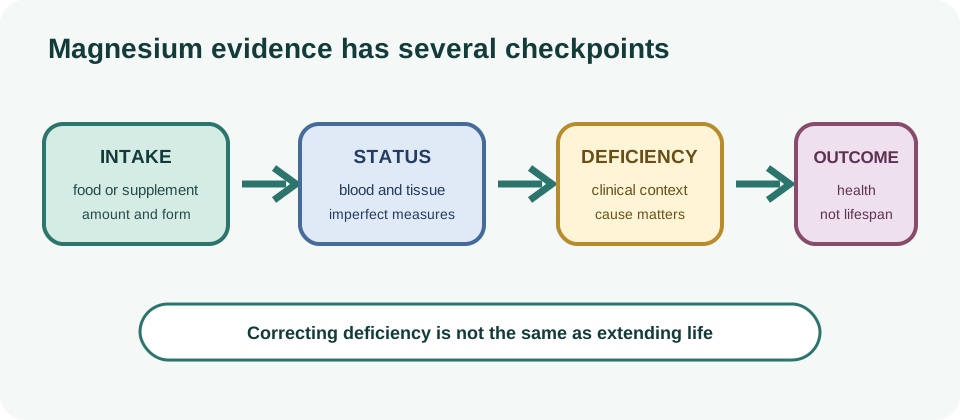
Magnesium is a mineral involved in hundreds of enzymatic reactions. It helps stabilize ATP, the molecule cells use to transfer energy, and it participates in nucleic-acid synthesis, protein production, nerve signaling, muscle contraction and glucose handling. Bone also stores a large share of the body’s magnesium. These roles make it biologically plausible that severe deficiency could impair resilience across several systems.
Plausibility is not the same as a lifespan intervention. An essential nutrient has a requirement curve: too little can cause harm, while more is not automatically better once physiological needs are met. Replacing an insufficiency may restore normal function without producing an extra anti-aging effect. That distinction is central to interpreting magnesium longevity claims.
Early deficiency symptoms can be nonspecific, including reduced appetite, nausea, vomiting, fatigue and weakness. More advanced deficiency can involve tingling, muscle contractions or cramps, seizures, abnormal heart rhythms and disturbances in calcium or potassium balance. The NIH Office of Dietary Supplements notes that symptomatic deficiency from low intake alone is uncommon in otherwise healthy people because the kidneys conserve magnesium, but illness, alcohol dependence, gastrointestinal losses and medicines can change that context.
A symptom such as a nocturnal leg cramp is not a diagnosis of magnesium deficiency. Fatigue, poor sleep, palpitations and muscle symptoms have many causes. Testing and treatment decisions belong in a clinical context, especially when kidney function, cardiac disease or interacting medication is involved. General patient information from MedlinePlus can provide background, but it cannot replace assessment.
How age, medications and kidney function change the question
Older adults can face several overlapping pressures. Dietary intake may fall because of reduced appetite, dental difficulty, limited food access, illness or a narrower diet. The ODS fact sheet also identifies age-related changes in absorption and renal handling, alongside the higher prevalence of chronic disease and medication use. These factors do not mean every older adult is deficient; they mean that the prior probability of inadequacy can be different. The National Institute on Aging nutrition guidance is useful for the broader food-pattern context.
Type 2 diabetes can increase urinary magnesium loss, particularly when glucose-related diuresis is present. Gastrointestinal disorders, chronic diarrhea, malabsorption, bowel surgery and alcohol dependence can reduce intake or increase losses. Diuretics can alter urinary magnesium handling. Long-term proton-pump-inhibitor treatment has been associated with hypomagnesemia in some people, and supplementation does not always correct the problem while the medication continues.
Kidney function creates the opposite safety issue. The kidneys excrete excess magnesium. When renal function is substantially impaired, a dose that would be tolerated by a healthy adult can accumulate, particularly when magnesium-containing laxatives, antacids or supplements are combined. Hypermagnesemia can cause hypotension, weakness, breathing difficulty, irregular heartbeat and, at extreme levels, cardiac arrest. This is why a “more is better” longevity protocol is medically unsound.
Medication review matters in both directions: some drugs change magnesium status, while magnesium can change the absorption of other drugs. This is not a reason to stop a prescribed medicine or supplement independently. It is a reason to give a clinician or pharmacist the complete list, including over-the-counter laxatives and antacids. The FDA medication-guide resource reinforces why product-specific instructions matter.
| Context | Why it matters | Evidence boundary |
|---|---|---|
| Older age | intake, absorption, renal handling and medication burden may change | higher risk does not mean universal deficiency |
| Diabetes | urinary losses may increase when glucose handling is impaired | disease-cohort associations do not prove supplementation benefit |
| GI disease or alcohol dependence | intake, absorption and losses can be disrupted | the cause of depletion must be evaluated |
| Kidney impairment | excretion of supplemental magnesium can be reduced | toxicity risk can outweigh a speculative longevity benefit |
Food intake, serum magnesium and depletion scores are different measures
Dietary magnesium estimates describe what someone reports eating, usually through food-frequency questionnaires or repeated dietary records. They are useful for population research and food planning, but they contain measurement error. A person’s intake can vary by day, portion size, food fortification and supplement use. A high dietary intake may also be a marker of a broader eating pattern rich in plants, whole grains, legumes, nuts and other beneficial nutrients.
Serum magnesium is a blood measurement, but it is not a perfect readout of total-body stores. Much of the body’s magnesium is outside the serum compartment, and homeostatic mechanisms can maintain circulating levels until depletion is more advanced. The ODS notes that routine U.S. population surveys have not measured serum magnesium in NHANES since 1974, so dietary intake is often used as a proxy in national data.
A magnesium depletion score is a composite research measure that combines factors thought to predict low status, such as dietary intake, medication or health characteristics. It can be useful for stratifying risk in a cohort. It is not equivalent to a direct measurement of tissue stores, and it does not identify which component caused an outcome. A higher score may also capture illness, frailty or medication burden that independently predicts poor health.
These measures answer different questions. Intake asks what was consumed. Serum asks what was circulating at one point. A depletion score predicts a probability of low status. None, by itself, demonstrates that raising magnesium will prevent a disease or slow aging. Good studies report the measurement method and avoid treating a proxy as a validated treatment target. Researchers also benefit from the CDC NHANES methods and survey documentation when interpreting population estimates.
- name the exposure measure;
- check whether it was measured once or repeatedly;
- separate risk prediction from treatment response;
- look for clinical endpoints beyond the biomarker.
Magnesium and the hallmarks of aging: mechanisms versus outcomes
A 2024 review, Magnesium and the Hallmarks of Aging, maps magnesium biology onto processes such as genomic stability, mitochondrial function, cellular senescence, nutrient sensing, inflammation, proteostasis and stem-cell function. This type of review is valuable for generating hypotheses. It can explain why a deficiency state might affect several aging-related pathways at once.
It cannot establish that supplementation changes the trajectory of human aging. Hallmarks are a framework, not a single endpoint. A change in oxidative stress, inflammatory signaling or a cellular marker may be biologically interesting while having no demonstrated effect on disability, dementia, cardiovascular events, cancer, healthspan or death. Even a favorable change in one hallmark can be offset by a different outcome or a safety problem.
Animal and cell studies are especially vulnerable to dose and context differences. Experimental magnesium concentrations may not resemble achievable human exposures. Cell models can isolate one pathway that, in a whole organism, interacts with kidney regulation, diet, medication, disease and age. Mechanistic evidence should therefore be labeled as mechanistic evidence.
The same caution applies to the phrase “anti-aging.” It can mean correction of deficiency, protection against a specific disease, improvement in a symptom, movement of a biomarker or extension of life. Those claims are not interchangeable. A credible geroscience claim needs a prespecified endpoint and a design capable of testing whether changing magnesium changes that endpoint.
Human DNA-damage and telomere evidence
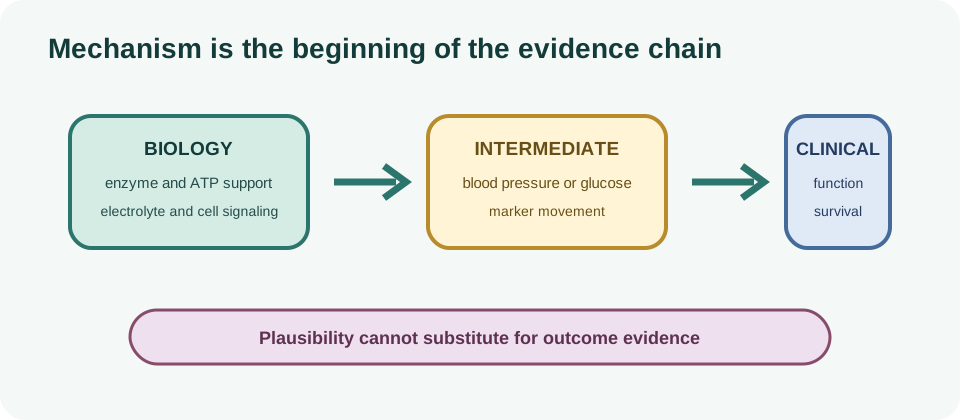
Human biomarker studies have reported relationships between magnesium status and markers related to genomic stress. A 2024 study examined low magnesium together with high homocysteine in relation to DNA damage. Findings of this kind can support a hypothesis that nutritional and metabolic context are connected to cellular injury. They do not show that a magnesium supplement repaired DNA or prevented an aging-related disease.
Telomeres illustrate the same problem. Telomere length is influenced by inherited biology, cell type, replication history, inflammation, smoking, obesity, illness and measurement method. A cross-sectional association between magnesium and telomere length can be confounded by health behavior or disease. A longer average telomere measurement is not a validated guarantee of slower aging, and a short-term change would not automatically be clinically meaningful.
For a biomarker to support a longevity intervention, researchers need more than a correlation. They need reliable measurement, temporal ordering, a plausible dose-response pattern, control of confounding, and ideally randomization showing that changing the exposure changes the biomarker. Even then, the biomarker must be validated as a surrogate for a patient-important outcome. DNA damage and telomere measures do not meet that standard for magnesium lifespan claims.
The responsible wording is therefore “associated with” or “consistent with a possible mechanism,” when the study supports it. “Slows aging,” “protects chromosomes” or “reverses biological age” would overstate the evidence unless a specific intervention trial directly tested and validated those outcomes. The National Institute on Aging biology-of-aging program is a useful reminder that aging mechanisms and clinical outcomes are related but not interchangeable.
Frailty and mortality associations in older adults
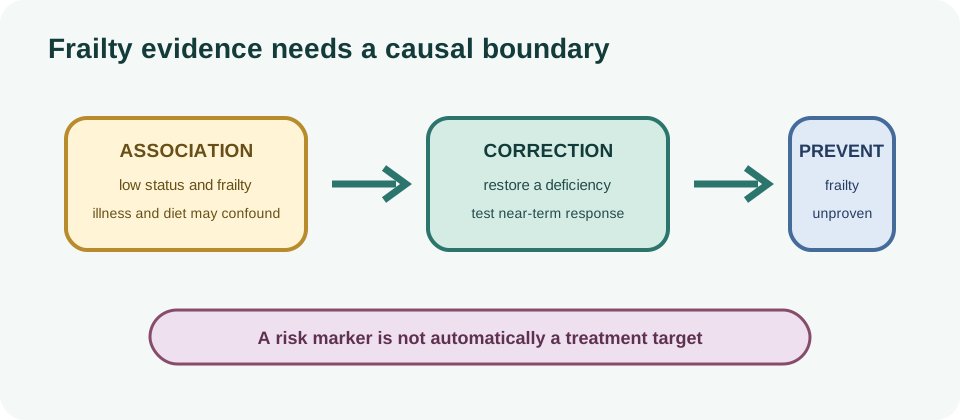
The 2025 NHANES analysis of magnesium depletion score, frailty and mortality is relevant because it focuses on outcomes that matter to older adults. The reported pattern linked a higher depletion score with greater frailty and mortality risk. That is more informative than a single cell marker, but it remains observational and depends on how depletion and frailty were defined.
Frailty is also a complex state. Lower food intake, muscle loss, chronic inflammation, kidney disease, disability, polypharmacy and socioeconomic conditions can all move together. Some of those factors can raise a depletion score and independently raise mortality risk. Reverse causation is possible: people becoming ill may eat less, lose weight or change medication before the measured outcome.
A mortality association can identify a population worth studying. It cannot tell us whether magnesium is the causal lever, whether the association reflects an unmeasured dietary pattern, or whether treating a deficiency would change survival. The difference is especially important when the score includes health characteristics that are themselves related to frailty.
For clinical practice, the useful implication is to look for modifiable causes of inadequacy and to assess frailty comprehensively. The unsupported implication would be to give every older adult a longevity supplement based on a population association. Magnesium is one part of a nutritional and medical assessment, not a substitute for resistance training, adequate protein, medication review, fall prevention or treatment of underlying disease.
Why disease-specific cohorts cannot be generalized to healthy adults
Magnesium associations can be stronger in people with diabetes or cardiovascular risk because their baseline biology, medication exposure and event rates differ. A nutrient that is inadequate in a disease context may have a different benefit-risk balance from the same nutrient in a healthy, replete adult. A high-risk group also produces more events, so a study may have more statistical power to detect an association.
The 2024 UK Biobank study included 149,929 participants, including 4,603 with type 2 diabetes, and followed them for about 12 years. Sufficient dietary magnesium was associated with lower ASCVD and mortality risks among participants with diabetes, while comparable associations were not significant in participants without diabetes. These subgroup differences are scientifically useful, but they do not turn the study into a randomized supplementation trial.
The 2026 cross-population cohort study likewise reported lower all-cause, cardiovascular and kidney-disease mortality with higher dietary magnesium among diabetes participants. Its recency makes it worth tracking, but its design still measures dietary exposure rather than random assignment. People consuming more magnesium may differ in fiber, potassium, overall diet quality, physical activity, healthcare use, kidney function and disease severity.
Generalization requires asking whether the population, exposure, comparator, follow-up and endpoint match the claim. “Higher dietary magnesium was associated with lower mortality in diabetes cohorts” is a defensible summary. “Magnesium supplements extend life in healthy adults” is a different claim and is not established by those studies.
| Study type | Can support | Cannot establish alone |
|---|---|---|
| Mechanistic review | plausible pathways and testable hypotheses | clinical benefit or longer life |
| Biomarker study | association with measured cellular or molecular status | that changing magnesium changes the marker |
| Prospective cohort | exposure-outcome association over follow-up | causal supplementation benefit |
| Randomized trial | effect of a named intervention in a defined population | lifespan benefit if too short or not designed for it |
UK Biobank and NHANES findings: association, not proof of causality
Large datasets create an understandable temptation to treat a hazard ratio as a treatment effect. It is not. A hazard ratio compares the observed event rate between exposure groups after the study’s statistical adjustments. It does not say what would happen if an individual changed from one exposure level to another, especially when exposure is dietary and measured imperfectly. The National Heart, Lung, and Blood Institute risk-factor overview illustrates why observational risk factors must not be read as prescriptions.
UK Biobank analyses can be powerful because of their size and long follow-up, but they are not free of selection, reporting and residual-confounding concerns. Participants may be healthier or more health-conscious than the general population. Dietary questionnaires can misclassify intake. A single baseline measure may not represent long-term status. Adjusting for many variables can reduce confounding, but it can also introduce bias if variables lie on the causal pathway or are measured poorly.
NHANES analyses offer nationally sampled data and can connect nutritional proxies with frailty or mortality. They still face the limitations of observational exposure measurement, missingness, reverse causation and competing health conditions. A depletion score is best used to identify a research or clinical risk context, not to create a universal treatment threshold for longevity.
When reading either study, ask five questions: what exactly was measured; when was it measured; who was studied; what was adjusted for; and what intervention, if any, was assigned? If no magnesium preparation was assigned and no repletion was confirmed, the result should not be marketed as supplement efficacy.
Randomized supplementation evidence for aging endpoints: what is missing
Randomized magnesium trials have commonly focused on blood pressure, glucose metabolism, migraine, pregnancy-related outcomes, muscle symptoms or other defined clinical questions. Those results can be useful without answering whether magnesium changes the rate of aging. A trial needs enough duration, adherence, power and an appropriate endpoint to test a geroscience hypothesis.
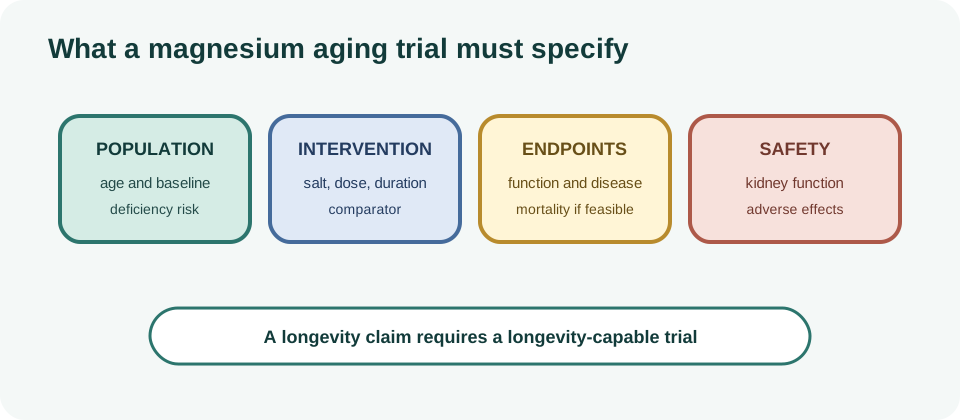
The missing evidence is not simply “one more positive study.” A convincing longevity trial would need to recruit people whose baseline magnesium status is characterized, randomize a standardized preparation against a credible comparator, monitor kidney function and co-medications, and follow participants long enough to observe durable functional or disease outcomes. It would need prespecified analyses for mortality, disability, falls, cognition or another patient-important endpoint rather than relying on a post hoc clock signal.
Repletion trials and enhancement trials should be separated. If a deficient group improves after correction, that supports treating deficiency in that group. It does not demonstrate benefit from supplementation above adequacy. Conversely, a null result in replete adults would not disprove the clinical value of correcting deficiency.
Surrogate outcomes can be included as secondary measures, but they cannot carry the headline unless validated. The biological-age test guide explains why a test can be responsive without being a proven surrogate for healthspan. Magnesium should be judged by the same standard applied to other longevity molecules.
Sleep, muscle, glucose and cardiovascular outcomes are adjacent evidence
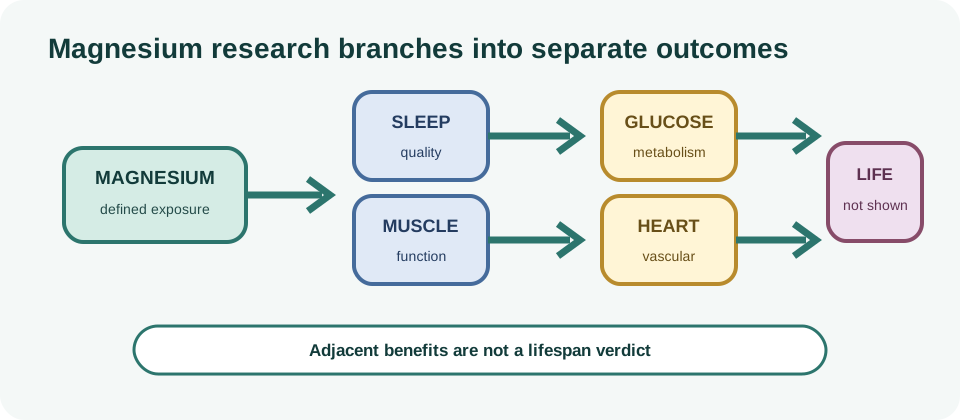
Magnesium is often promoted through sleep and muscle claims. These are plausible areas because magnesium participates in neuromuscular signaling and energy metabolism. But a sleep questionnaire, a short-term symptom score or a change in muscle cramping is not a lifespan endpoint. The size and reliability of any benefit can depend on baseline deficiency, the population, the form used, the duration and the outcome measure.
Glucose and cardiovascular outcomes also require careful separation. Magnesium biology is relevant to insulin signaling, vascular tone and cardiac excitability. The ODS summarizes clinical-trial evidence as showing only marginal blood-pressure reductions from supplementation, while prospective studies have reported associations between higher intake or serum levels and lower cardiovascular risk. The pattern is compatible with benefit but remains insufficient to claim a universal cardiovascular or longevity effect.
A person with diabetes, hypertension or documented hypomagnesemia may have a clinically meaningful reason to discuss magnesium. That is a treatment question with a defined diagnosis, monitoring plan and medication context. It is not equivalent to taking magnesium as a general anti-aging protocol.
The sarcopenia and muscle-aging page and mitochondrial dysfunction page provide useful adjacent context. Muscle and mitochondrial outcomes are important, but improving one component does not prove that a supplement extends life. The inflammaging page similarly explains why a plausible inflammatory pathway must still be connected to a meaningful clinical result.
Magnesium forms: bioavailability marketing is not longevity evidence
Supplements use different magnesium salts and formulations, including oxide, citrate, glycinate, chloride and others. They differ in elemental magnesium content, solubility, gastrointestinal effects and the evidence available for a particular use. A label’s large number may refer to the compound weight or to elemental magnesium, so the label must be read carefully.
Bioavailability is a pharmacokinetic question: how much is absorbed and how exposure changes over time. A formulation that produces a higher blood concentration, fewer loose stools or better adherence may be relevant for a defined indication. It is not, by itself, evidence that the product improves sleep, slows biological aging or extends life.
The ODS notes that diarrhea, nausea and abdominal cramping are common risks of high supplemental intakes, and reports that carbonate, chloride, gluconate and oxide are among the forms commonly associated with diarrhea. This does not create a universal ranking of “best” forms. Tolerability, indication, dose studied, kidney function and interaction profile matter more than influencer shorthand.
Marketing often moves from “better absorbed” to “more anti-aging.” That is an invalid leap. Even if one form improves magnesium status more efficiently, the next question is whether the corrected status changes a patient-important endpoint. Until that is demonstrated, formulation claims should remain formulation claims.
Safety: diarrhea, kidney disease and drug interactions
For healthy adults, the U.S. tolerable upper intake level for magnesium from supplements and medications is 350 mg per day. This limit does not include magnesium naturally present in food, and it is not a personalized target. The RDA includes all sources and differs by age and sex; the amount appropriate for an individual depends on the whole clinical context.
High supplemental doses can cause diarrhea, nausea and cramping. Very large doses from magnesium-containing laxatives or antacids have been associated with toxicity. Risk increases when kidney function is impaired because the body cannot remove excess magnesium efficiently. Warning symptoms such as marked weakness, low blood pressure, breathing difficulty or an irregular heartbeat require urgent medical attention.
Magnesium can reduce absorption of oral bisphosphonates and can bind tetracycline or quinolone antibiotics in the gut. The ODS advises separating these medicines from magnesium-containing products by specified intervals. Diuretics can increase or reduce magnesium loss depending on the class, and long-term proton-pump inhibitors can contribute to low serum magnesium in some people.
This page intentionally does not provide a personal dose or a preferred formulation. Anyone with kidney disease, an abnormal electrolyte result, heart-rhythm concerns, significant gastrointestinal symptoms, pregnancy, or a complex medication list should obtain individualized advice before using a supplement. Food, supplement and medication sources all belong in the review.
Food-first framing and correction of deficiency
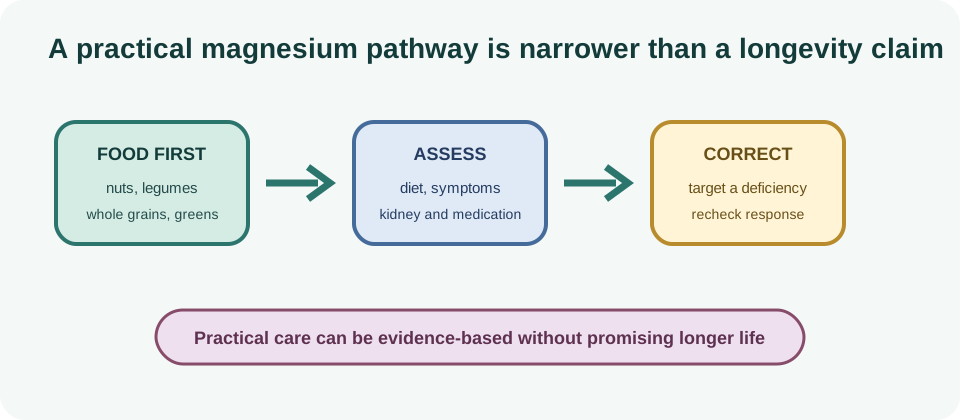
Food-first does not mean supplements are never appropriate. It means the default nutritional question is whether a varied diet can meet needs, while the clinical question is whether a documented or strongly suspected inadequacy needs targeted treatment. Magnesium-rich foods include legumes, nuts, seeds, whole grains and leafy green vegetables, as well as some dairy and fortified products. These foods also bring fiber, protein or other minerals that can contribute to health.
Food is generally less likely than a high-dose supplement to cause magnesium toxicity in people with healthy kidneys because renal excretion can remove excess from the diet. That general statement does not override a medically restricted diet or kidney disease. It also does not mean a food pattern can replace treatment for severe deficiency or a disease causing ongoing losses.
Correction should address the cause. If diarrhea, malabsorption, alcohol dependence, diabetes, a diuretic or a proton-pump inhibitor is contributing, the intervention may require diagnosis, medication review and monitoring rather than indefinite self-supplementation. A single normal serum value does not answer every status question, but neither does a symptom or an online “depletion score” justify a high dose.
For longevity readers, the practical conclusion is deliberately modest: meet nutritional needs, investigate risk factors for inadequacy, and treat documented deficiency with clinical oversight. This is a sound health-maintenance position even though it does not support the stronger claim that magnesium is an anti-aging drug. The World Health Organization healthy-diet overview provides broader dietary context without making a magnesium-specific longevity claim.
Evidence verdict: essential nutrient, promising signals, unproven lifespan effect
Magnesium has a strong physiological rationale and a legitimate clinical role. Inadequacy can matter, and risk is not distributed evenly across the population. Older adults, people with gastrointestinal disease, diabetes or alcohol dependence, and people taking medicines that alter magnesium handling deserve context-sensitive assessment. Correcting deficiency is different from adding magnesium to a person who is already replete.
The human observational literature is suggestive but not decisive. Lower magnesium status or higher depletion scores have been associated with DNA damage, frailty and mortality in selected studies. UK Biobank and newer diabetes-cohort findings add useful disease-specific evidence, but dietary associations cannot establish that supplements cause the observed risk differences. The magnesium hallmarks review supplies plausible mechanisms, not proof of a geroscience effect.
Randomized evidence for adjacent outcomes such as blood pressure, glucose, sleep or muscle symptoms may inform specific clinical questions. It does not establish broad slowing of biological aging. A future trial would need measured baseline status, a standardized intervention, adequate duration, prespecified function and disease endpoints, and active kidney, gastrointestinal and medication-safety monitoring. Biomarkers could be included, but only as validated secondary evidence.
The responsible conclusion is magnesium is essential and deficiency correction can matter; supplementation for lifespan extension remains unproven. The claim should change only if well-controlled human intervention evidence shows durable, clinically meaningful benefit in the population and context where the claim is made, with benefits that outweigh toxicity and interaction risks.
- separate deficiency treatment from supplementation in replete adults;
- label dietary intake, serum status and depletion scores correctly;
- treat DNA damage, telomeres and aging hallmarks as evidence layers, not proof of rejuvenation;
- do not generalize diabetes or cardiovascular cohorts to healthy adults without evidence;
- include kidney function, diarrhea and drug interactions in every supplement discussion.