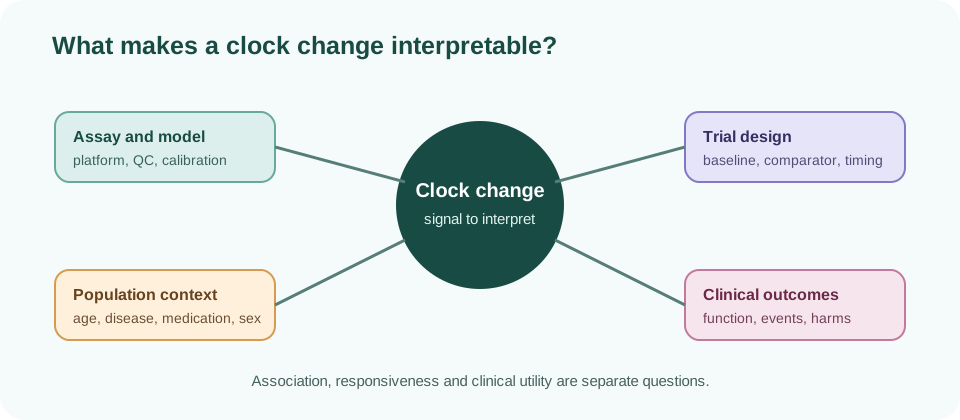
What the Nature Medicine study asked
Epigenetic clocks are DNA-methylation algorithms that summarize patterns associated with chronological age, phenotypic aging, mortality risk or pace of aging. They are often proposed as practical endpoints because a blood sample can be collected in months rather than waiting decades for enough deaths or age-related disease events.
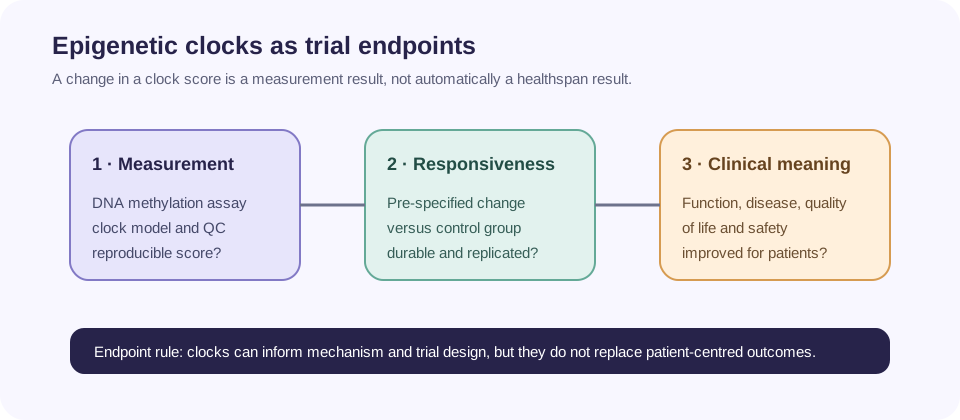
The 2026 Nature Medicine analysis asked a narrower but essential question: which DNA-methylation biomarkers actually respond consistently when humans receive interventions proposed to promote longevity? Responsiveness is a prerequisite for a surrogate endpoint. A measure that never changes cannot help detect an intervention effect.
The study did not ask whether a clock change itself causes better health. That causal and clinical question remains open.
What TranslAGE contains
The researchers curated TranslAGE, a harmonized database of 51 public and private longitudinal intervention studies with pre- and post-intervention blood methylation data. The database contained 3,128 samples. They standardized study metadata and calculated the same panel of 16 prominent epigenetic clocks across the datasets, alongside 94 additional DNAm biomarkers that could help explain the clock changes.
The pipeline adjusted for chronological age, standardized age-residualized biomarker scores and compared paired pre- and post-intervention samples. This does not erase heterogeneity: the studies differed in population health, intervention, duration, sample handling and design. It does make cross-study patterns more visible than a literature in which every paper chooses a different clock panel.
| Feature | Why it helps | What remains unresolved |
|---|---|---|
| 51 studies | broader view of intervention responsiveness | heterogeneous populations and interventions |
| 3,128 samples | more observations than a single small trial | sample count is not event-based clinical power |
| 16 clocks | consistent cross-clock comparison | agreement does not prove surrogacy |
| 94 DNAm biomarkers | mechanistic and component-level context | more measures create testing and interpretation demands |
Why responsiveness matters, and why it is only the first gate
A useful intervention endpoint should move when the intervention changes the underlying process it is meant to target. It should be measured reliably, respond in the expected direction, and show enough signal relative to technical and biological noise. TranslAGE addresses part of that problem by examining many interventions and many biomarkers in one framework.
Surrogate validity is a higher bar. A valid surrogate must capture the intervention’s effect on a clinical outcome. A treatment could lower a clock while causing an unrelated harm, or improve a clock without changing disability, disease or survival. The clock would be responsive but not a trustworthy substitute for the outcome that matters.
The epigenetic-aging page and biological-age test page distinguish technical reliability, prognostic association, intervention responsiveness and causal surrogacy.
First-generation clocks versus mortality and pace-of-aging clocks
The analysis compared first-generation chronological-age clocks such as Horvath and Hannum with newer measures trained around phenotypic aging, mortality risk or pace of aging. Mortality- and pace-oriented clocks generally showed stronger and more consistent responses across interventions than first-generation chronological-age predictors.
DunedinPACE appeared especially responsive across the intervention set, while PCGrimAge showed strong statistical evidence. These findings can guide future trial design, but they are not a ranking of interventions by longevity efficacy. A clock may be sensitive to a physiological change without identifying the pathway that caused it or proving that the change is beneficial.
Explainable clocks with multiple subscores may provide more biological detail than one global number. That detail can help researchers ask which systems moved, but more components also create more opportunities for selective interpretation.
Intervention categories and response modifiers
TranslAGE grouped interventions into pharmacological, lifestyle, supplement and medical-procedure categories. Pharmacological and lifestyle interventions produced stronger average DNAm responses than several other categories in the reported analyses. That pattern describes biomarker behavior, not which category extends life.
Study population and duration were important response modifiers. A disease population may have more reversible pathological biology than a healthy population, while a longer intervention may provide more time for a signal to emerge—or more time for adherence and attrition to change the sample. Age range, sex composition, baseline health and sample timing all influence interpretation.
For that reason, a clock response in an intervention study should be reported with the enrolled population and the clinical context. The 2026 biological-aging clocks review and organ-specific biological-age page provide related context without turning a molecular response into a rejuvenation claim.
Replication, consistency and multiple testing
The study examined repeated interventions and related clocks because a result that appears in one clock and one study may be a false positive or a context-specific effect. Consistency in direction and magnitude across related measures and independent studies increases confidence that the signal is real.
Yet consistency is not the same as clinical validation. Harmonizing many studies also raises issues of multiple testing, selective data availability, publication bias and the choice of which datasets enter a private or public database. The paper’s patterns are valuable evidence for prioritizing future tests, not a final efficacy ranking.
| Question | What to inspect | Why it matters |
|---|---|---|
| Is it reliable? | technical repeatability and measurement noise | prevents mistaking assay variation for biology |
| Is it prognostic? | association with morbidity or mortality | shows risk prediction, not intervention benefit |
| Is it responsive? | consistent change after intervention | necessary for endpoint use |
| Is it a surrogate? | captures intervention effect on clinical outcome | the highest and still-unmet bar |
What trial designers can do differently now
Future trials can prespecify a smaller, justified clock panel instead of calculating every available measure after seeing the data. They can collect baseline and follow-up samples consistently, report missing samples and cell-composition analyses, and define the primary biomarker outcome before unblinding.
They should also measure function, disease outcomes, quality of life and safety. A clock may be a secondary or exploratory endpoint while the trial establishes whether the intervention changes a clinical trajectory. The longevity clinical-trials page sets out this evidence hierarchy.
Consumers should not interpret a clock decrease as proof that a supplement, procedure or drug has reversed aging. Nor should effect size be used to rank interventions for lifespan extension when the database combines different populations and endpoints.
How this changes the biological-age-test canonical page
The practical update is a clearer hierarchy. A biological-age test can be technically reproducible and prognostic, then show responsiveness in a controlled intervention study. Only after it demonstrates that intervention-induced changes track meaningful clinical benefits can it approach surrogate-endpoint status.
This hierarchy makes the page more useful because it preserves what the clock can do without overstating what it proves. A result can be scientifically interesting, statistically robust and still insufficient for a clinical longevity decision.
Evidence verdict
TranslAGE is an important 2026 stress test of epigenetic-clock responsiveness. Its harmonized 51-study database, 3,128 samples, 16-clock panel and 94 additional DNAm biomarkers improve comparability and identify promising response patterns. Mortality- and pace-of-aging-oriented clocks, including DunedinPACE and PCGrimAge, deserve focused follow-up.
The analysis does not validate epigenetic clocks as surrogate endpoints. It combines heterogeneous interventions and populations, and it cannot by itself show that a clock change mediates lower disease risk, better function or longer life.
The responsible conclusion is use these findings to design better aging trials, not to claim proven rejuvenation. The next test is causal linkage: does changing a prespecified clock reliably accompany durable, patient-important benefit with acceptable safety?
- report study population, duration and intervention category;
- separate reliability, prognosis, responsiveness and surrogacy;
- prespecify clock panels and handle multiple testing transparently;
- replicate across studies and connect biomarkers to clinical outcomes;
- never rank interventions by clock effect size alone.