What COSMOS tested and why the ancillary study matters
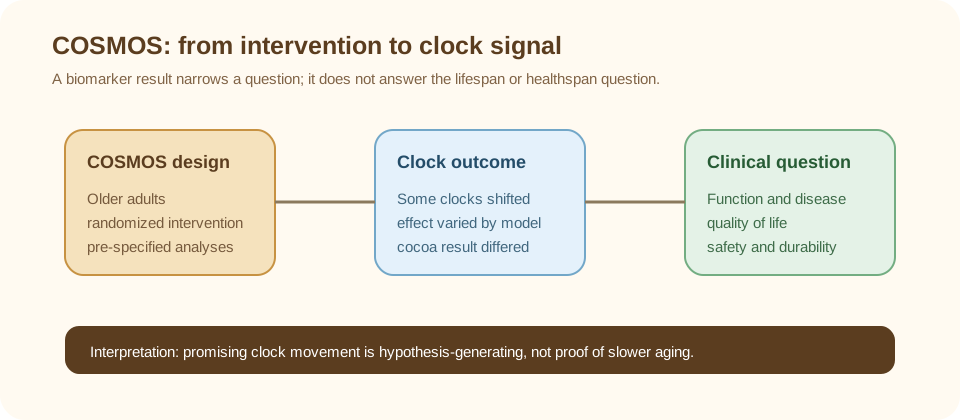
COSMOS is a large randomized program studying cocoa extract and multivitamin–multimineral supplementation in older adults. The new Nature Medicine analysis asked whether either intervention changed DNA-methylation measures of biological aging over two years. It is called an ancillary study because the clock analysis is a prespecified component of the broader program, not the same as the parent trial’s primary clinical outcomes.
A randomized design strengthens causal inference for the measured biomarker, but the clock remains a research endpoint rather than a clinical outcome.
Who was included and how the study was designed
The analysis included 958 participants: 482 women and 476 men. Participants were randomized to daily multivitamin–multimineral supplementation, cocoa extract or matching placebo within the COSMOS framework and followed for two years. The multivitamin was Centrum Silver; the cocoa intervention supplied 500 mg of cocoa flavanols per day, including 80 mg of (−)-epicatechin.
Randomization, placebo comparison and repeated sampling are important strengths. They reduce some confounding that affects supplement-user cohorts. The study still has a defined age range, intervention, follow-up, sample-availability pattern and biomarker endpoint, so its results should not be generalized to every supplement, every age group or every health outcome.
Which five clocks were tested?
The investigators measured PCHannum, PCHorvath, PCPhenoAge, PCGrimAge and DunedinPACE. These represent different generations and constructs, including chronological-age-related measures, phenotypic or mortality-related measures and pace-of-aging-oriented measures.
Testing several clocks is more informative than reporting one favorable score, but it also requires a clear analysis plan. The clocks do not measure exactly the same biological construct. A change in one or two measures should not be described as all clocks improving.
- PCHannum and PCHorvath estimate age using first-generation clock models.
- PCPhenoAge and PCGrimAge capture later health- or mortality-related constructs.
- DunedinPACE estimates the pace of aging rather than chronological age.
Why the clocks can disagree
An epigenetic clock is an algorithm that combines DNA-methylation measurements at selected sites into a score. The result depends on which sites the model uses and the outcome for which it was trained. First-generation clocks were designed chiefly to estimate chronological age. Later clocks use patterns associated with health, mortality risk or the pace of aging. These tools can therefore respond differently when an intervention changes some underlying processes more than others.
PCHannum and PCHorvath are principal-component versions of earlier clocks; PCPhenoAge and PCGrimAge are principal-component forms of later clocks; DunedinPACE estimates the pace of aging. Their labels do not make them direct measures of every organ, nor do they identify a single mechanism. A methylation score can also reflect blood-cell composition and other features of the sampled tissue. It is a measurement produced from a blood sample, not a whole-body age reading.
Clock results can differ because models capture distinct age-related constructs and may respond differently to the same intervention. The complete five-clock pattern therefore matters more than selecting only the two positive findings.
| Intervention or measure | Reported finding | Interpretive limit |
|---|---|---|
| MVM and PCGrimAge | yearly-change difference −0.113 years; 95% CI −0.205 to −0.020 | small clock-rate difference, not life extension |
| MVM and PCPhenoAge | yearly-change difference −0.214 years; 95% CI −0.410 to −0.019 | small clock-rate difference, not rejuvenation |
| MVM and baseline aging subgroup | stronger PCGrimAge signal among those with accelerated baseline aging | subgroup finding needs replication |
| Cocoa extract | no significant effect on the five tested clocks | null result for these measures and duration |
What changed with the multivitamin
Compared with placebo, daily MVM modestly reduced the rate of increase in PCGrimAge (yearly-change difference −0.113 years; 95% CI −0.205 to −0.020; P=0.017) and PCPhenoAge (−0.214 years; 95% CI −0.410 to −0.019; P=0.032).
The wording is important: these are differences in clock trajectories, not literal years added to life. A result of “less increase” is not the same as reversing a participant’s chronological age. The study authors describe the effects as statistically significant but small and call for additional work on clinical relevance.
The estimates summarize differences between randomized groups over follow-up. They do not mean every person taking the multivitamin had the same change, and they do not establish that an individual’s clock will move by the group average. The confidence intervals describe uncertainty around the estimated group differences. Both reported intervals exclude zero, while their modest size leaves open how much practical or clinical meaning the shifts carry.
Baseline accelerated-aging subgroup: interesting, not decisive
The MVM effect on PCGrimAge was stronger among participants classified as having accelerated biological aging at baseline. The reported between-group difference was −0.236 years in that subgroup versus −0.013 years among participants with normal or decelerated baseline aging, with a reported interaction P value of 0.018.
Subgroup findings can generate a useful precision-aging hypothesis: people with a larger baseline risk signal may show more measurable change. But subgroup estimates are less precise, can be influenced by regression to the mean and require independent replication. They should not be used to identify a supplement regimen for an individual.
The subgroup comparison was based on a baseline classification derived from each clock, and the paper notes that accelerated status was defined differently for DunedinPACE than for the first two generations of clocks. The interaction tests were not adjusted for multiple comparisons. That makes the result a hypothesis-generating observation, even though the reported interaction is statistically notable. A stronger response in one subgroup does not establish a reliable way to select people for treatment.
Cocoa extract was null across the tested clocks
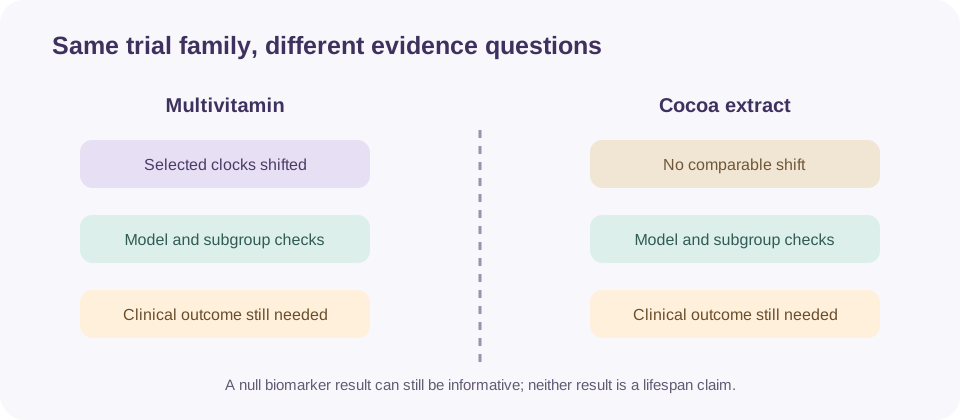
Cocoa extract did not significantly affect PCHannum, PCHorvath, PCPhenoAge, PCGrimAge or DunedinPACE in this analysis. That is a clear result for the prespecified clock question. It does not prove that cocoa flavanols have no effects on any health outcome, vascular pathway or biomarker under every dose or duration.
It also demonstrates why the field needs null results. A trial that tests two interventions can produce one modest biomarker signal and one null result. The correct summary preserves both rather than treating the study as a general validation of supplements.
The null finding applies to this cocoa-extract formulation, the tested clock outcomes and the two-year study context. It cannot be generalized to ordinary cocoa foods, a different flavanol preparation or a different clinical endpoint without evidence. A null result also does not prove exact equivalence: it means the analysis did not establish a significant effect on the measures tested.
Ancillary clocks versus the parent COSMOS program
The broader COSMOS program has examined cognition, cardiovascular events, cancer and other outcomes in separate analyses. Those outcomes should not be merged with this methylation-clock result. Even when a parent trial reports a clinical association or benefit, the clock analysis must independently show whether the molecular measure mediates that outcome.
Conversely, a clock difference does not establish that the supplement caused fewer cancers, better memory, lower cardiovascular risk or longer life. The endpoint, analysis population and follow-up must remain visible.
How this fits the 2026 TranslAGE analysis
The 2026 TranslAGE paper harmonized 51 longitudinal human intervention studies, 3,128 blood-methylation samples, 16 clocks and 94 additional DNA-methylation biomarkers. It found that mortality- and pace-of-aging-oriented clocks were generally more responsive than first-generation chronological-age clocks, while pharmacological and lifestyle interventions showed strong average responses.
The COSMOS findings fit that framework: PCGrimAge and PCPhenoAge moved modestly, while the other tested clocks did not share the same result and cocoa was null. TranslAGE helps explain why clock choice matters, but does not validate the COSMOS result as a surrogate for clinical benefit. The TranslAGE research brief and biological-age-test page distinguish responsiveness from surrogacy.
The TranslAGE authors note that no empirically defined minimal clinically important difference exists for DNA-methylation clocks.
Funding, product context and what would establish relevance
The COSMOS program received NIH support, investigator grants from FOXO Technologies and the Massachusetts Life Sciences Center, and study materials or infrastructure from Mars Edge and Pfizer Consumer Healthcare (now Haleon). The paper says sponsors were not involved in trial design, conduct, data collection, analysis or writing. Disclosures include grants, donated materials and other company relationships; one author was formerly employed by FOXO, which helped generate and preprocess the methylation data. These are relevant context, not reasons by themselves to accept or reject the result.
The tested MVM was a specific commercial multivitamin–multimineral product, Centrum Silver, within a blinded randomized trial. The result cannot establish that an arbitrary multivitamin with a different composition, dose, quality standard or population will produce the same clock response. Nor does the trial answer whether someone with a documented nutrient deficiency should receive treatment; that is a separate clinical question from supplementation to change a longevity biomarker.
Clinical relevance would require replication, durable change, validated links to patient-important outcomes and evidence that the biomarker captures an intervention effect. A clock response alone is not enough. See the epigenetic-aging page and longevity clinical-trials page.
| Evidence step | Question | Status here |
|---|---|---|
| Independent replication | Does the signal recur? | Not established by one ancillary analysis |
| Clinical outcomes | Does the change track health or function? | Not tested as an outcome here |
| Surrogate validation | Does clock change predict intervention benefit? | Not established |
What a clinically informative follow-up would need
A next randomized study should prespecify its primary clock and clinical outcomes, report every tested measure and track whether the PCGrimAge and PCPhenoAge differences persist in an independent population. Useful outcomes include physical function, cognition, incident disease and quality of life, with enough follow-up to test whether biomarker changes accompany durable benefits.
Surrogate validation requires more than association or responsiveness: biomarker changes must reliably predict intervention effects on meaningful outcomes across studies, without missing important harms or benefits. Trialists should also distinguish the full MVM formulation from individual nutrients and record relevant baseline diet or deficiency status. This is a research agenda, not a reason to start supplementation.
Evidence verdict
The COSMOS ancillary study provides credible randomized evidence that daily multivitamin–multimineral supplementation modestly changed two second-generation epigenetic-clock trajectories over two years in older adults. It also provides a useful null result: cocoa extract did not significantly affect the five tested clocks.
The magnitude was small, the subgroup finding needs replication, and the endpoint was a methylation measure rather than disease, function or survival. The result does not show that multivitamins reverse biological age, prevent disease through clock changes or extend lifespan.
The responsible conclusion is treat this as a modest biomarker signal that informs future trial design, not as a supplement recommendation or longevity breakthrough. The omega-3 longevity page provides a separate supplement evidence comparison.
- report clock-specific results rather than saying all clocks improved;
- describe the finding as a difference in yearly clock change;
- keep cocoa’s null result visible;
- separate ancillary biomarkers from parent-trial clinical outcomes;
- do not infer a supplement regimen or lifespan benefit.