What the 2026 study reported
The Nature Communications paper, published 19 May 2026, analyzed banked blood samples from a completed 32-week phase 2b randomized, double-blind, placebo-controlled semaglutide trial. The parent trial enrolled adults with HIV-associated lipohypertrophy and was designed around adipose-tissue quantity and distribution, with metabolic, body-composition, inflammation and safety outcomes.
For the epigenetic analysis, paired peripheral-blood mononuclear-cell samples were available from 84 participants: 45 assigned to semaglutide and 39 to placebo. Semaglutide was titrated for eight weeks and then given at 1.0 mg weekly for 24 weeks. The researchers assessed multiple first-, second- and third-generation DNA-methylation clocks, plus a pace-of-aging measure and an intrinsic-capacity clock.
The authors reported statistically significant adjusted differences on several measures, including PhenoAge, PCGrimAge, GrimAge V2, OMICmAge, RetroAge and DunedinPACE. The analysis was not prespecified in the parent trial, and the authors describe it as post-hoc and exploratory. Those design facts belong in the headline-level interpretation.
Which clocks moved, and by how much?
In adjusted annualized models, the largest second-generation estimate was a −4.90 years/year difference for PhenoAge, with a 95% confidence interval from −8.16 to −1.63 and P = 0.004. PCGrimAge was −3.08 years/year, with P = 0.007, and GrimAge V2 was −2.26 years/year, with P = 0.009. These are annualized clock-scale differences derived from a 32-week observation period; they are not literal years removed from a participant’s body.
DunedinPACE, which is intended to estimate pace rather than age, was 0.09 units lower relative to placebo, corresponding to an approximately 9% slower pace on that measure. OMICmAge and RetroAge also moved significantly. In contrast, some clocks did not reach statistical significance, including the intrinsic-capacity clock. The mixed response is important because it shows that “the biological age” is not a single instrument with one universal readout.
The paper also evaluated 11 organ-system clocks. Adjusted reductions were reported for several systems, with the largest signals in inflammation, brain and metabolic measures. Lung, musculoskeletal, immune and hormone clocks moved directionally but did not reach statistical significance. Multiple estimates across many clocks increase the need for prespecified hypotheses and multiple-testing control.
| Reported result | What it means | What it does not mean |
|---|---|---|
| PhenoAge −4.90 years/year | adjusted between-group difference on a clock scale | participants became 4.9 years younger |
| DunedinPACE −0.09 | lower estimated pace in the semaglutide group | 9% longer life or slower aging of every tissue |
| 11 system clocks | researchers tested multiple organ-associated signatures | semaglutide repaired 11 organs |
| Intrinsic capacity unchanged | one distinct functional-resilience clock did not show a significant difference | all biological aging measures agree |
| Separate 24-week HIV/MASLD pilot | 41-person, single-arm study showed median DunedinPACE +0.018 and PCGrimAge +0.54 years; no control arm | these changes cannot be attributed to treatment or confirm a consistent clock response |
Why the result is exploratory
The parent trial’s primary endpoint was visceral adipose tissue, not epigenetic aging. Blood methylomes were analyzed after the trial question had already been defined, so the aging analysis was secondary and post-hoc. That does not make it invalid; it changes the level of confidence and the kind of claim it can support.
The sample was modest, follow-up lasted 32 weeks, and P values were reported without adjustment for multiple comparisons in the clock analyses. The paper adjusted for sex, baseline BMI and inflammatory markers, and blood-cell deconvolution did not show significant group differences. These are useful sensitivity checks, but adjustment cannot create the information that a larger, longer, prospectively powered trial would provide.
The cohort also matters. Participants were adults living with controlled HIV and lipohypertrophy, with obesity and metabolic dysfunction common in the analyzed sample. HIV, antiretroviral treatment, adiposity, inflammation and weight change may all influence blood methylation. Results may be relevant to accelerated-aging biology without being directly transferable to a healthy person seeking an anti-aging drug.
Weight loss and metabolic improvement may be part of the explanation
Semaglutide changes appetite, body weight and metabolic physiology. Adiposity and inflammation are associated with epigenetic aging measures, so a favorable clock movement could reflect weight loss, improved metabolic state, altered inflammation, direct drug effects, or a combination of pathways. The current analysis cannot cleanly assign the clock result to one mechanism.
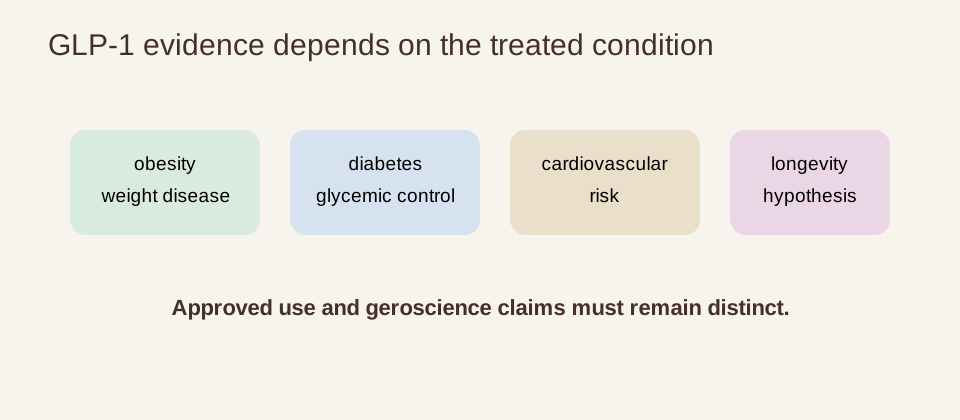
This is why the distinction between a metabolic medicine and a gerotherapeutic matters. Semaglutide’s established clinical value is tested with outcomes such as glycemic control, weight management and cardiovascular events in defined populations. The SELECT trial, for example, randomized 17,604 adults with preexisting cardiovascular disease and overweight or obesity but without diabetes, and semaglutide reduced the composite of cardiovascular death, nonfatal myocardial infarction or nonfatal stroke over a mean follow-up of 39.8 months. That is clinical-outcome evidence, but it does not prove that the mechanism was epigenetic rejuvenation.
Likewise, STEP trials show that semaglutide can produce substantial weight loss in adults with overweight or obesity. Weight and metabolic changes can improve health without implying that a clock has measured a reversal of the aging process. The GLP-1 longevity overview keeps these clinical and geroscience questions separate.
Why different clocks can disagree
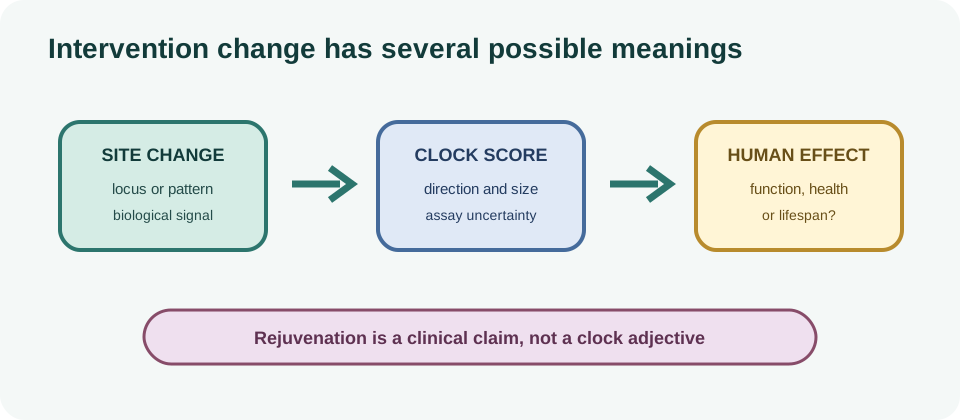
Epigenetic clocks are algorithms that summarize DNA-methylation patterns. First-generation clocks were primarily trained to estimate chronological age. Later clocks incorporate mortality-associated or phenotype-associated measures, and pace clocks estimate a rate rather than an age. Organ-system and explainable clocks aim to add specificity, but each still has a training target and measurement error.
The 2026 Nature Medicine TranslAGE analysis harmonized 51 longitudinal human intervention studies and calculated 16 prominent clocks plus 94 related methylation biomarkers. It found that clock responsiveness depends on intervention category, population and study duration. Clocks trained to predict mortality or pace of aging showed stronger and more consistent responses across interventions than some earlier-generation measures, but the authors emphasized that evidence to guide biomarker selection remains limited.
That framework makes the semaglutide findings more interesting, not more conclusive. Multiple clocks moving in the same direction is evidence of a reproducible-looking molecular pattern within this dataset. It is not yet evidence that the pattern is a treatment surrogate for fewer heart attacks, less disability, better cognition or longer life.
- Prediction: a clock may correlate with future risk in a population.
- Responsiveness: the clock changes after an intervention.
- Surrogacy: the change reliably predicts the intervention’s effect on a clinical outcome.
What validation would require. To validate a clock as a treatment surrogate, researchers would need more than a statistically significant change. The clock should respond reliably across independent trials, populations, laboratories and relevant interventions. Its change should predict the direction and magnitude of clinical-outcome effects, and the relationship should hold after accounting for weight, inflammation, baseline risk and other pathways through which treatment works.
Prospective semaglutide trials could prespecify the methylation measures, define a primary aging hypothesis, control multiple testing, measure weight and inflammatory mediators, follow participants longer and link clock changes to function, disease events or validated clinical outcomes. A healthy older-adult cohort would answer a different question from the HIV-lipohypertrophy cohort and should be studied separately.
The epigenetic-aging guide and biological-age test review explain why a consumer clock result should not be treated as a medical diagnosis. The 2026 clock-responsiveness brief tracks the broader validation effort, while longevity clinical-trial coverage focuses on what prospective outcome studies actually measure.
Safety and clinical-indication context
Semaglutide is a prescription medicine with clinically relevant effects and risks. The epigenetic analysis does not create an indication for people without an approved or clinically appropriate reason to use it. Gastrointestinal adverse effects, gallbladder events, dehydration and other warnings belong to the medication’s clinical evaluation; an aging-clock signal does not change that risk-benefit assessment.
Do not start, stop or change semaglutide because a study reports a lower epigenetic-age estimate. A qualified clinician should determine whether the medicine is appropriate, which formulation and indication apply, and how benefits and harms should be monitored.
What this finding changes—and does not change
The findings strengthen the case for prospectively testing whether metabolic interventions influence aging-associated molecular measures. They also show why researchers should report exact clocks, tissue source, population, follow-up and prespecification status. The favorable randomized-trial signal and the mixed single-arm pilot do not establish rejuvenation, a slower pace of whole-body aging or a lifespan effect.
For now, the most defensible conclusion is narrow: one specific randomized trial cohort showed favorable changes in several peripheral-blood DNA-methylation aging measures over 32 weeks, while a separate HIV/MASLD pilot did not show consistent overall movement across three measures. The next question is whether a prospective, adequately controlled trial can show that prespecified clock changes track meaningful clinical benefit.