What the NIA Interventions Testing Program is
The NIA Interventions Testing Program, or ITP, tests candidate interventions for lifespan and late-life pathology in genetically heterogeneous UM-HET3 mice. Testing is conducted simultaneously at the University of Michigan, The Jackson Laboratory and the University of Texas Health Science Center at San Antonio under shared procedures. A data coordinating center maintains a public archive of outcomes and protocols.
The design is useful because it reduces dependence on a single laboratory, a single mouse strain or one unusually favorable cohort. Both male and female mice are tested, and the program can examine whether dose, treatment age or sex changes the outcome. The ITP is still a mouse program, but it is a stronger preclinical filter than an isolated result in one model.
The current NIA description says Stage I testing is usually powered to detect a 10% lifespan increase for either sex when results are pooled across sites. Promising agents can move to Stage II, where dose, treatment timing, pathology, health and biochemical mechanisms are examined. Negative results are part of the program’s value because they prevent weak signals from being treated as established interventions.
What form and result were tested
The 2026 ITP report tested eleven compounds, including alpha-ketoglutarate, in genetically heterogeneous UM-HET3 mice. The study included novel agents and interventions tested at different doses or starting ages from earlier work. Its primary question was whether any of those protocols increased lifespan in male or female mice.
None of the tested compounds significantly increased lifespan in either sex. That includes alpha-ketoglutarate. The finding is narrower than “AKG can never affect any health outcome,” but it directly contradicts the stronger claim that AKG is already an established lifespan extender across mammalian aging models.
Negative results can be affected by formulation, exposure, dose, treatment age, background diet, sex and strain. Those variables are reasons to define a new hypothesis carefully, not reasons to ignore an unfavorable replication. A new experiment should state in advance what would count as confirmation, failure or a narrower healthspan signal.
| Question | What the result says | What it does not say |
|---|---|---|
| Lifespan | no significant increase in male or female UM-HET3 mice | every AKG protocol is ineffective |
| Replication | broad commercial lifespan confidence should be reduced | all earlier findings were fraudulent or irrelevant |
| Formulation | the tested protocol is the evidence unit | alpha-KG and every calcium-AKG product are identical |
| Translation | human lifespan remains untested by this result | human biomarkers prove benefit or harm |
Why negative replication evidence deserves weight
Commercial supplement narratives often emphasize the most favorable study: a longer-lived mouse strain, a biomarker shift or an exploratory human signal. A multi-site ITP result tests whether a lifespan effect survives a more heterogeneous design. When it does not, the appropriate update is a reduction in confidence, even if the mechanism remains interesting.
Replication is not a demand for every experiment to produce the same number. It is a demand to distinguish a robust effect from a context-dependent one. If a benefit appears only in one strain, sex, dose or age window, that narrower boundary should become part of the claim.
Earlier AKG and CaAKG findings versus the ITP result
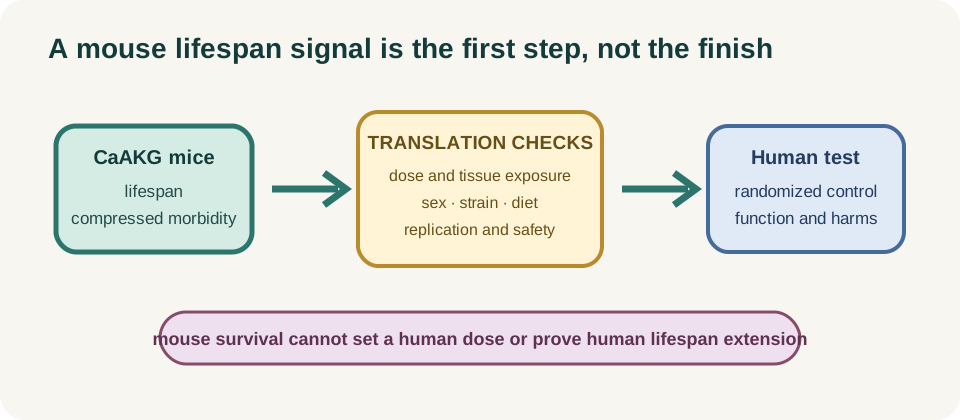
An influential 2020 study reported that calcium alpha-ketoglutarate, or CaAKG, extended lifespan and compressed morbidity in C57BL/6 mice. The authors linked the result to lower inflammatory cytokines and proposed an IL-10 mechanism. A 2014 study also reported lifespan extension in Caenorhabditis elegans, a nematode model. These findings explain why AKG entered longevity discussions, but they are not the same intervention, species or design as the 2026 ITP test.
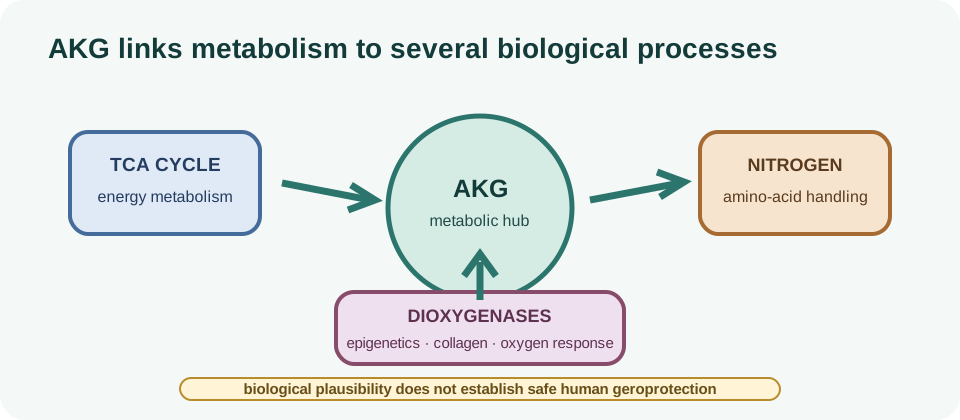
Alpha-ketoglutarate is a central metabolite, while CaAKG is a calcium salt used to deliver it. Salt form can affect dose calculation, absorption, mineral exposure and tissue levels. The words “AKG” and “CaAKG” should therefore not be treated as interchangeable labels without a direct comparison.
Timing and dose can also matter. The new ITP report emphasizes that earlier findings may fail when an agent is tested at a different exposure or starting age. That possibility keeps a narrower experiment open, but it prevents a broad statement that the original lifespan result has been established across models.
Healthspan endpoints versus lifespan
Lifespan is not the only aging outcome. An intervention might affect frailty, inflammation, exercise tolerance or a specific organ without extending survival. That possibility is why the ITP can expand Stage II measurements to health, pathology and mechanism. It still requires a prespecified endpoint and a result that is meaningful for the tested animals.
A healthspan result would not rescue an unsupported lifespan advertisement automatically. “Improves one marker of frailty in a selected mouse cohort” is a narrower claim than “extends life.” The distinction should be preserved when an intervention has mixed outcomes.
Human AKG evidence and biological-age claims
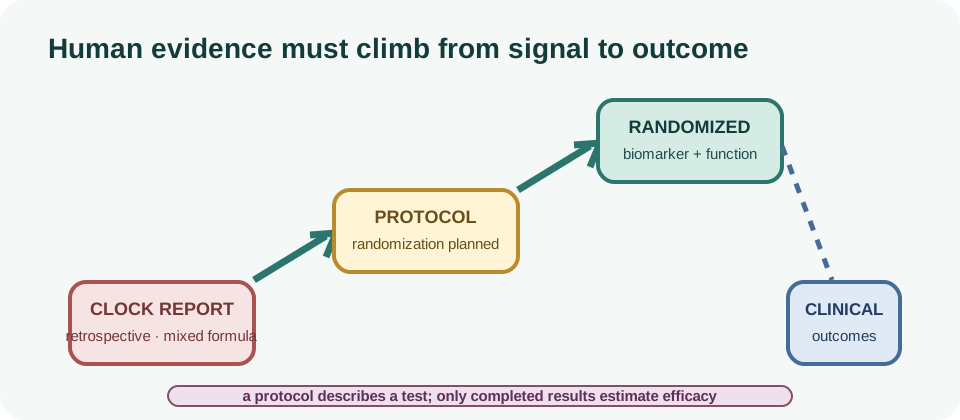
Human AKG research includes small studies, metabolite or inflammation measurements and exploratory biomarker work. A biomarker can show that an exposure is biologically active, but it cannot by itself establish fewer diseases, preserved function or longer life. The biological-age test page explains why a change in an age estimate is not a validated longevity endpoint.
Epigenetic-age results require the same caution. A clock can respond to a treatment while remaining an imperfect or unvalidated surrogate for disease and mortality. See the epigenetic aging page for the difference between responsiveness, prediction and clinical validation.
The human evidence question is therefore still open. The negative mouse lifespan study weakens a broad translation narrative; it does not answer whether a defined AKG protocol affects a specific human outcome. Any human trial would need a clear formulation, exposure, comparator, prespecified outcome and transparent harms.
What supplement marketing claims the result challenges
The ITP result challenges claims that AKG is a proven lifespan-extending supplement, that a positive early mouse result has been replicated broadly, or that a biological-age change demonstrates longer life. It also challenges product pages that move between AKG, CaAKG, human cells and mice without identifying the evidence unit.
It does not justify saying AKG is proven harmful, that every formulation is inactive, or that no human health benefit is possible. The correct update is proportional: lower confidence in broad lifespan claims, retain narrower hypotheses, and require better evidence before making a clinical or commercial promise.
Evidence verdict and what to watch next
In the 2026 NIA ITP study, alpha-ketoglutarate did not significantly extend lifespan in male or female genetically heterogeneous UM-HET3 mice. The multi-site design gives the negative result meaningful weight. Earlier CaAKG and model-organism findings remain part of the research history but cannot be presented as replicated mammalian lifespan evidence.
The responsible conclusion is AKG remains a research question, not an established human longevity intervention. Watch for direct comparisons of formulation and exposure, replicated healthspan endpoints, registered human trials and biomarker studies that test whether changes predict outcomes that matter. The canonical AKG longevity page should be updated to reflect this evidence correction, while the best longevity supplements page should not rank AKG as proven lifespan extension.
- state the ITP result as a mouse lifespan result;
- separate alpha-ketoglutarate from calcium-alpha-ketoglutarate;
- name sex, strain, dose and treatment age when comparing studies;
- do not turn biomarkers into proof of longevity;
- avoid saying one negative study proves universal ineffectiveness;
- require direct human outcomes before making a human longevity claim.