Scope note: This is a study explainer, not medical advice. Gardening is an optional activity, not a prescribed longevity treatment. Choose activities that fit personal mobility, health, access and preferences, and seek clinical guidance for individual safety questions.
What question did the Lothian study ask?
Gardening combines several things that can be difficult to separate in health research: movement, time outdoors, contact with nature, purposeful activity, routine, and sometimes social interaction. It also depends on practical circumstances such as having a garden, tools, transport, physical capacity and help. A cohort study can ask whether people who report gardening more often later differ in measured health. By itself, it cannot show which part of that bundle matters or whether gardening is the reason for the difference.
Corley and colleagues examined gardening frequency alongside psychological, physical and blood-derived aging measures in members of the Lothian Birth Cohort 1921. The analysis used questionnaire data from 475 participants at a mean age of about 79, then related the reported frequency to assessments at later study waves and to mortality records. It was a secondary observational analysis of an existing cohort, not a randomized trial of gardening.
Who was studied, and how was gardening described?
Participants were members of a Scottish birth cohort born in 1921 and living in the Lothian region. Gardening frequency was self-reported around age 79 and grouped as frequent (207 participants), sometimes (78), or never/rarely (190). That is a broad exposure measure. It does not specify a standardized activity, workload, garden size, task, season, duration per session or lifetime history.
The cohort’s single region and birth generation limit generalizability. It does not automatically represent younger or contemporary populations, other countries, or older adults with different health and access profiles.
Researchers adjusted for measured individual and neighborhood characteristics, including education, occupational class, living alone, neighborhood amenities, smoking, body mass index and selected health conditions; sensitivity models also considered physical activity. Adjustment helps, but only addresses variables measured and modeled adequately. It cannot remove every difference between gardening groups.
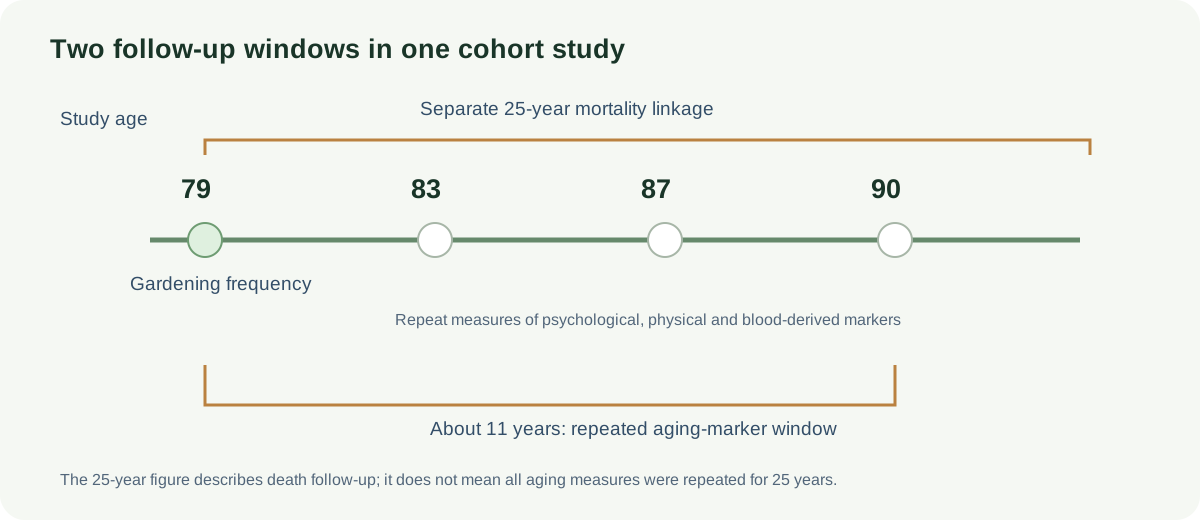
Two timelines sit inside the phrase “25-year study”
The aging measures were collected at approximately ages 79, 83, 87 and 90, which is about an 11-year repeated-measure window. Mortality follow-up used linkage to death records extending much longer from baseline. Those are related analyses in the same cohort, but the time horizon for one outcome cannot be carried over to the others.
The 25-year duration refers to mortality linkage; the repeated phenotype measures do not span a continuous quarter-century.
What outcomes were reported?
The paper covered several domains rather than one all-purpose “biological age.” Psychological outcomes included self-reported quality of life and psychological wellbeing. Physical function included objective measures such as gait speed, grip strength, lung function and functional ability. Blood-derived measures included telomere length and DNA-methylation-based PhenoAge. Each outcome has its own measurement properties; a favorable association in one domain does not mean every dimension of aging improved.
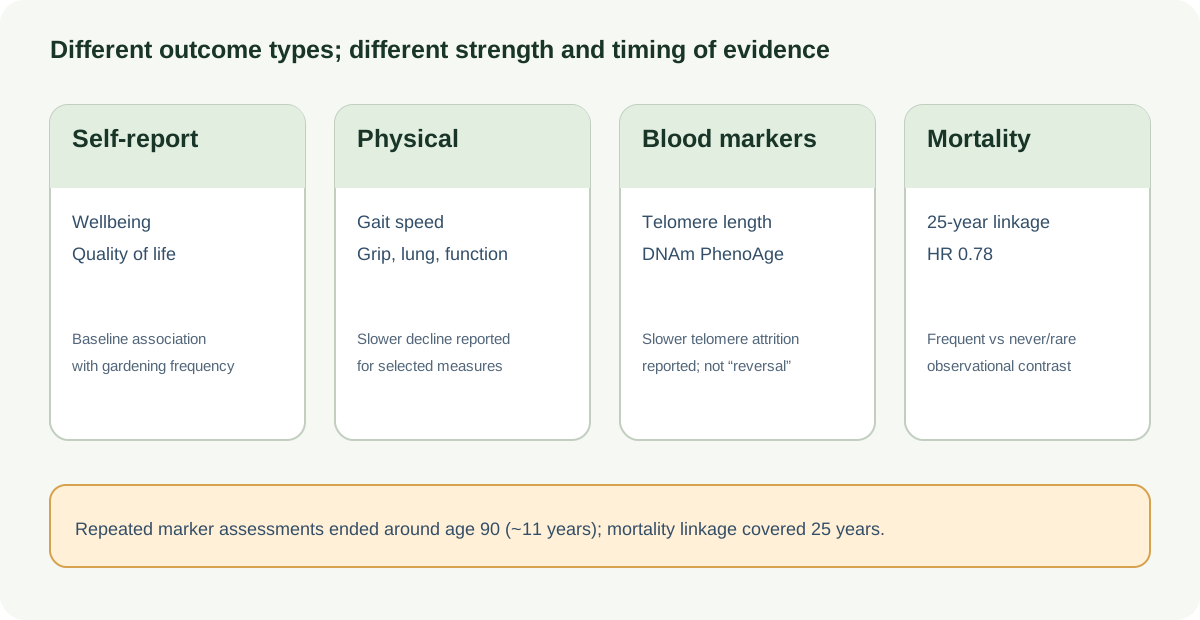
At baseline, greater gardening frequency was associated with better psychological wellbeing, stronger physical function and longer telomeres. In longitudinal models, more frequent gardening was associated with slower decline in gait speed and slower telomere attrition from roughly age 79 to 90. Not every outcome showed this pattern; the findings do not mean gardening slowed aging overall.
Telomere length and PhenoAge are biological measures, not direct readings of lifespan. A difference in a marker can be scientifically interesting without proving that a person became younger, that a change is clinically meaningful, or that changing the marker would improve health. The direction and size of estimates should be interpreted outcome by outcome, with the study’s model and uncertainty in view.
What does the mortality estimate mean?
Compared with participants who never or rarely gardened, the frequent-gardening group had an adjusted hazard ratio of 0.78 for mortality, with a 95% confidence interval from 0.62 to 0.97. The authors describe this as a 22% lower mortality risk. More precisely, the estimate compares modeled hazards between groups under the study’s analysis; it is not a 22 percentage-point change in an individual’s chance of dying, a guaranteed lifespan extension, or a forecast for a particular gardener.
The confidence interval is compatible with a range of association sizes, and its upper end is close to 1.0. Adjustment and a sensitivity analysis adding physical activity make the estimate more informative than a raw comparison, but do not turn an observational study into an experiment.
A separate analysis of 13,812 U.S. adults in NHANES also reported an association between self-reported outdoor gardening activity and lower mortality over a median 16.8 years. The adjusted all-cause estimate was HR 0.76 (95% CI 0.68–0.85). This is useful contextual convergence across cohorts, not causal confirmation: both studies remain observational and may share sources of bias such as healthier participants being more able to garden.
Why the association does not establish cause
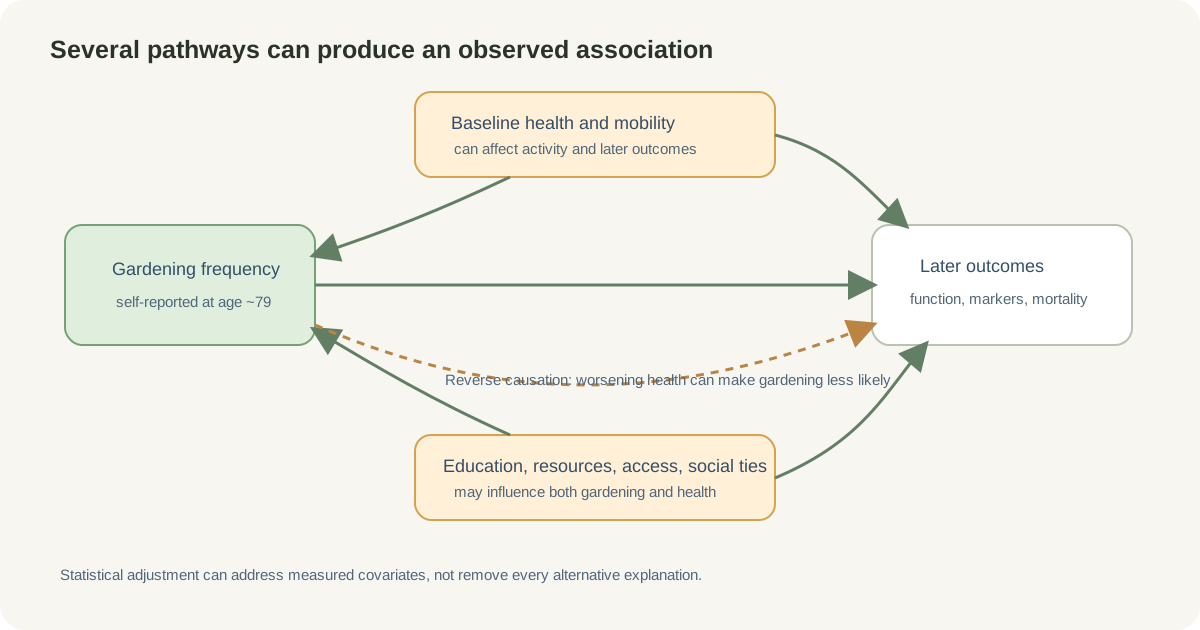
Reverse causation is plausible. People with better mobility, strength, lung function or general health may be more able to garden. If health influences the activity, the observed association can partly run from health to gardening rather than the other way around.
Healthy-user and access differences can remain. Frequent gardeners may differ in income, education, housing, safe outdoor space, neighborhood design, social support, diet, healthcare access or other habits. The study adjusted for a number of measured factors, but residual confounding can persist when variables are absent, self-reported imprecisely or represented imperfectly in a model.
Selection and survival matter at older ages. The analysis depends on who entered the cohort, supplied gardening data and contributed follow-up information. Survival to advanced ages and continued participation can select a distinctive group. Statistical methods address some missingness and censoring questions, but cannot make the sample equivalent to all older adults.
The exposure is not a reproducible intervention. “Frequent” gardening does not say what a person did or how much physical effort was involved. Digging, watering, sitting among plants, growing food and joining a communal garden may differ in movement, social contact and risk.
Gardening could contribute to movement or enjoyment, or signal existing capacity and resources; this cohort cannot isolate those pathways.
How do intervention studies change the interpretation?
Intervention research asks a different question: what happens when people are offered or assigned a defined gardening program? A 2025 systematic review included 23 controlled studies with 4,535 adults living with chronic conditions (13 randomized trials and 10 quasi-experimental studies). Its database search ended in September 2023. Pooled estimates across mental, physical and general health domains were imprecise and their confidence intervals included no difference. The participants had a mean age of about 54, so this review is not a direct test of the Lothian mortality result in adults in their eighties.
A 2024 review of horticultural therapy in older adults summarized 27 studies with 1,629 participants. It reported possible physical and psychosocial benefits but rated certainty very low, given variation in programs, populations, measures and study quality. It does not show that gardening prevents death or changes long-term aging.
A 2026 scoping review mapped 32 nature-based and garden interventions for people with dementia and caregivers. It described psychosocial and wellbeing outcomes, mixed cognitive findings, and implementation barriers. That literature concerns a distinct care population and heterogeneous intervention studies; it did not test mortality and cannot corroborate the Lothian cohort’s survival association.
Cohort and intervention evidence therefore complement rather than replace each other. Cohorts can observe long follow-up and uncommon outcomes such as mortality, while interventions can better test whether a specified program changes a chosen outcome over a defined period. Neither type of evidence answers every question, and a short trial of wellbeing or function would not automatically prove a mortality benefit.
For adjacent topics, see our explainers on physical activity and longevity, gait speed, telomere attrition, and the limits of biological-age testing. For more on movement, see the systems hub.
What can readers reasonably take from this result?
The study makes gardening a reasonable subject for further research on activity, wellbeing and aging in place. It adds longitudinal observations in a cohort followed into very old age and a long mortality linkage analysis. The repeated-measure pattern for gait speed and telomere attrition is worth testing in other populations with better exposure detail and designs that can more clearly separate activity from baseline capacity and access.
For an individual, the paper does not support starting gardening to extend life, replacing exercise or treatment, or aiming for a specific number of hours. Someone who enjoys gardening may choose it for enjoyment, routine, food growing or social contact, adapting tasks and surroundings to their needs. These are practical possibilities, not outcomes demonstrated by this mortality comparison.