Biology of aging · evidence reviewed September 2026
What NAD+ is: cofactor and signaling substrate
Nicotinamide adenine dinucleotide, usually written NAD+, is a small molecule used throughout biology. In its oxidized form, NAD+ accepts electrons and becomes NADH; this reversible pair helps cells transfer energy through glycolysis, the citric-acid cycle and oxidative phosphorylation. NAD+ also participates in signaling reactions that consume it rather than simply cycling it between redox states.
That dual role is why NAD+ appears in both metabolism and aging research. A cell needs enough NAD+ to handle electron transfer, but it also spends NAD+ when enzymes respond to DNA damage, inflammation, chromatin state or other stress. The relevant question is therefore not just how much NAD+ is in a sample. It is how the molecule is distributed, how quickly it is made and consumed, and whether the pool limiting a specific function can be changed safely.
NAD+ is not an “energy molecule” that acts alone. It works inside pathways that also depend on oxygen, substrates, mitochondria, enzymes, membranes and tissue blood supply. If another part of the system is limiting, adding a precursor may change a metabolite without correcting the functional bottleneck.
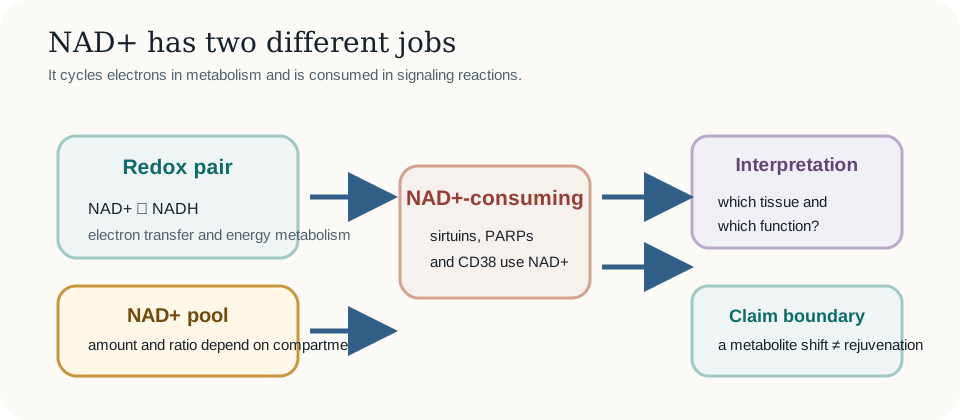
NAD+, NADH and cellular compartmentalization
The NAD+/NADH ratio describes redox conditions, but there is no single uniform ratio for the whole body. Cytosolic, nuclear and mitochondrial pools are partly separated and are controlled by different enzymes and transport processes. NADH produced in one compartment may not directly compensate for a shortage of NAD+ in another. A whole-blood value can therefore be a poor proxy for a vulnerable mitochondrial or nuclear pool.
Measurement itself is difficult. NAD-related molecules can change during sample handling, and different studies use different tissues, extraction methods and analytic platforms. Some report total NAD, some distinguish NAD+ from NADH, and others use downstream metabolites or peripheral blood mononuclear cells. These choices can produce apparently different age patterns without one study necessarily being “wrong.”
A trustworthy human result should identify the compartment or tissue measured, the assay, the fasting or exercise state, medication context and the timing of sampling. It should also state whether the endpoint was a primary clinical outcome or a biochemical intermediate. The 2025 human review of NAD precursor trials emphasizes that tissue-specific evidence remains limited and that rodent findings do not translate automatically.
How cells make NAD+
Cells can maintain NAD+ through several routes. The salvage pathway recycles nicotinamide released when NAD+-consuming enzymes do their work. Nicotinamide phosphoribosyltransferase, or NAMPT, is a key step in this route, followed by conversion through NMN and NAD synthetase. The Preiss–Handler pathway uses nicotinic acid, while the de novo pathway can build NAD+ from tryptophan through several intermediates.
These pathways are not equally important in every tissue. Nutrient supply, enzyme expression, inflammation, organ function and the activity of NAD consumers all shape the local balance. A precursor that enters one route may have a different effect from another precursor, and increased availability of an intermediate does not guarantee that the next enzyme is capable of using it.
Salvage also creates a feedback problem. Recycling nicotinamide is useful, but high substrate levels can influence the activity of enzymes in the pathway. In a diseased or stressed tissue, the bottleneck may be accelerated consumption, impaired mitochondrial handling, inflammation or a downstream defect rather than lack of precursor. This is one reason the phrase “NAD depletion” needs a tissue and mechanism attached to it.
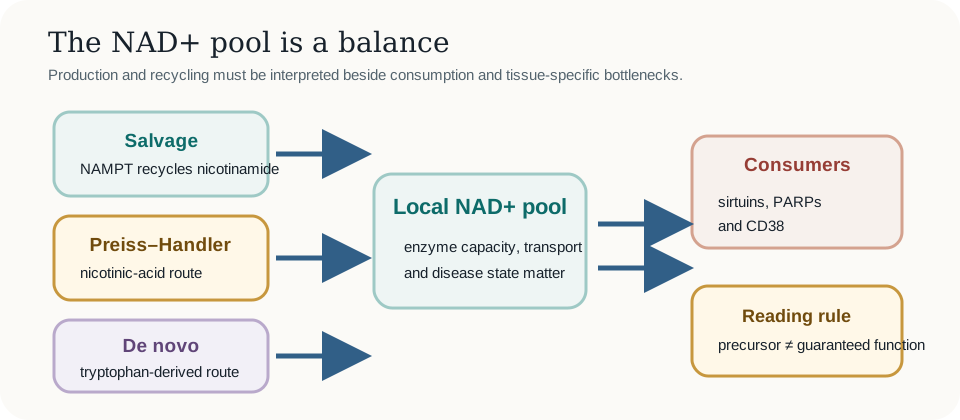
Major NAD+ consumers: sirtuins, PARPs and CD38
Sirtuins are NAD-dependent enzymes involved in deacetylation and related signaling reactions. They connect NAD+ availability with chromatin regulation, mitochondrial programs and stress responses. This does not mean that supplying more NAD+ will increase every sirtuin function in every cell. Enzyme abundance, localization, competing substrates and the redox environment also matter.
Poly(ADP-ribose) polymerases, or PARPs, consume NAD+ when they respond to DNA damage and other signals. DNA repair is valuable, but persistent damage can increase demand. CD38 is another important consumer associated with immune and inflammatory biology. Age-related changes in immune-cell composition or inflammation could therefore affect NAD metabolism without a single universal decline in all tissues.
These consumers illustrate why an intervention might have different results in muscle, liver, brain, immune cells or tumors. A precursor may raise circulating or cellular NAD-related metabolites while consumption remains high in a target tissue. Alternatively, reducing consumption could have its own consequences because the consuming reaction may be part of repair or host defense.
For a broader discussion of NAD-dependent signaling, see our guide to sirtuins and aging. Sirtuin mechanism, NAD supply and clinical outcome are connected questions, not interchangeable evidence.
Does NAD+ decline with human aging?
The strongest version of the popular claim is that NAD+ falls throughout the body as people grow older and that restoring it reverses aging. Human evidence does not support that universal formulation. Some tissues and studies report age-related changes, while other human datasets are smaller, inconsistent or show no clear relationship after accounting for health, lifestyle and measurement method.
A 2025 Nature Metabolism review concluded that convincing evidence for an age-related NAD+ decline in humans has been observed in only a limited number of studies. The 2026 systematic review of NAD supplementation found reliable biochemical target engagement for oral NR and NMN, but heterogeneous and often null functional, metabolic or vascular outcomes. Together, these reviews support biological plausibility while placing a boundary around the marketing narrative.
“Decline” also needs a reference point. A cross-sectional comparison of young and old adults cannot show when the change occurred or whether it is a cause, consequence or correlate of disease. A longitudinal study can be more informative, but it still needs repeated tissue-specific measurements and control of medication, body composition, physical activity, diet, sleep and acute illness.
| Question | Why it matters | Common overreach |
|---|---|---|
| Which tissue? | NAD pools and consumers differ by compartment. | Using blood to represent every organ. |
| Which molecule? | NAD+, NADH and precursors answer different questions. | Treating any NAD-related metabolite as NAD+ itself. |
| Which time point? | Feeding, exercise and illness can alter metabolism. | Calling one sample a lifelong baseline. |
| Which outcome? | Biomarkers, function and disease events are distinct. | Calling target engagement rejuvenation. |
Tissue-specific and disease-specific NAD changes
Human aging is not a synchronized biochemical event. Liver, skeletal muscle, brain, skin, blood and adipose tissue have different metabolic roles and different exposure to inflammation or disease. Even within an organ, cell types can differ. A lower value in one population may reflect cell composition rather than a uniform change inside every cell.
Disease can change NAD metabolism independently of chronological age. Obesity, insulin resistance, neurodegeneration, cardiovascular disease, infection and chronic inflammation all alter energy demand or the activity of NAD consumers. This makes it difficult to infer a general longevity treatment from a disease-specific study. A result in people with a defined condition may still be valuable, but its population and endpoint should be preserved.
Recent human pharmacokinetic work is beginning to ask whether oral precursors reach the brain or other compartments. Those studies are important precisely because they test distribution rather than assume it. A blood response may be necessary for a tissue response, but it is not sufficient evidence that the desired tissue changed.
Inflammation, DNA damage and CD38
Inflammation and DNA damage can increase demand for NAD-consuming reactions. CD38 expression is often discussed in relation to aging-associated immune changes, but a pathway association is not proof that CD38 is the dominant cause of a person’s NAD status. Cell composition, inflammatory tone and tissue location all matter.
DNA repair provides a useful example of the trade-off. PARP activity can consume NAD+ while responding to damage. Lowering that consumption might preserve a metabolite pool, but it could also interfere with a repair process. The desirable intervention would need to improve the balance of repair, energy and signaling rather than merely maximize a laboratory concentration.
Immune biology adds another layer. NAD-related interventions could affect immune-cell metabolism, but immune responses are not uniformly beneficial when increased. A study must distinguish an improved response to a vaccine or infection from excessive inflammation, and it must report the population, timing and safety window.
NAD+ and mitochondria
Mitochondria depend on NAD-related redox chemistry to transfer energy through oxidative metabolism. NAD+ also intersects with mitochondrial sirtuins, substrate use, quality control and communication with the nucleus. This makes NAD biology relevant to mitochondrial dysfunction, but it does not make every mitochondrial problem an NAD deficiency.
Mitochondrial pools are partly buffered and interconnected with other cellular pools. A blood or cytosolic increase may not reach the compartment that limits respiration, mitophagy or regeneration. The 2026 review of mitochondrial quality control in human aging places NAD+, AMPK activators and caloric restriction within a broader network that includes dynamics, biogenesis and mitophagy. Its framing reinforces the need to measure the relevant process rather than infer it from one metabolite.
For this reason, a mitochondrial endpoint should be specified. It might be oxygen consumption, mitochondrial content, muscle energetics, mitophagy flux or mobility. These outcomes can move independently. Our mitochondrial dysfunction and aging guide and AMPK and aging review address related but separate mechanisms.
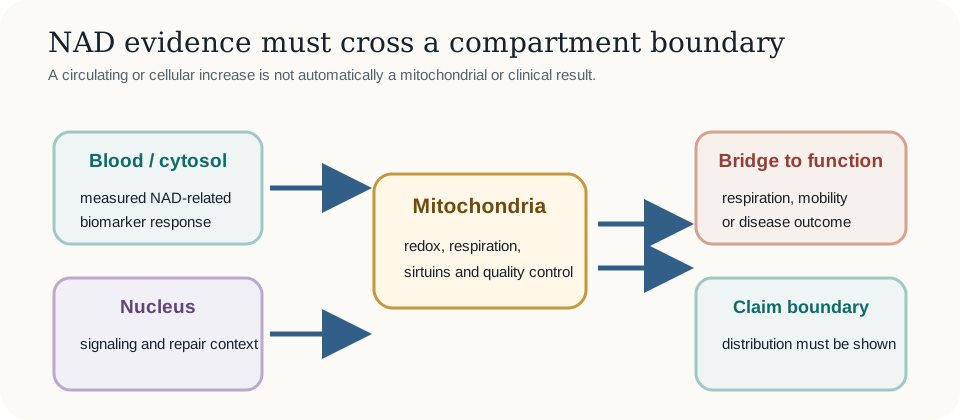
NAD+ and sirtuins
Sirtuins use NAD+ as part of reactions that regulate proteins and gene expression. In model organisms, sirtuin-related pathways are connected with stress resistance and longevity phenotypes. In humans, the translation is more complicated: enzyme activity is tissue-specific, NAD+ is only one input, and a change in a circulating precursor does not establish a durable change in every sirtuin target.
This is a classic example of mechanistic plausibility outrunning clinical evidence. A precursor may raise NAD-related biomarkers and produce a molecular signature, while a trial’s primary functional endpoint remains unchanged. That result is not necessarily a failure of the pathway; it may show that the dose studied, population, duration, tissue distribution or endpoint did not test the right question.
Readers should also avoid stacking claims. Evidence that a molecule raises NAD+, activates a sirtuin in a cell assay and improves a rodent phenotype does not create three independent human proofs. The human outcome must be measured directly.
Precursor strategies: NMN, NR, niacin and nicotinamide
Nicotinamide riboside, or NR, and nicotinamide mononucleotide, or NMN, are commonly studied NAD precursors. Nicotinic acid, often called niacin, and nicotinamide are established vitamin B3-related compounds with different pharmacology and tolerability considerations. They should not be treated as interchangeable simply because all can contribute to NAD biosynthesis.
Human trials generally show that oral NR or NMN can increase NAD-related measurements in blood or selected cells over weeks to months. The 2026 systematic review identified 33 human intervention studies within its eligibility criteria and found consistent biochemical target engagement, while functional, metabolic, vascular and other healthspan outcomes were heterogeneous and often null or endpoint-specific. That is meaningful evidence of biological activity, not proof of a universal benefit.
Doses in trials are doses studied, not recommendations. Product quality, formulation, baseline status, adherence and co-medications can alter exposure. A supplement label also does not establish pharmaceutical-grade identity, long-term safety or an indication for treating aging. No reader should use this review as individualized dosing or treatment advice.
Compare the parent pathway with our focused pages on NMN and longevity, NR and longevity and NMN versus NR. Those pages should be updated when new randomized human evidence changes the comparison.
What human supplementation trials consistently show
The most consistent human result is biochemical: oral NR and NMN can raise NAD-related biomarkers in the blood and, in some studies, in cells or tissues sampled during the trial. Many short studies report acceptable tolerability over their limited follow-up. These findings support continued investigation and help define pharmacology.
What they do not show consistently is a broad improvement across clinical domains. Trials have examined muscle, metabolic, vascular, inflammatory, cognitive, dermatologic and other outcomes, but results vary with population, endpoint and study design. A secondary change in a biomarker should not be promoted above a null primary endpoint.
Systematic reviews help because they show the pattern rather than a single favorable result. The 2026 review also noted that no eligible outcomes trials evaluated intravenous or intramuscular NAD+ itself for anti-aging or wellness indications. One nonrandomized intravenous NMN study contributed mainly short-term safety and biomarker information. The evidence gap is therefore especially large for parenteral wellness claims.
What human trials do not consistently show
Human trials do not consistently show that raising NAD-related biomarkers reverses biological age, prevents multiple age-related diseases, restores youthful mitochondrial function or extends lifespan. They also do not establish that every older adult has a treatable NAD+ deficiency, that blood NAD predicts tissue aging, or that intravenous NAD+ is an evidence-based anti-aging therapy.
Null results can be informative. If a well-designed trial raises the target biomarker but does not change its primary functional endpoint, the result narrows the claim: target engagement occurred, but that exposure did not produce the tested benefit in that population and timeframe. It may motivate a different trial, but it should not be relabeled as success.
- Was the primary endpoint prespecified and clinically meaningful?
- Was the measured tissue the one expected to benefit?
- Was the trial long enough for the outcome to change?
- Were adverse events, withdrawals and product quality reported?
- Was the result replicated independently?
Why blood NAD is not tissue rejuvenation
Blood is convenient to sample, but it is not a universal window into intracellular metabolism. Circulating NAD-related metabolites may reflect red-cell biology, immune-cell composition, recent food intake, exercise, inflammation and analytic handling. They can be useful target-engagement endpoints while still being poor surrogates for brain, muscle, liver or mitochondrial function.
A clinical trial should connect the chain: exposure, blood biomarker, relevant tissue or mechanistic measure, prespecified function and patient-important outcome. Each link can fail. A precursor may not reach the target tissue; the tissue may not be limited by NAD+; a downstream enzyme may be impaired; or the molecular change may be too small or too brief to affect function.
This chain also explains why “biological age” language is risky. A clock or composite score may respond to an intervention without establishing that the person will live longer or remain healthier. NAD-related biomarkers should be interpreted as the specific measurements they are, not as a validated whole-body rejuvenation index.
IV NAD+ and cancer or context caveats
Intravenous NAD+ is promoted in some wellness settings, but the evidence for anti-aging or wellness efficacy is notably thin. The 2026 systematic review found no eligible human outcomes trials of intravenous or intramuscular NAD+ itself for those indications. A pharmacokinetic observation or a short-term infusion experience cannot substitute for randomized clinical evidence.
NAD metabolism is also relevant to cancer biology and rapidly dividing cells. That does not mean a precursor causes cancer or that it is categorically unsafe; it means context matters and broad claims should not ignore the biology of DNA repair, metabolism, tumor type and treatment. Evidence from cell or animal cancer models should not be turned into a personalized warning without clinical data, but it is a reason for careful trial design and medical oversight.
People with cancer, active inflammatory disease, liver or kidney disease, pregnancy, or complex medication regimens need individualized clinical advice. This page cannot assess those situations. General wellness marketing is not a replacement for a regulated indication or a clinician who knows the person’s history.
Evidence verdict and open questions
NAD+ is indispensable to redox metabolism and signaling, and age-related dysregulation is a credible biological hypothesis. Human data, however, do not establish a universal decline across tissues. Oral NR and NMN reliably change NAD-related biomarkers, while healthspan outcomes remain inconsistent, often null or specific to an endpoint and population.
The next decisive studies will be human, tissue-aware and clinically anchored. They should use validated assays, report the relevant NAD pool, define the primary endpoint before analysis, measure target engagement and follow safety long enough. They should also test whether a defined subgroup with a defined metabolic problem benefits, rather than assuming a supplement has the same effect in all older adults.
For now, NAD+ is best understood as a central metabolic hub and a promising research target—not as a universal anti-aging deficiency, a validated biological-age test or proof that infusion products rejuvenate tissue.