What biological age means—and what it does not
Chronological age is time since birth. Biological age is a model-derived estimate of a selected molecular, physiological, clinical or imaging pattern associated with age or aging-related outcomes. It is not a single quantity stored inside the body. Two clocks can assign different biological ages because they measure different inputs and were trained for different targets.
A result can be older or younger than chronological age without implying a literal five-year difference in remaining life. The estimate may reflect current inflammation, smoking, medication, body composition, disease, cell composition, recent illness or technical variation. It can be informative without being a diagnosis.
The 2026 Nature Medicine review describes clocks for individuals, organs, tissues and cells and emphasizes possible uses in risk stratification and intervention research. Those uses require validation beyond attractive marketing language.
What a credible validation record should show
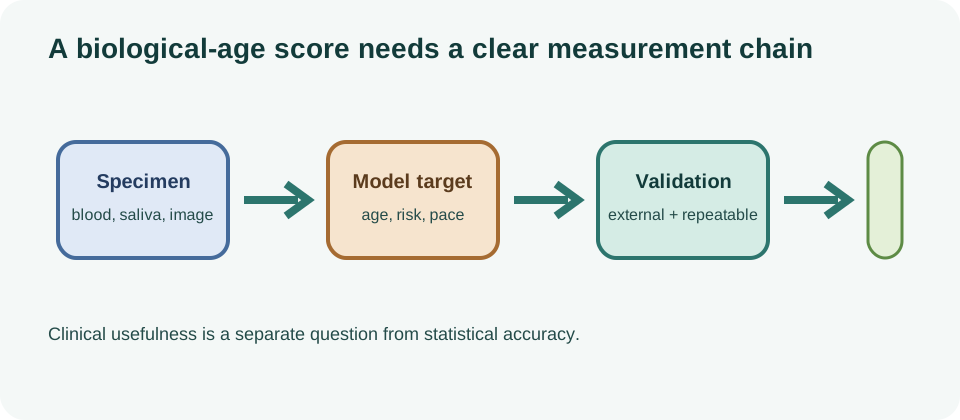
A useful report should identify the training target, the population used to build the model and the exact specimen or measurement platform. “AI-powered” is not a validation result. Readers need to know whether the model predicts chronological age, a clinical phenotype, disease incidence, mortality, functional decline or a rate of change. Those endpoints have different definitions and different levels of practical importance.
External validation matters because a model can perform well in the cohort from which it was developed and weaken in another population. Age range, ancestry, sex, socioeconomic context, medication use, disease burden, laboratory platform and missing-data patterns can all affect transportability. Look for calibration as well as discrimination: a ranking of higher and lower risk is not enough if the predicted probabilities are systematically too high or too low.
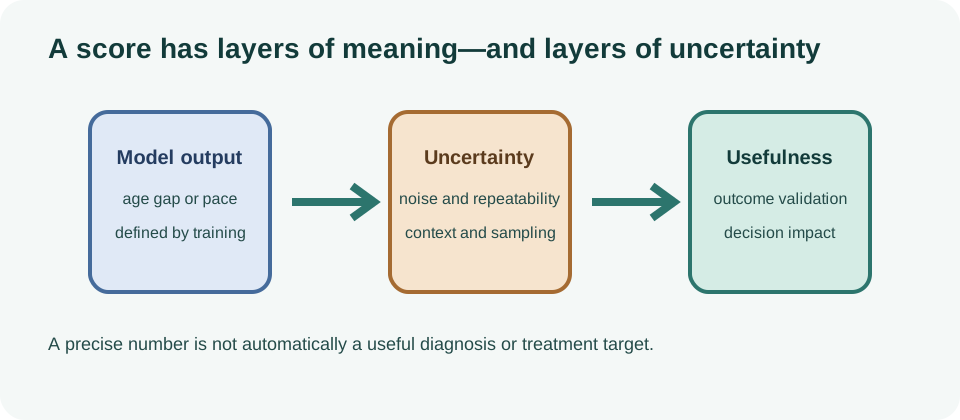
Validation should also report uncertainty, not just a single headline number. A confidence interval, prediction interval or repeatability estimate helps show how much of an apparent difference could be noise. A responsible comparison records the same laboratory, sample type, collection conditions and preprocessing pipeline. If those inputs change, a new score may not be comparable with the old one.
Finally, ask whether the clock adds information beyond ordinary clinical measures and whether anyone has shown that acting on it improves an outcome. Incremental prediction is different from clinical usefulness, and clinical usefulness is different from proving that the clock measures a fundamental aging process. The most informative evidence connects a prespecified change in the score to a patient-important endpoint in an independent, preferably randomized, study, with transparent reporting of harms, missing data and subgroup performance. That is the difference between an interesting biomarker and a result ready to guide care.
| Validation question | Why it matters | Warning sign |
|---|---|---|
| What is the target? | defines what the score can reasonably mean. | one score is marketed as age, risk and treatment response. |
| Was it externally tested? | shows whether performance travels beyond development data. | only an internal accuracy chart is shown. |
| Is it calibrated? | checks whether estimated risk matches observed risk. | only correlation or rank ordering is reported. |
| Does it improve decisions? | tests whether using the result changes care or outcomes. | marketing treats association as an actionable diagnosis. |
Chronological-age clocks and health-risk clocks
First-generation epigenetic clocks were trained to predict chronological age from DNA-methylation sites. A low prediction error for chronological age shows that the model captures age-correlated molecular patterns. It does not automatically show that the clock predicts mortality, frailty, disease or treatment response.
Later clocks such as GrimAge and related approaches use methylation surrogates for risk factors or mortality-related targets. PhenoAge combines clinical variables to estimate a phenotypic-age construct. DunedinPACE aims to estimate the pace of aging rather than a person’s age. These models answer different questions and should not be ranked by one shared “accuracy” score.
| Clock family | Typical training target | Interpretive limit |
|---|---|---|
| Chronological-age clock | age in years. | low age error is not proof of health-risk prediction. |
| Mortality or risk clock | survival, smoking or disease-related risk proxy. | association does not prove causal aging measurement. |
| Pace-of-aging clock | longitudinal change or rate-related phenotype. | requires longitudinal and external validation. |
| Clinical/phenotypic clock | composite clinical age or risk. | may partly restate known clinical risk factors. |
Epigenetic, proteomic, clinical and organ-specific clocks
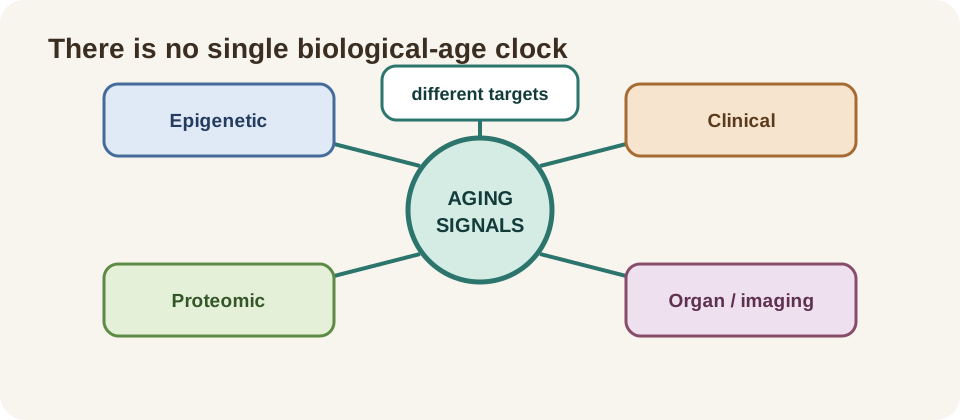
Epigenetic clocks infer age-related patterns from DNA methylation. Proteomic clocks use circulating proteins or tissue proteomes. Clinical clocks combine routine measurements such as blood pressure, glucose, kidney function and blood counts. Imaging clocks estimate age-related patterns from MRI or other images. Organ-specific clocks attempt to estimate the aging state of brain, heart, kidney, liver or other systems.
Organ clocks are attractive because aging is heterogeneous: a person can have relatively older vascular or kidney features and younger brain or immune features. The 2026 Nature Aging review emphasizes the need to identify the organ, tissue, sample and target rather than collapsing every signal into one number.
Proteomic clocks may predict disease and longevity across populations, but the proteins can reflect acute illness, medication, sex, ancestry, assay platform, kidney clearance and other exposures. Cross-population validation and technical harmonization are essential.
What age acceleration or an age gap means
Age acceleration usually means the difference between a clock’s estimate and chronological age, often after adjusting for age or covariates. A positive residual means the sample looks older than expected for that model; a negative residual means it looks younger. The exact residual depends on the training set, preprocessing, reference population and model.
An age gap is therefore not a literal biological countdown. It does not mean five extra years of life, and it should not be used to diagnose “premature aging” without clinical context. Comparing results from different companies or clock families can be meaningless because the scales and targets differ.
Accuracy: predicting age is not predicting health
Mean absolute error, correlation with chronological age and calibration describe one kind of performance. A health-risk clock needs discrimination, calibration, external validation, transportability and incremental value beyond established clinical predictors. A clock can predict age extremely well while adding little useful information about disease or function.
Outcome validation should be prospective where possible and should distinguish association from intervention utility. If a result changes, clinicians need to know whether changing the underlying signal changes the outcome. A predictor is not automatically a treatment target.
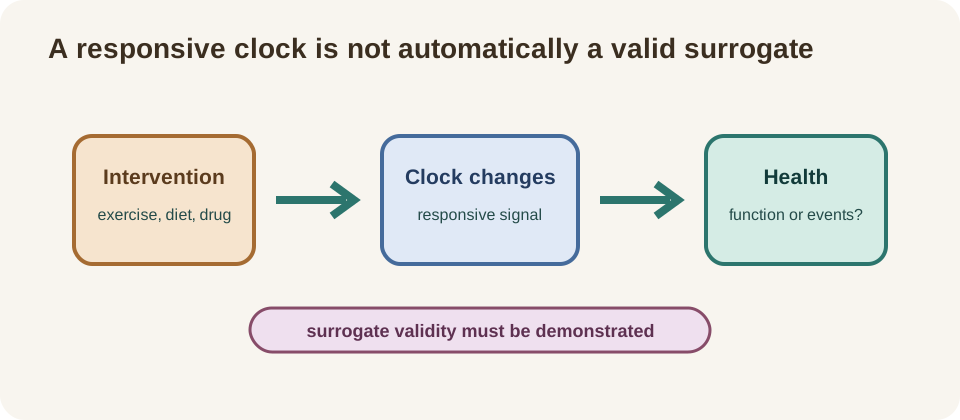
The 2026 Nature Medicine commentary on putting clocks on trial makes this surrogate-endpoint problem central. A clock becomes a credible surrogate only when intervention-induced changes reliably predict changes in patient-important outcomes across trials and populations.
Repeatability and technical measurement error
Repeated testing can vary because of sample collection, storage, batch, laboratory platform, cell composition, assay noise, recent infection, sleep, exercise, fasting, medication and model preprocessing. A single result has uncertainty even when the laboratory report prints many decimal places.
Regression to the mean adds another trap. If a person tests unusually old by chance, a second result may move closer to average without any intervention effect. The opposite can happen after a particularly favorable first measurement. Repeatability statistics, within-person variation and a prespecified retest interval are more useful than a dramatic before-and-after story.
| Source of change | Possible explanation | Required control |
|---|---|---|
| Technical variation | assay, batch, platform or preprocessing difference. | same laboratory and harmonized protocol. |
| Biological fluctuation | illness, inflammation, sleep, exercise or medication. | record timing and relevant state. |
| Regression to mean | extreme first result moves toward average. | repeat measurements and appropriate comparator. |
| True intervention response | the model signal changes after exposure. | randomized design and outcome linkage. |
Can a clock change after an intervention?
Yes, some clocks change after lifestyle, dietary, exercise or drug interventions. The important question is whether the change is reproducible, larger than measurement error, biologically interpretable and linked to a meaningful health outcome. A responsive clock is not automatically a valid surrogate.
A 2026 Nature Medicine analysis harmonized 51 intervention studies and found that mortality- and pace-of-aging-oriented clocks were among the more responsive classes. Responsiveness varied across clock type and intervention. This is evidence about measurement behavior, not proof that changing a clock extends life.
For example, a supplement may alter inflammation or blood-cell composition and thereby move a methylation or proteomic score. That may be a useful signal, a confounder, or both. The intervention still needs clinical endpoints.
How commercial biological-age tests should be evaluated
Commercial tests may use blood, saliva, dried blood spots, questionnaires, wearable data or combinations. The report may provide a biological age, age gap, pace score, organ score or proprietary wellness interpretation. The existence of a polished report does not establish independent clinical validation.
Look for the model’s training target, sample type, laboratory method, reference population, external validation, confidence interval, repeatability, missing-data handling, conflicts of interest and whether the company has tested intervention responsiveness against clinical outcomes. Ask whether the test is regulated as a medical device or sold for wellness purposes; those categories do not carry the same evidentiary meaning.
Do not use a commercial result to start or stop a prescription, supplement, fasting plan or medical screening schedule. If a result is unexpected or concerning, discuss the underlying health question with a qualified clinician rather than treating the clock as a diagnosis.
Questions to ask before buying and retesting
- What target was the model trained to predict: chronological age, risk, pace, function, or a disease outcome?
- Which specimen, laboratory platform, reference population, and preprocessing pipeline produced the score?
- Was the model externally validated, calibrated, and tested for repeatability in people like you?
- What would a change in the score mean for a patient-important decision or outcome?
Before purchase, ask: What was the clock trained to predict? Was the validation independent? Does the company publish performance in populations like mine? What is the expected within-person variation? Are raw data and laboratory quality controls available? What does a five-year age gap actually mean statistically? Does the report identify uncertainty or only provide a single reassuring score?
Retesting makes scientific sense only when the same method, laboratory, sample type and relevant collection conditions are used and when the interval matches the biology and measurement precision. Frequent testing can create noise, false alarms and pressure to chase a number. A clock result should complement—not replace—blood pressure, lipids, glucose, fitness, sleep, vaccination, cancer screening and other established care.
Evidence verdict and future clinical role
Biological-age tests are valuable research tools and may eventually support risk stratification, prevention or intervention trials. Their usefulness depends on target definition, validation, repeatability, fairness, clinical calibration and outcome linkage. Epigenetic, proteomic, clinical, imaging and organ-specific clocks should be treated as distinct instruments.
The strongest current consumer conclusion is modest: a clock may reveal a model-defined pattern that chronological age misses. It cannot currently tell you your exact biological age, remaining lifespan or whether a treatment has reversed aging. The permanent epigenetic aging page, proteomic clocks page and organ-specific age page should preserve these boundaries.
Future evidence should use randomized interventions, harmonized assays, repeated measures, organ-aware models and patient-important outcomes. Until then, the responsible interpretation is informative but provisional.
- identify the clock’s training target before reading the score;
- separate chronological prediction from health-risk prediction;
- quantify repeatability, measurement error and regression to the mean;
- treat intervention responsiveness as different from surrogate validity;
- never interpret a consumer age gap as a direct lifespan estimate.