From induced pluripotency to partial reprogramming
In 2006, researchers showed that a small set of transcription factors could reset differentiated cells toward pluripotency. The canonical Yamanaka combination is usually called OSKM: OCT4, SOX2, KLF4 and c-MYC. The resulting induced pluripotent stem cells, or iPSCs, can proliferate and differentiate into many cell types. That reset is powerful, but it also means the original mature identity is intentionally lost.
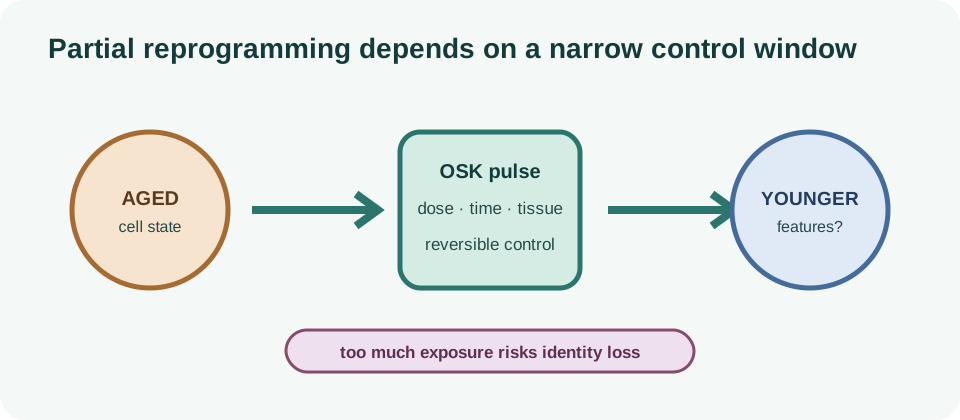
Partial reprogramming uses a shorter or more carefully timed exposure. Instead of completing the journey to pluripotency, investigators try to open a window in which age-associated chromatin and transcriptional features are reset while the cell remains a neuron, muscle cell, skin cell or another differentiated type. The proposed benefit is restored function without identity loss.
The distinction is about exposure and endpoint, not a magic switch. A factor set can be partial in one tissue and unsafe in another. Expression level, duration, cycling schedule, cell state, delivery vector and the presence of other stressors all influence the outcome. A claim that a method is “rejuvenating” therefore needs a description of the experiment, not just the name OSK or OSKM.
What OSKM and OSK actually are
OSKM refers to OCT4, SOX2, KLF4 and c-MYC; OSK omits c-MYC. Removing c-MYC may reduce one oncogenic concern, but it does not make the intervention automatically safe. OCT4 and the other factors can still alter transcriptional networks, cell-cycle behavior and lineage stability. In an experiment, factor identity is only one part of the dose: the vector, promoter, amount, timing and tissue exposure matter as well.
Inducible systems are designed to turn expression on and off, often with an externally controlled trigger. This can make a schedule experimentally manageable and may improve reversibility. It does not guarantee that every treated cell receives the same exposure or that a tissue returns cleanly to its prior state when expression stops.
| Term | What it describes | What it does not prove |
|---|---|---|
| iPSC reprogramming | reset toward pluripotency and broad differentiation potential. | that a mature tissue has been safely rejuvenated. |
| Partial reprogramming | limited or timed factor exposure intended to preserve lineage. | that identity is preserved in every cell or tissue. |
| OSK | one factor combination used in several preclinical systems. | that all OSK schedules or vectors have the same risk. |
| Epigenetic reset | change in methylation, chromatin or transcriptional features. | durable functional recovery or longer human life. |
Why cell identity is the central constraint
A mature cell is defined not only by its age-associated marks but also by the regulatory network that keeps it in its lineage. Reprogramming factors can loosen that network. In a controlled culture dish, a shift may look like a younger expression profile. In an organ, the same shift could change contractility, electrical activity, immune behavior or tissue organization.
Mesenchymal drift is one example of why the boundary matters. Cells that should maintain a specialized epithelial or stromal role can acquire features of another state under stress or reprogramming. That may compromise tissue repair, extracellular-matrix organization or communication with neighboring cells. A low clock score cannot compensate for a cell that no longer performs its original job.
Lineage preservation therefore needs direct tests: morphology, identity markers, transcriptomic state, functional assays, clonal stability and long-term follow-up. Single-cell measurements are useful because a reassuring average can hide a small population of aberrant cells. The safety question is not simply whether the mean treated tissue looks younger; it is whether any dangerous subpopulation has been created.
What “epigenetic rejuvenation” means
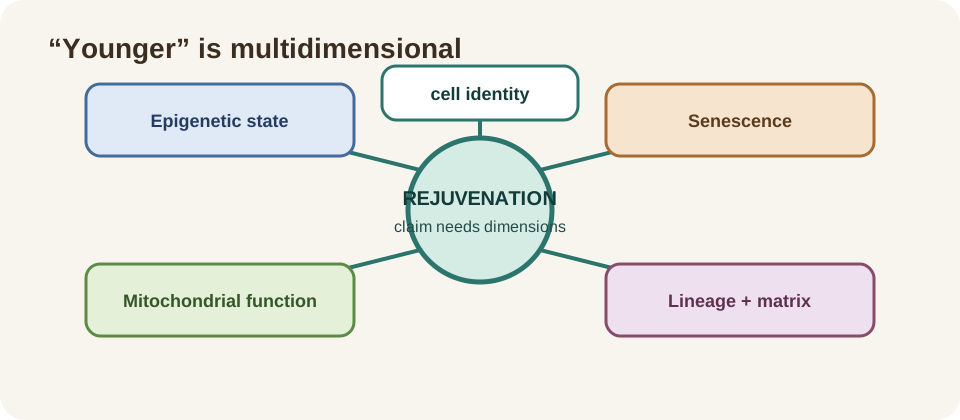
Reprogramming can alter DNA methylation, chromatin accessibility, histone marks and gene expression. These changes are often summarized with an epigenetic clock or an age-acceleration score. Such measures can be informative because they capture coordinated molecular patterns associated with age, but they are model outputs rather than a complete readout of cell health.
The article on epigenetic aging explains why clock choice, tissue and normalization matter. A clock trained on one tissue may not apply to another. A score can move because of cell-composition changes, inflammation or technical batch effects. The companion biological-age test guide covers repeatability and surrogate validity in more detail.
Genuine rejuvenation would require more than a younger-looking methylation profile. Researchers should test mitochondrial performance, proteostasis, DNA-damage responses, senescence burden, extracellular-matrix behavior, regeneration, organ function and durability. If a molecular signal changes but the tissue becomes fragile, the intervention has not achieved the intended endpoint.
Evidence from cultured human cells
Human-cell experiments can show whether a factor system changes a molecular marker or a cell assay. They are valuable for mechanism and for detecting toxicity before animal work. They are not evidence that a whole human can be rejuvenated safely. Culture conditions remove circulation, immune surveillance, tissue architecture and the long time horizon in which abnormal clones might emerge.
The 2024 OSK gene-therapy paper reported epigenetic changes in human keratinocytes expressing exogenous OSK. PubMed identifies these as two technical repeats per group, a small laboratory result that supports biological plausibility but not clinical efficacy. The same paper’s systemic lifespan experiment was in very old male mice, not people. Those two evidence streams should not be merged into a human-treatment claim.
Useful next steps for human cells include independent replication, multiple donors, disease-relevant and healthy cells, blinded assays, longer washout periods and functional tests that matter to the tissue. Researchers also need to look for rare abnormal states, not just average improvement. A cell population that becomes younger in one assay but unstable in another is a safety signal, not a success.
Retinal, nerve and tissue-specific animal work
Some of the most persuasive preclinical experiments are tissue-specific. Local or restricted factor expression can test whether a damaged retina, nerve or other tissue shows improved repair while limiting systemic exposure. These models help separate delivery questions from the harder question of whole-body rejuvenation.
Tissue-specific success still has limits. A vector that reaches the retina may not reach skeletal muscle, kidney or brain in the same way. A schedule tolerated by one cell type may disrupt another. The animal’s age, strain, sex, injury model, immune response and follow-up duration all influence the result. A functional improvement in one organ is not evidence of a generalized change in biological age.
For translation, the decisive measurements are sustained function, pathology, abnormal growth, immune toxicity and off-target expression. A study should report what happened after the factors were withdrawn and whether untreated tissues or distant organs were affected. Local efficacy and systemic safety need separate claims.
The 2024 systemic OSK mouse lifespan study
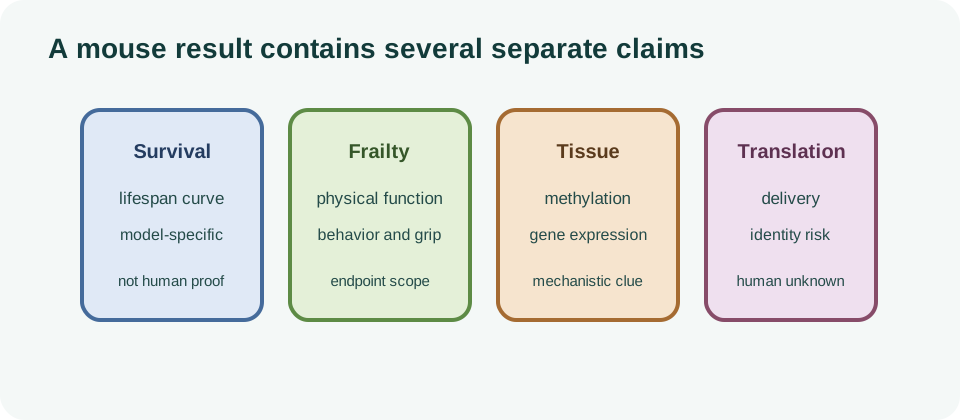
In the 2024 Cell Reprogramming study, researchers delivered an inducible OSK system with adeno-associated virus to 124-week-old male mice. The abstract reports that the treated animals had a 109% extension of median remaining lifespan compared with the stated controls and improved frailty scores. The study also reported tissue-specific DNA-methylation age changes and OSK-associated epigenetic changes in cultured human keratinocytes.
This is an important result to track because it combines a late-life intervention, a survival outcome and functional measures. It is also a result that needs careful replication. The PubMed record discloses that most authors performed the work while employed by Rejuvenate Bio, and that related patent interests and licensing were present. Those disclosures do not invalidate the findings, but they make independent confirmation especially important.
Why the mouse lifespan finding needs careful interpretation
“109% extension” refers to median remaining lifespan after treatment in that experimental comparison; it does not mean mice lived 109% longer from birth, and it does not establish a conserved human effect. Late-life intervention studies can be sensitive to small sample sizes, control selection, injection effects, husbandry, censoring, historical comparisons and chance. The paper’s figure description mentions both doxycycline-treated controls and historical published data, so the exact comparison matters.
A lifespan result is stronger when reproduced by independent groups with prespecified endpoints, adequate power, transparent exclusions, blinded frailty scoring and a complete pathology review. It should also be tested across sex, strain and age rather than assumed to generalize from old males. Improvements in frailty are encouraging, but the pattern of causes of death and adverse events is equally important.
Animal biology can support a mechanism without predicting a safe therapeutic window in humans. AAV immunogenicity, tissue distribution, repeat dosing limits and pre-existing antibodies are human development issues. The correct conclusion is promising but provisional: OSK is a candidate for deeper preclinical work, not a validated longevity therapy.
Senescence, mitochondria, inflammation and matrix effects
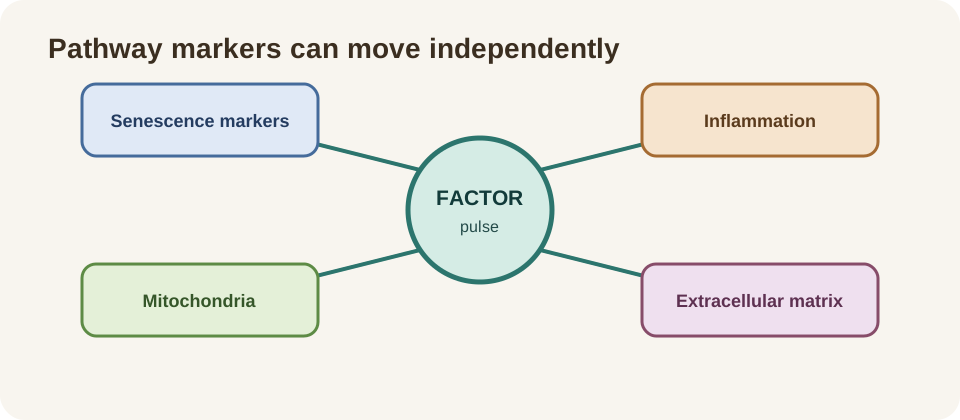
Reviews of partial reprogramming describe changes across several conserved processes: chromatin regulation, stress responses, mitochondrial biology, inflammatory signaling, senescence-associated features and extracellular-matrix remodeling. These pathways interact. Reducing one marker may expose a different bottleneck, and an intervention that improves mitochondrial output in a short assay may have a different long-term effect on genome maintenance.
Senescence is not a single switch. Some senescent cells contribute to wound healing or development, while persistent senescence-associated signaling can damage tissue. A study needs a defined senescence assay and should not infer clearance from one secreted marker. Similarly, a lower inflammatory signal may reflect altered immune composition rather than repaired tissue.
The same caution applies to mitochondria and matrix. Respiration, membrane potential, mtDNA integrity, turnover and redox balance are distinct endpoints. Collagen organization, stiffness, fibrosis and cell-matrix signaling are also distinct. A robust package measures several layers and checks whether improvement persists after factor withdrawal.
Chemical, CRISPR and control-circuit approaches
Genetic factor delivery is not the only path. Chemical cocktails, mRNA, transient proteins, epigenome editing and synthetic control circuits are being explored to make exposure shorter, more controllable or easier to stop. Each approach moves the risk profile rather than removing it. A chemical can have off-target pharmacology; mRNA can be inflammatory; an epigenome editor can create durable unintended changes; a circuit can fail in a subset of cells.
CRISPR-based concepts may eventually provide tissue-specific activation, repression or sensing of cell state. They still require strict control of guide specificity, delivery, duration, immune response and genomic integrity. “Non-viral” or “non-integrating” is not synonymous with safe. The relevant question is whether the system has a measurable off-switch and whether investigators can find and eliminate abnormal cells.
Comparisons should therefore be made across a common checklist: factor exposure, target tissue, delivery route, reversibility, lineage retention, tumor surveillance, biodistribution, immune toxicity, durability and meaningful function. A more elegant delivery platform is valuable only if it improves this complete risk-benefit profile.
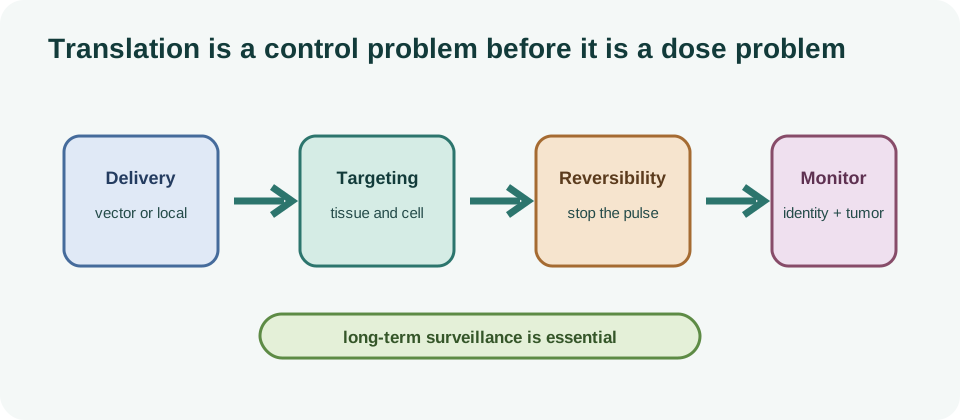
Delivery, tumorigenesis and genomic stability
AAV can deliver genetic instructions to tissues, but distribution is not uniform and immune responses can constrain dosing. The vector may reach cells outside the intended organ, while some target cells receive too little expression. Promoter choice, capsid, route, dose and repeat exposure can all change the outcome. A treatment that cannot be precisely localized has a higher burden of proof.
Tumorigenesis is the most visible risk, but not the only one. Full reprogramming has been shown in animal work to produce teratomas and iPS-like cells when uncontrolled. Partial systems seek to stay below that threshold, yet the threshold may vary by tissue and by cell. Clonal expansion, abnormal differentiation, immune escape, fibrosis and impaired repair are plausible long-term failure modes.
Safety packages should include integration and vector analysis where relevant, karyotyping or genome-stability assays, clonal tracking, pathology of every exposed organ, tumor surveillance beyond the treatment window and a plan for managing abnormal expression. A short follow-up with a favorable clock is not a long-term safety study.
| Risk | Why it can occur | Evidence needed before human use |
|---|---|---|
| Loss of identity | factor exposure disrupts lineage-maintaining networks. | single-cell identity, function and long-term stability. |
| Tumorigenesis | cell-cycle activation or pluripotent drift creates abnormal clones. | durable pathology, tumor surveillance and clonal analysis. |
| Off-target delivery | vectors or payloads reach unintended tissues. | biodistribution, dose control and organ-specific pathology. |
| Irreversible change | epigenetic or genomic edits persist after exposure stops. | validated off-switch, washout studies and reversibility data. |
How to measure genuine rejuvenation
A compelling rejuvenation study needs a hierarchy of endpoints. First, confirm delivery and factor expression. Second, show that the target tissue retains its lineage and does not acquire dangerous states. Third, measure molecular changes using independent assays. Fourth, demonstrate a meaningful function such as regeneration, contractility, vision, cognition, strength or organ physiology. Finally, show durability and safety after the intervention ends.
Epigenetic clocks can sit in the molecular layer, but they should be prespecified and interpreted alongside transcriptomic, proteomic, metabolic and functional outcomes. The cellular senescence page, mitochondrial dysfunction page and stem-cell exhaustion page provide the relevant biological context. A clock reversal without improved function is an unresolved signal, not a completed translation.
Good studies also report null results and harms. If only selected tissues, animals or time points are shown, readers cannot assess the whole intervention. Predefined stopping rules, independent pathology review, raw-data availability and replication across laboratories are signs that a field is moving from exciting observation toward credible therapy.
- separate molecular age from cell identity and organ function;
- test treated and distant tissues after factor withdrawal;
- look for rare abnormal clones rather than relying on averages;
- report adverse findings, missing data and causes of death;
- require independent replication before human efficacy claims.
What a 2026 translational checklist should ask
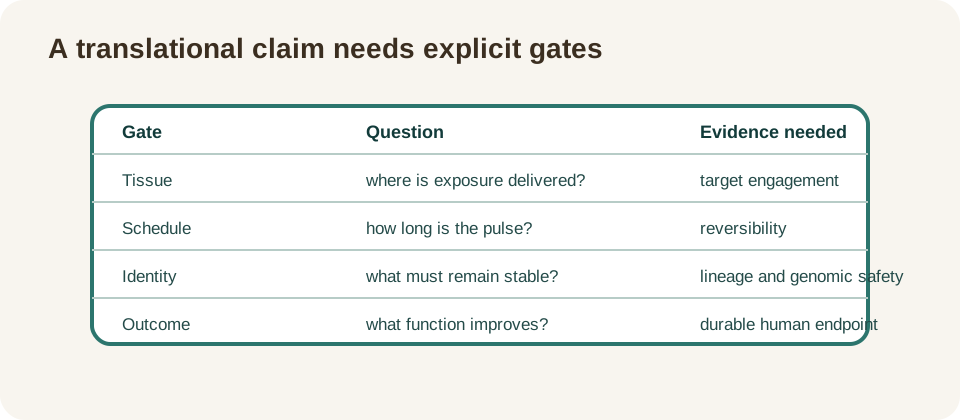
Current reviews frame partial reprogramming as a control problem as much as a discovery problem. Before a human study, investigators need a defined tissue, a defined disease or functional endpoint, a controllable exposure window and a safety plan that remains credible after the experiment ends. The phrase “cellular rejuvenation” should never substitute for those particulars.
| Domain | Minimum question | Interpretation if missing |
|---|---|---|
| Target | which cell, tissue and clinical function are being changed? | systemic claims are premature. |
| Schedule | what turns expression on, off and back off again? | reversibility is uncertain. |
| Identity | do cells remain differentiated and functional? | molecular youth may conceal lineage drift. |
| Safety | how long and how broadly were abnormal states monitored? | tumor and off-target risk remain open. |
| Outcome | does the intervention improve a meaningful function? | clock movement alone is insufficient. |
A useful partial-reprogramming translational checklist should be updated when a credible human therapeutic trial or major safety result appears. The field will need pharmacology-style dose finding, manufacturing controls, regulated delivery, independent monitoring and a way to stop or rescue treatment if a harmful cell state emerges.
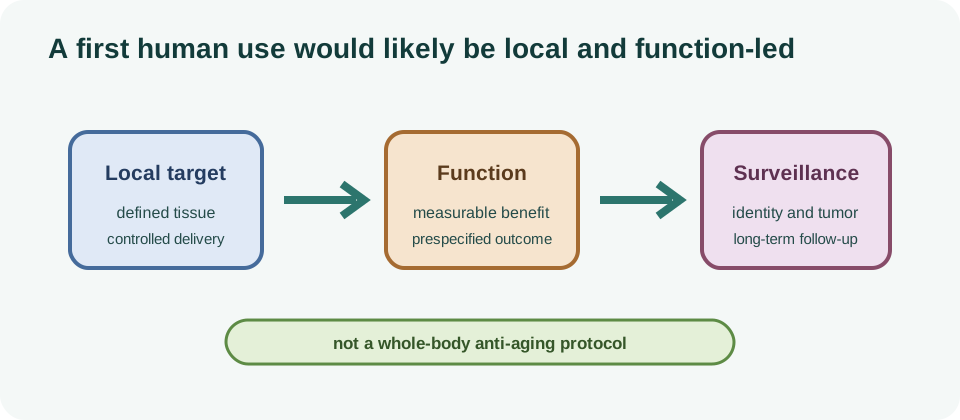
What human translation would likely look like first
The first credible human applications, if they emerge, are more likely to be local, temporary and disease-specific than a whole-body anti-aging injection. A restricted tissue with a measurable deficit may offer a clearer risk-benefit calculation than systemic exposure. The initial endpoint might be regeneration, wound repair, visual function or another organ outcome rather than a biological-age score.
Early studies would need carefully selected participants, dose escalation, sentinel monitoring, long follow-up and independent adverse-event review. A phase I trial would primarily establish delivery and safety, not prove longevity. Even a small human signal would require replication and comparison with existing care. No one should infer a life-extension effect from an early biomarker or from an uncontrolled before-and-after result.
That path is demanding because the intervention is intended to change a cell’s regulatory state. The burden of proof is therefore higher than for a casual wellness supplement. The sensible near-term milestone is not a younger number; it is controlled, tissue-specific functional repair with a durable safety record.
Evidence verdict and milestones to watch
Partial cellular reprogramming is one of the most intellectually interesting approaches to aging biology. It offers a way to test whether some age-associated states are reversible and whether tissues can recover selected functions. Cell and mouse results justify continued research, including the reported late-life OSK mouse survival finding and tissue-specific work.
They do not yet establish human rejuvenation. The field must solve identity preservation, tumorigenesis, genomic stability, delivery, dose timing, tissue specificity, immune effects and durable outcome measurement. The most important milestone is an independently replicated, well-controlled human study that shows functional benefit without unacceptable harm—not a commercial clock claiming that a person became younger.
Until that evidence exists, treat partial reprogramming as a preclinical research program. Follow the interventions hub for updates, and keep the claims connected to the level of evidence. The responsible summary remains: promising mechanism, unresolved safety, no established human longevity treatment.
- watch for the first credible human therapeutic trial and its safety design;
- look for independent replication of animal survival and function;
- check whether lineage stability is measured after washout;
- separate tissue repair from systemic lifespan claims;
- require patient-important outcomes beyond epigenetic clocks.