What qualifies as a longevity or geroscience trial?
A geroscience trial tests an intervention because it may affect biological processes that influence multiple age-related diseases, functional decline or healthspan. It may enroll older adults, people with frailty, people with a specific disease, or a broader population selected for a measurable aging risk. The rationale and endpoints should be stated rather than inferred from marketing language.
A disease trial can still inform geroscience. For example, a cardiovascular or kidney trial may reveal whether a therapy reduces events in an age-related condition. But it should be labeled as disease-specific evidence unless aging biology or a cross-disease outcome was a stated target.
This distinction protects readers from counting every trial in an older population as an anti-aging study. Age is a risk factor; the intervention must target aging biology.
Trial status is a taxonomy, not a result
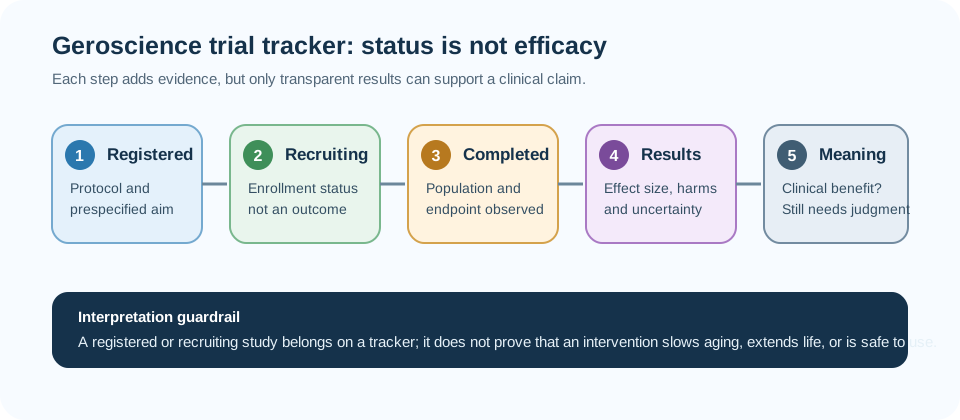
“Planned” means a study is proposed or in development. “Registered” means a record exists in a public registry. “Recruiting” means the registry reports active enrollment, while “active, not recruiting” and “completed” describe operational status. “Results published” means a report can be inspected; it does not necessarily mean the result is positive.
Registry records can lag behind real-world activity, change without a corresponding publication, or omit important details. A tracker should record the date checked, registry identifier, sponsor, phase, population and primary endpoint. It should not silently replace a null or negative result with a later optimistic summary.
| Status | Permitted description | Not permitted |
|---|---|---|
| Planned | proposed or in development | calling it active or successful |
| Recruiting | enrollment is reported in the registry | claiming efficacy before results |
| Completed | study operations are reported finished | assuming the endpoint was met |
| Results published | inspect the reported analysis | ignoring bias, harms or null components |
Registration is not efficacy
A registry record is an accountability tool. It can show the intended population, comparator, sample size, intervention, primary endpoint and recruitment status. Those details make a study auditable and help prevent selective outcome reporting.
Registration cannot show whether participants improved, whether the intervention was safe, or whether the study was sufficiently powered. A press release, conference abstract or protocol may be useful context, but the evidence hierarchy still favors complete, inspectable results with prespecified analyses.
Why the registry record needs a date
Status fields are time-sensitive. A study listed as recruiting can later pause, close, change its sample size or update its primary endpoint. The tracker should preserve the date inspected and link to the registry record so a reader can distinguish a current observation from an old snapshot.
When a publication becomes available, the registry and publication should be compared rather than assumed to match. Deviations, missing outcomes and changes in analysis can affect how much confidence the result deserves.
Clinical outcomes, healthspan and biomarkers
The strongest geroscience endpoint is patient-important: fewer disabling events, preserved intrinsic capacity, better function, delayed multimorbidity or longer disability-free survival. Mortality can be informative but requires enough participants and follow-up. A composite endpoint must show its components, event counts and clinical meaning.
Biomarkers can make trials shorter or help test mechanism. Epigenetic clocks, inflammatory markers, proteomic scores, imaging and multi-omic measures are not interchangeable, and their predictive value does not automatically make them valid intervention endpoints. The biological-age test page explains why prediction and causal aging measurement must be separated.
Intrinsic capacity, frailty, gait, grip strength, cognition, activities of daily living and quality of life may be more actionable than a single molecular score. The sarcopenia and muscle-aging page keeps muscle quantity separate from function, while the clinical-trial methods page records endpoint standards.
| Layer | Examples | Interpretive limit |
|---|---|---|
| Biology | mTOR signaling, inflammation, methylation or metabolomics | mechanism is not clinical benefit |
| Function | gait, strength, cognition, intrinsic capacity | requires validated measurement and follow-up |
| Disease | multimorbidity, cardiovascular events, dementia or cancer | population and indication still matter |
| Survival | all-cause mortality or disability-free survival | needs adequate power and duration |
Current intervention map
The human pipeline includes several classes, each with different evidence maturity. Rapamycin and rapalogs have a strong animal rationale and a growing human trial landscape, but the rapamycin longevity page keeps immunologic and metabolic safety questions visible.
Metformin remains clinically established for diabetes and scientifically interesting for aging. AFAR describes TAME as a prepared, multi-site design that still needs fundraising to launch; it is not a completed efficacy result. See the metformin longevity page for its observational confounding and safety context.
Senolytic strategies such as dasatinib-plus-quercetin, fisetin and related combinations are being explored in small human studies. Their status, dosing, target population and endpoints vary, so the senolytics human-evidence page separates feasibility signals from proof that senescent-cell reduction improves healthspan.
NAD-precursor studies have generally focused on metabolism, tissue NAD-related measures or disease-specific function. A 2025 review notes that human efficacy remains limited and tissue-level NAD evidence is sparse. Supplement availability should not be mistaken for clinical validation.
Metabolic, immune and regenerative approaches
GLP-1 receptor agonists and SGLT2 inhibitors have broad randomized evidence for selected metabolic, cardiovascular, heart-failure and kidney outcomes. That evidence is relevant to healthy aging but remains disease- and population-specific. The GLP-1 longevity page and SGLT2 aging page keep organ protection separate from a general lifespan claim.
Immune-rejuvenation and thymic approaches seek to improve immune function, vaccine response or thymic biology. A biomarker or immune-response improvement can be meaningful, but it must be connected to infection, function or other patient-important outcomes before it supports a broad healthspan claim.
Partial reprogramming, gene therapy and regenerative strategies face an even higher human-readiness bar. Delivery, tissue targeting, oncogenic risk, durability and reversibility are central. Preclinical excitement cannot substitute for first-in-human safety evidence and long-term surveillance.
Caloric restriction, lifestyle comparators and intrinsic capacity
Lifestyle and caloric-restriction studies are important comparators because they can affect weight, metabolic health, physical function and multiple age-related pathways at once. They also show why adherence, nutrition, social context and baseline fitness must be measured carefully.
A lifestyle comparator is not an inert placebo. A geroscience trial should describe what each group actually did, how adherence changed, and whether the comparison tested an intervention against usual care, attention control or another active strategy.
Frailty and intrinsic-capacity endpoints may be especially useful when the goal is healthspan rather than a single disease. The 2026 ICFSR Task Force review emphasizes endpoint validation, biomarker limitations and the need to connect biological signals with function. That is a design principle for the whole tracker.
How each tracker entry should be presented
Every entry should show the registry identifier, intervention, comparator, sponsor type, phase, sample size, age range, disease status, recruitment status, primary endpoint, follow-up and date last checked. If results are available, it should show the prespecified endpoint, effect estimate, uncertainty, absolute event counts and important harms.
Primary outcomes must be distinguished from secondary and exploratory outcomes. A trial can meet a symptom endpoint while missing a biomarker endpoint, or show a biomarker change without improving function. The page should preserve both facts.
| Field | Why it matters | Common failure |
|---|---|---|
| Population | defines generalizability and baseline risk | describing disease cohorts as healthy aging |
| Primary endpoint | identifies the planned causal test | promoting a favorable exploratory result |
| Status and date | keeps the record current | treating an old registry record as live |
| Sponsor and conflicts | adds context for interpretation | hiding commercial or investigator interests |
| Null and harms | prevents survivorship reporting | removing unfavorable evidence |
Funding, conflicts and negative trials
Sponsor funding is not a verdict on study quality. It is part of the evidence context. The tracker should identify commercial, academic, government and philanthropic support, relevant author conflicts, and whether the sponsor had a role in design, analysis or publication.
Null and negative trials are essential. They help estimate the size of an effect, identify populations that do not benefit, expose endpoint problems and prevent a field from becoming a catalog of only positive signals. A well-powered null result can be more informative than a small uncontrolled improvement.
Refresh cadence and breakthrough criteria
This page should be refreshed monthly because registry statuses, publications and trial plans change quickly. Major results, TAME status changes, regulatory developments and consensus work on aging endpoints should trigger an unscheduled update. Each refresh should preserve the prior status and record what changed.
A genuine geroscience breakthrough would combine a credible randomized design, a prespecified and clinically meaningful endpoint, durable benefit, transparent component outcomes, acceptable harms, reproducibility and a population clearly described. A single positive biomarker or a disease-specific result would not be enough.
The final question is not whether an intervention touches an aging pathway. It is whether changing that pathway improves meaningful human health without an unacceptable trade-off.
Evidence verdict
Human geroscience is no longer only a laboratory field: rapalogs, metformin, senolytics, NAD-related strategies, metabolic drugs, immune approaches and lifestyle interventions are being studied in people. Yet the evidence remains heterogeneous. Many studies are early phase, small, disease-specific, biomarker-focused or still only registered.
The tracker therefore treats status as metadata, not efficacy; keeps primary outcomes separate from exploratory measures; and reports population, sponsor, follow-up, null results and harms. No completed trial has demonstrated that a drug extends human lifespan by targeting aging.
The responsible conclusion is follow the human evidence, but do not turn a registry record or a biomarker into a longevity prescription. A real breakthrough will need durable clinical and functional benefit, transparent safety data and replication.
- verify registry status and the date checked;
- show who was enrolled and what the primary endpoint was;
- separate disease outcomes, function and biomarkers;
- preserve null, negative and safety findings;
- disclose sponsor type and relevant conflicts;
- update monthly or after major status and results changes.