What NMN and NR are
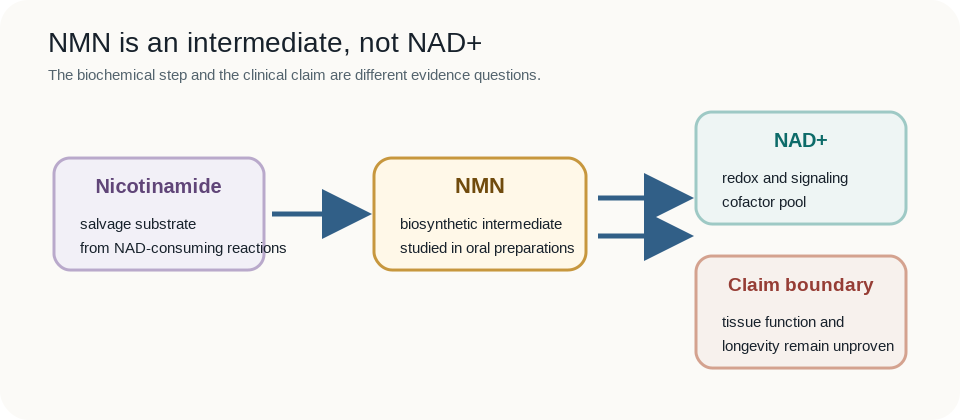
Nicotinamide mononucleotide (NMN) and nicotinamide riboside (NR) are vitamin B3-related compounds that can contribute to the synthesis of nicotinamide adenine dinucleotide, or NAD+. NAD+ is involved in redox reactions, energy metabolism and enzyme systems that respond to cellular stress. That biology makes the compounds interesting; it does not make either one an established anti-aging treatment.
The commercial comparison is often framed as “which one raises NAD more?” That is only one layer of the question. A larger change in whole-blood NAD does not automatically mean greater NAD restoration in muscle, brain, liver or blood vessels. It also does not establish better strength, cognition, metabolic control, disease prevention or survival.
This page compares the human evidence and safety boundaries. The NAD metabolism and aging overview covers the pathway, while the longevity-supplement ranking places both compounds beside creatine, omega-3 and other popular interventions.
Where each enters NAD+ salvage metabolism
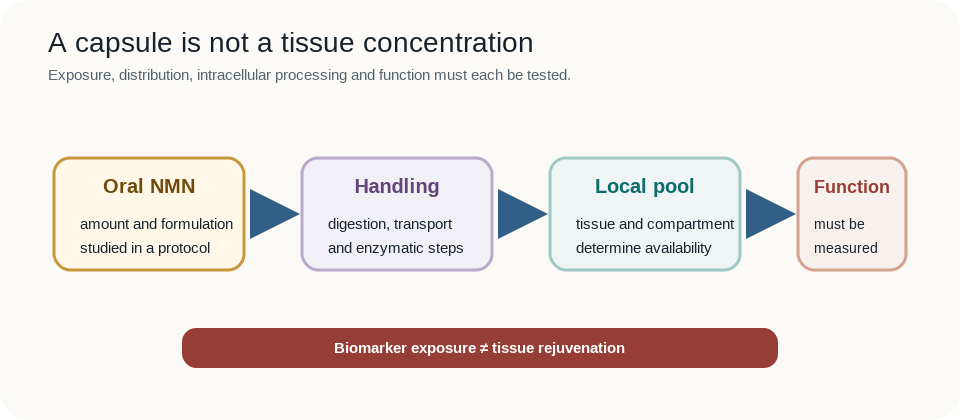
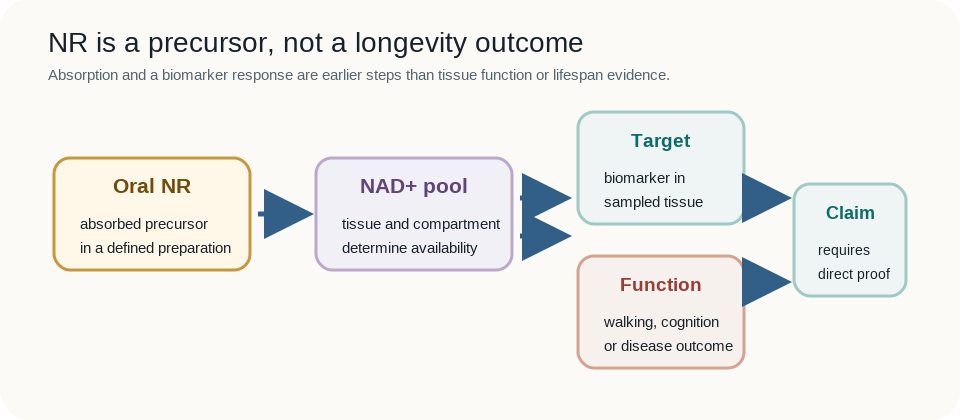
Pathway diagrams can make NMN look one step closer to NAD+ than NR. In cells, NMN can be converted to NAD+ by NMN adenylyltransferases, while NR is phosphorylated to NMN before entering that final step. But oral absorption is not a simple diagram. Enzymes in the gut, transporters, the liver, circulating metabolites and the microbiome can change what reaches tissues.
Human pharmacokinetic studies support a layered interpretation. NR can be absorbed and metabolized through the canonical salvage pathway, while NMN may be converted to NR, nicotinamide or other metabolites before or during absorption. A review of NMN metabolism describes multiple possible routes, including deamidated and microbiome-linked pathways. These routes help explain why “one step closer” does not by itself predict a larger tissue response.
The practical evidence question is therefore not which molecule looks closer on paper. It is which oral preparation, dose studied, tissue, time point and clinical endpoint were measured in humans. Different products or delivery systems should not be assumed equivalent because they share a label.
| Measurement | Reasonable conclusion | Conclusion it cannot establish alone |
|---|---|---|
| Whole-blood NAD+ | the studied intervention changed a circulating NAD-related measure | more NAD in every tissue or better aging outcomes |
| NAD metabolites | the compound was absorbed and metabolized in the measured window | long-term restoration of cellular function |
| Blood pressure or glucose | an estimate of a clinical or physiologic endpoint in a defined cohort | general benefit in healthy adults or lifespan extension |
| Strength, walking or cognition | a functional result under a particular protocol | universal anti-aging activity or survival benefit |
Does either reliably raise blood NAD+?
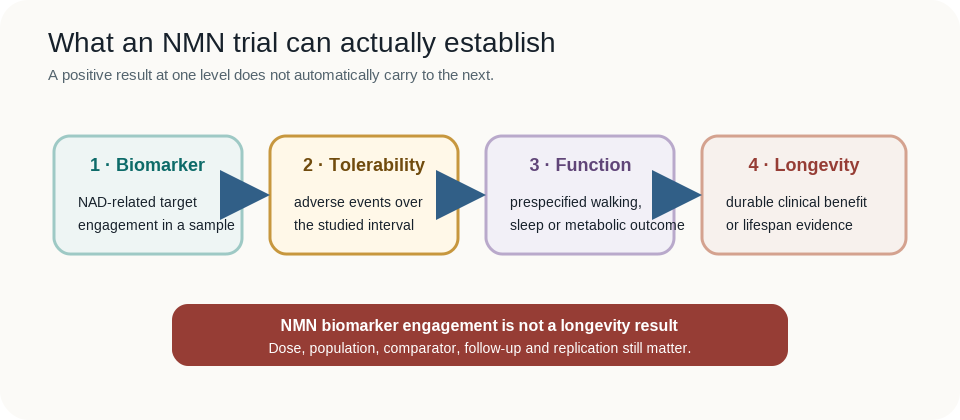
Both can raise NAD-related measurements in humans. An earlier placebo-controlled NMN trial in 30 healthy subjects used 250 mg/day for 12 weeks and reported increased whole-blood NAD+ without obvious adverse effects during the study. NR also has randomized human evidence showing that oral dosing changes the NAD metabolome and can be well tolerated over short periods. These results establish pharmacologic activity, not clinical superiority.
A 2026 randomized, open-label, placebo-controlled study enrolled 65 healthy participants and compared NR, NMN, nicotinamide and placebo for 14 days. The study reported comparable increases in circulating NAD+ with NR and NMN, while nicotinamide did not produce the same sustained pattern. The investigators also reported microbiome-linked metabolism and proposed that both compounds may increase systemic NAD through related routes. Industry affiliations are relevant when interpreting a short mechanistic study.
Even a comparable biomarker result is not a head-to-head aging trial. The study was short, the endpoint was circulating NAD+, and it did not test mortality, disability, cognition or a validated healthspan measure. It narrows the biomarker debate while leaving the clinical comparison unresolved.
Human trial depth: why NR currently leads the evidence count
NR entered human clinical research earlier and has been studied in healthy adults, older adults and several disease or risk cohorts. This does not guarantee benefit, but it gives NR a longer record of dose exploration, pharmacokinetics and adverse-event observation. A 2018 randomized crossover study reported that chronic NR supplementation was well tolerated and stimulated NAD metabolism in healthy middle-aged and older adults.
NMN has accumulated more human studies in recent years, including randomized trials focused on blood NAD, sleep, metabolism, vascular measures and physical performance. A 2026 systematic review of 15 randomized trials evaluated oral NMN or related preparations. Doses ranged from 250 to 2,000 mg/day and durations from 14 days to 24 weeks. The review found no clear increase in overall, serious or withdrawal-related adverse events and no significant broad improvements in body weight, fasting glucose, HbA1c, lipids or systolic blood pressure.
The NMN safety result is useful but time-limited. Absence of a short-term safety signal is not proof of indefinite safety, and a meta-analysis cannot remove limitations in the underlying trials. Product formulation, participant selection, follow-up and reporting quality still matter.
What the 2025 Nature Metabolism review concluded
The 2025 Nature Metabolism review is a useful anchor because it evaluates the human clinical evidence rather than repeating the preclinical promise. It concluded that human trials of NAD+ precursors have shown limited efficacy, that consistent age-related declines in human NAD have been observed in only a limited number of studies, and that tissue-specific metabolism remains poorly defined.
That conclusion does not say that NMN or NR do nothing. It says that a strong biological rationale has not yet translated into a reliable, broad clinical effect. The review also warns against straightforward extrapolation from rodents to humans. Rodent dose, tissue distribution and disease models are not interchangeable with an oral supplement used by a healthy adult.
The sirtuins and aging page explains another common overreach. NAD availability may influence NAD-dependent enzymes, but a pathway connection does not demonstrate that supplementing a precursor restores all age-related enzyme activity or prevents disease.
What the 2026 PRISMA review adds
A 2026 PRISMA-guided systematic review identified 113 eligible intervention studies published from 2010 through October 2025: 33 human studies, including 28 randomized and five nonrandomized interventions, alongside 80 rodent studies. The human and animal evidence therefore remains very different in both scale and outcome relevance. One nonrandomized intravenous NMN study contributed mainly short-term safety and biomarker information; parenteral NAD-related evidence should not be treated as equivalent to oral NMN or NR.
A review that counts studies is not the same as a review that proves efficacy. Human trials may differ in age, health, dose, formulation, duration and outcome. Some are powered for a biomarker, not for function or clinical events. The correct synthesis is that the research base is active and increasingly human, but still not decisive for healthy aging.
NR’s larger evidence history is an advantage for confidence about what has been studied. It is not a license to claim that NR improves lifespan. NMN’s growing evidence base is encouraging for research and short-term tolerability, but it is not a reason to infer that a newer compound is more youthful or more potent in every tissue.
Muscle and physical-function outcomes
Muscle is one of the most relevant places to test an NAD precursor because age-related loss of strength and mobility matters to independence. A 2025 systematic review and meta-analysis specifically synthesized NMN and NR trials in adults with a mean age over 60. NMN did not significantly improve skeletal-muscle index, handgrip strength, gait speed or the five-time chair-stand test. Narrative results for other measures were heterogeneous. NR showed a longer six-minute walk distance in a peripheral-artery-disease population, but other groups had less favorable physical-function findings.
The authors concluded that current evidence does not support NMN or NR for preserving muscle mass and function in older adults. That is a narrower and more useful conclusion than saying the compounds are “anti-aging failures.” Trials may be too small, too short or not targeted to people with a baseline NAD-related deficit. But until better studies show a reproducible functional effect, a biomarker change should not be used as a substitute.
For readers interested in muscle health, compare this evidence with the stronger, function-focused creatine literature in the older-adult creatine review. The comparison is not about declaring creatine universally superior; it shows the value of measuring an outcome people can experience.
| Question | NMN | NR | Current interpretation |
|---|---|---|---|
| Raises NAD-related biomarkers? | yes in several short trials | yes in several short trials | shared pharmacologic signal |
| Preserves older-adult muscle? | no consistent pooled benefit | no consistent pooled benefit | not established |
| Improves hypertension? | broad benefit not shown in NMN synthesis | NR plus exercise pilot was not superior for daytime systolic BP | research-stage and cohort-specific |
| Long-term healthspan? | not demonstrated | not demonstrated | no validated winner |
| Extends human lifespan? | no evidence | no evidence | neither qualifies |
Glucose, blood pressure and vascular signals
Metabolic and vascular outcomes have produced hints rather than a stable pattern. In the 2026 NMN meta-analysis, broad measures such as fasting glucose, HbA1c, lipids and systolic blood pressure did not improve significantly. Diastolic blood pressure decreased slightly and HOMA-IR showed a non-significant downward trend, signals that may justify more targeted trials.
A 2025 pilot randomized trial studied 54 sedentary adults aged 55 or older with elevated daytime blood pressure. Participants received 1,000 mg/day NR with supervised walking, placebo with the same exercise or NR alone for six weeks. NR plus exercise was not superior to placebo plus exercise for daytime systolic pressure. A post hoc subgroup without antihypertensive medication showed a trend toward lower nighttime pressure, but that finding needs confirmation.
These studies illustrate why disease cohorts and post hoc subgroups must be labeled. A signal in people with hypertension is not a general healthy-aging result, and a trend is not a confirmed treatment effect. Neither NMN nor NR should replace prescribed blood-pressure or diabetes care.
Cognition and neurological outcomes
NAD biology is relevant to neurons, mitochondrial function and cellular stress, so cognition is a plausible research target. Human evidence, however, remains thin and mixed. A small or short study may detect a change in a cognitive task without showing protection from dementia or slower decline. Disease cohorts also differ from healthy older adults in baseline biology, medication, functional status and risk.
The 2025 human-aging review’s overall conclusion of limited clinical efficacy applies here. The absence of a convincing clinical cognition result does not disprove the mechanism; it means the intervention has not yet met the evidence standard. Trials need prespecified cognitive outcomes, objective exposure measures, adequate duration and transparent handling of multiple comparisons.
Intravenous NAD+ protocols, animal brain studies and oral NMN or NR trials should remain separate evidence categories. A result from one route or species cannot be silently transferred to another route, dose or population.
Safety, duration and product-quality limits
Short-term oral NMN and NR trials generally report tolerability, but the safety record is not the same as a long-term outcome record. The 2026 NMN meta-analysis included durations as short as 14 days and no longer than 24 weeks. Many commercial users imagine years of use; the evidence base often observes months. That gap should be stated plainly.
Safety also depends on the product. Research preparations have defined identity, strength and stability. Marketplace products may differ in purity, formulation, storage and dose. A label that says “NAD booster” does not show that the product matches a trial preparation. Independent quality testing can help with manufacturing and label verification, but it cannot guarantee clinical efficacy.
People with cancer, liver disease, kidney disease, pregnancy, a planned procedure or a complex medication list should obtain appropriate clinical advice. Do not stop a prescribed treatment because a supplement raises a biomarker. The supplements hub provides the broader safety and evidence framework.
Why there is no validated longevity dose
A dose can be validated only for a defined outcome, population, preparation and follow-up. NMN trials have used a wide range of doses and durations, while NR trials have done the same across different goals. A dose that raises blood NAD for two weeks is not automatically a dose that improves muscle over a year, and neither is a proven dose for survival.
Loading strategies, split dosing, sublingual products and combination formulas add more variables. A 2026 pharmacokinetic study comparing sublingual with oral NMN in 14 healthy men found faster increases in terminal metabolites with the sublingual route, but no significant difference in blood NMN, nicotinamide or NAD+ concentrations during the measured window. That is a route-of-administration result, not proof of better aging outcomes.
Readers should therefore treat doses as doses studied. The appropriate clinical question is whether a particular person has a defined indication, what risks apply, and which outcome will be monitored. A larger number on a label does not solve the evidence gap.
Are there direct NMN-versus-NR trials?
Yes, direct human comparisons now exist at the level of short-term pharmacology. The 2026 study comparing 1 g/day NR and NMN for 14 days reported comparable increases in circulating NAD+. That is important because it is more informative than comparing separate studies with different populations and laboratory methods.
It is not, however, a robust head-to-head comparison of aging outcomes. There is no convincing direct trial showing that NMN or NR is superior for muscle preservation, cognition, metabolic health, disability, disease prevention or lifespan. The study’s open-label design, short duration, biomarker endpoint and industry affiliations further limit how far the result can be generalized.
Future head-to-head trials should randomize enough participants, match purity and dose, stratify baseline NAD status, measure relevant tissues where feasible, prespecify clinical endpoints, follow participants long enough and report adverse events and funding clearly. Until then, “NMN is closer to NAD” or “NR has more research” are incomplete answers rather than clinical verdicts.
Evidence verdict: which has better human evidence?
NR has better-established human evidence in the sense of trial history. It has been studied for longer across more settings, so the evidence base for pharmacokinetics and short-term tolerability is deeper. NMN is no longer a purely preclinical idea: randomized human trials and a 2026 safety meta-analysis provide a growing short-term record.
Neither has better evidence for extending life. Both can raise NAD-related biomarkers, and the newest direct comparison suggests similar short-term circulating NAD changes. But the muscle meta-analysis did not support preserving muscle mass and function in older adults, the NMN safety synthesis found no broad metabolic benefit, and the NR exercise pilot did not improve daytime systolic blood pressure beyond placebo plus exercise.
The most honest current conclusion is therefore conditional: choose neither as a proven longevity intervention. If someone is evaluating a compound for a research or clinical question, the decision should be based on the defined endpoint, studied population, product quality, duration and safety context—not on a pathway diagram or a single biomarker result.
- Use NR’s longer trial history as a confidence advantage, not as proof of anti-aging efficacy.
- Read NMN’s newer safety data as short-term reassurance, not a long-term guarantee.
- Treat comparable blood NAD increases as a pharmacology finding, not a healthspan result.
- Keep human oral studies separate from animal, intravenous and mechanistic evidence.
- Re-rank both compounds if a well-powered, long-duration head-to-head clinical trial changes the outcome picture.