What question did the researchers ask?
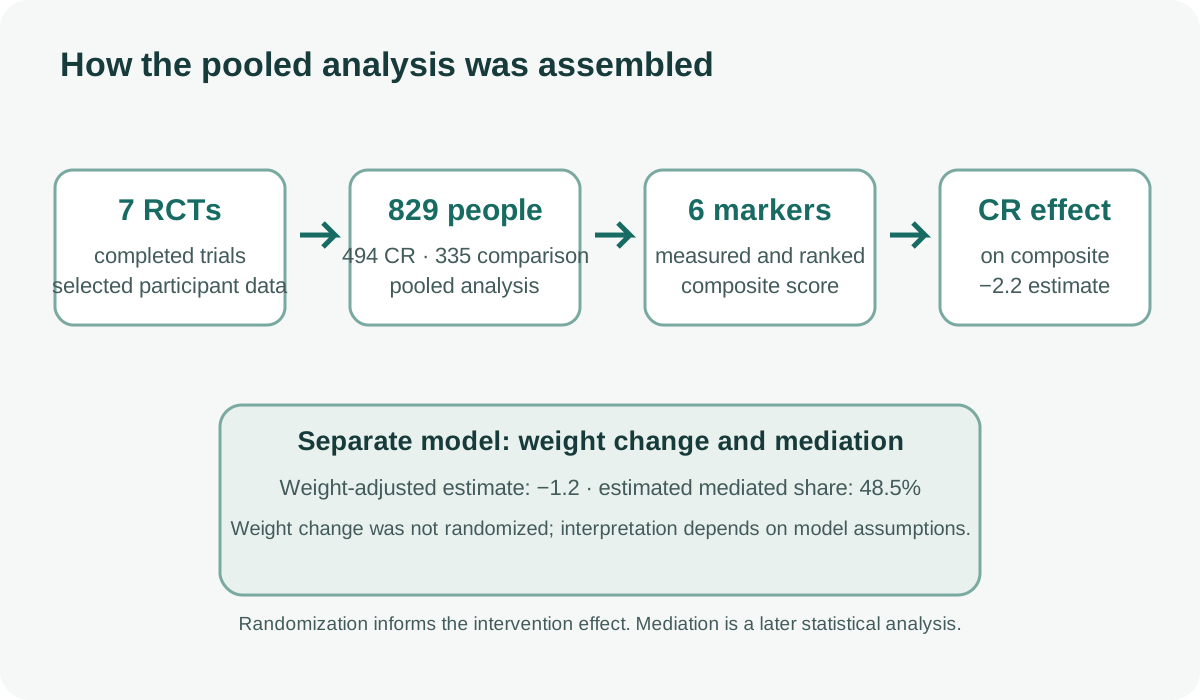
The investigators asked whether assignment to caloric restriction (CR) changed a composite blood-biomarker profile across seven randomized trials in older adults, and how much of that association was statistically related to weight change. The analysis used biospecimens and participant data from completed trials. It was not a new trial in which the research team assigned a fresh group of volunteers to one standardized calorie target.
Pooling randomized trials can be stronger than comparing people who chose different diets: random assignment supports a causal estimate for the intervention as delivered within those trials. But the pooled analysis is still a secondary analysis of selected samples. Trial eligibility, interventions, control conditions, exercise components, duration and biomarker measurements differed. A pooled estimate summarizes that evidence; it does not erase the differences.
The seven trials included adults generally selected because they were older and had overweight or obesity. Across the pooled sample, mean age was 67.5 years, about two-thirds were women, and most participants were White. Mean BMI within contributing studies ranged from about 30 to 36. The sample therefore does not represent all older adults, particularly people who are underweight, frail, malnourished or living with other conditions that make weight loss unsafe.
For related context on how these measures differ from clinical outcomes, see our biomarker overview, inflammaging review, biological-aging clock review, muscle-aging guide and 2026 research tracker.
What is in the six-marker composite?
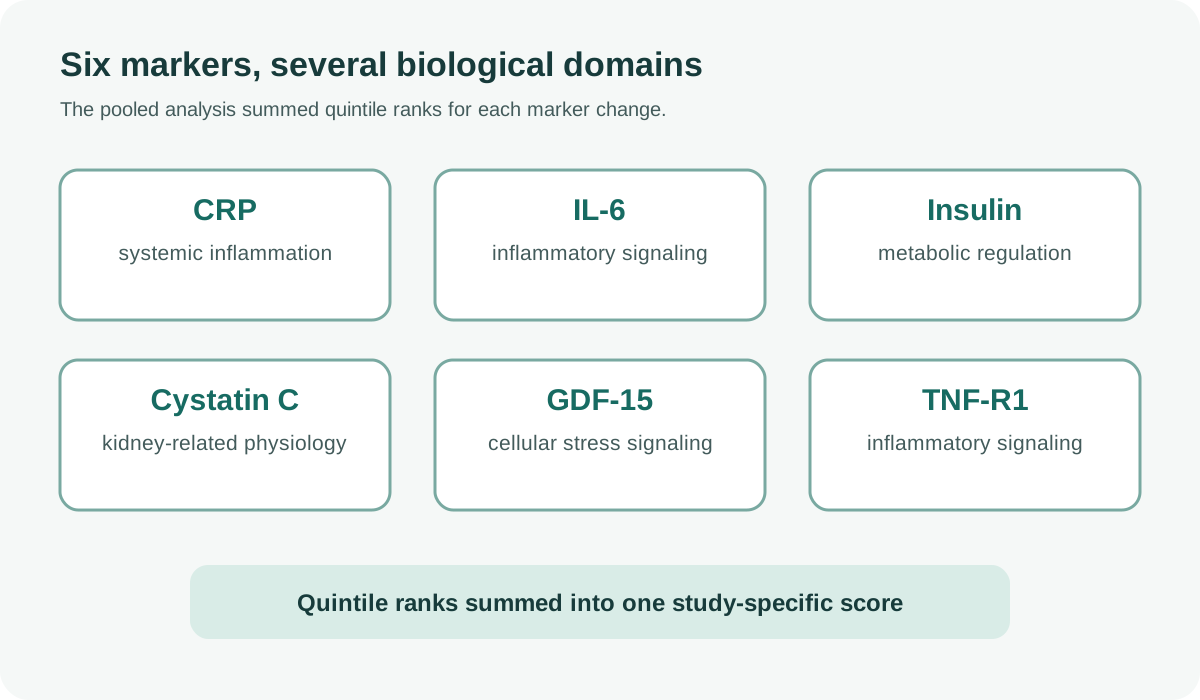
The index combines changes in C-reactive protein (CRP), interleukin-6 (IL-6), cystatin C, insulin, growth differentiation factor 15 (GDF-15) and tumor necrosis factor receptor 1 (TNF-R1). These markers relate to inflammation, metabolism, kidney-related physiology and cellular stress. They do not all represent the same process, and a movement in one marker can have a different interpretation from a movement in another.
Rather than report the combined outcome as “years younger,” the researchers converted each biomarker’s change into a quintile rank and summed the six ranks. The score is therefore a study-specific way to summarize direction and relative position of biomarker changes. It is not a calendar-age estimate, a diagnostic threshold or a commercial test with established clinical meaning.
| Marker | Broad domain | Interpretation limit |
|---|---|---|
| CRP | Systemic inflammation | Can change with infection, adiposity and other conditions |
| IL-6 | Inflammatory signaling | Not specific to aging or to one tissue |
| Cystatin C | Kidney filtration-related marker | Can reflect kidney physiology and other factors |
| Insulin | Metabolic regulation | Depends on measurement conditions and metabolic context |
| GDF-15 | Cellular stress and systemic signaling | Can rise in many diseases and stress states |
| TNF-R1 | Inflammatory signaling | Does not identify one cause or organ-level aging process |
A composite can reduce reliance on any single marker and may make an intervention response easier to detect. But the formula, marker selection, assay comparability and weighting determine what the score represents. A composite is not automatically more clinically meaningful simply because it contains several measurements.
What changed in the pooled analysis?
The paper reported an overall CR assignment estimate of −2.2 points on the quintile-sum index before weight change was included in the model. After adjustment for weight change, the estimate was −1.2 points, with a 95% confidence interval from −2.0 to −0.3. Both are estimates on the study’s composite scale, not years of biological age.
CR groups lost more weight on average than comparison groups across the contributing studies. In the pooled analysis, the reported mean weight change was −7.9 kg in CR groups and −1.2 kg in non-CR groups; intervention durations varied. CRP, IL-6 and insulin showed clearer patterns than some other components. Cystatin C and GDF-15 varied more between trials, and the paper notes heterogeneity for these markers. The component results caution against treating the composite as if all six biomarkers moved uniformly.
The team also estimated that 48.5% of the CR effect on the composite was mediated through weight loss, with a 95% confidence interval of 22.6% to 82.2%. That interval is broad. The estimate describes a model-based partition of the observed relationship under stated assumptions; it is not a direct measurement showing that exactly half of an anti-aging effect came from weight loss.
| Analysis result | Reported estimate | Safe interpretation |
|---|---|---|
| CR assignment before weight adjustment | −2.2 composite points | Assignment was associated with a more favorable score in the pooled sample |
| CR assignment after weight adjustment | −1.2 points (95% CI −2.0 to −0.3) | Residual association after including weight change in the model |
| Estimated share mediated by weight loss | 48.5% (95% CI 22.6% to 82.2%) | Model-dependent mediation estimate, not a measured biological mechanism |
| Clinical outcome validation | Not tested in this analysis | No inference about disability, disease incidence or lifespan |
Why “48.5% mediated” is not proof of a separate longevity pathway
Randomization can help estimate the effect of assignment to CR on an outcome. Weight change, however, was not separately randomized. Mediation analysis asks how the relationship between assignment and the biomarker outcome may be statistically partitioned through a mediator. Its causal interpretation relies on assumptions, including no important unmeasured confounding between the mediator and outcome after accounting for the model.
Weight change and CR assignment were strongly related in this dataset. Including both in one model changes what each coefficient represents and can attenuate both estimates because they explain overlapping variation. The residual CR coefficient does not name the pathway responsible for the remaining association. The study did not directly test AMPK, mTOR, sirtuins or another proposed mechanism as the explanation for that residual.
There are also practical analysis limits. The trials came from one research network, sample selection was required because not every participant had all measurements, and one contributing study’s mediation result did not converge because of its small sample. The authors used imputation and sensitivity analysis, but those tools do not turn an observational mediator into a randomized exposure. Their sensitivity analysis adjusting for exercise modality in three trials did not materially change the main findings; exercise and trial heterogeneity still belong in the interpretation.
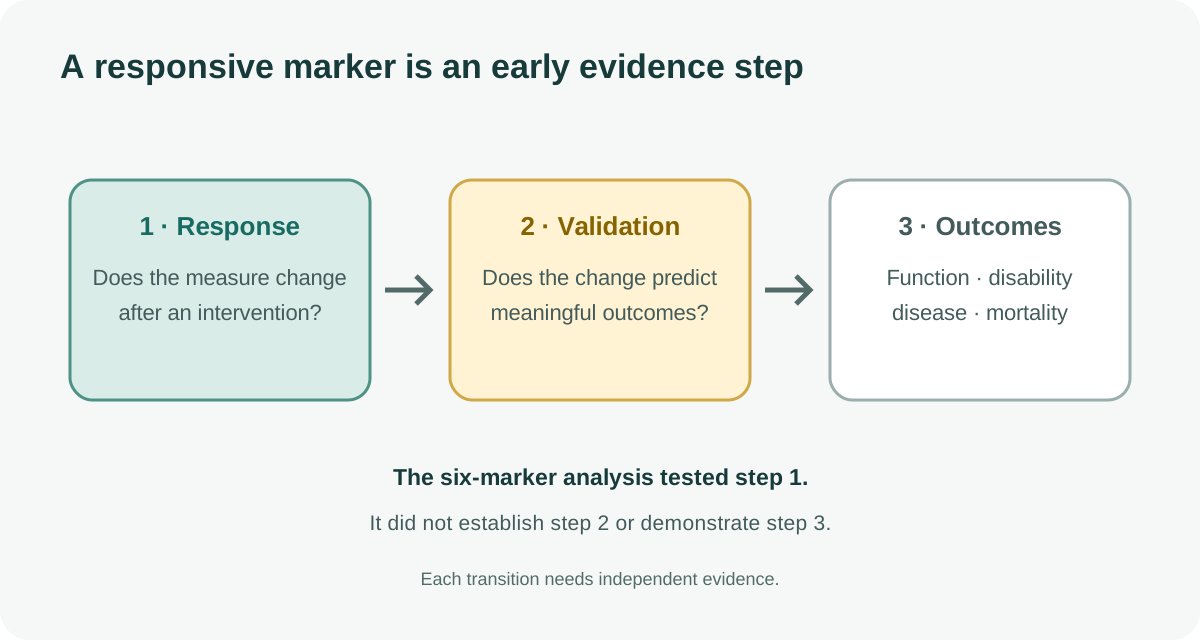
Biomarker response is not surrogate validation
A biomarker is a surrogate endpoint only when evidence shows that intervention-related change in that marker reliably predicts change in a meaningful clinical outcome in the relevant context. This pooled analysis tested response of the composite to an intervention. It did not test whether a lower score predicts fewer heart attacks, less disability, preserved mobility, delayed dementia or longer life.
A separate 2026 analysis of a subset of 185 CALERIE participants reported changes in organ-specific biological-age measures after two years of caloric restriction. That report used different measures and participants than the seven-trial six-marker analysis discussed here. It adds to research showing that biomarker-based measures can respond to interventions; it does not validate this particular quintile-sum score or show that either biomarker change predicts a clinical benefit.
That distinction is central to geroscience. A measure can be biologically plausible, statistically responsive and useful for selecting questions for future trials while remaining unvalidated as a substitute for health outcomes. The next step is not to rename the score “biological age” and apply it to individuals; it is to test whether the measure replicates in independent populations and predicts later function, disease or survival. Such validation should be prespecified and tested in trials that also track patient-important outcomes.
Safety and generalizability
These trials studied planned weight-loss interventions in older adults generally selected for overweight or obesity; the pooled analysis does not establish a universal calorie target. Intentional weight loss can have different benefits and risks depending on body composition, nutritional status, strength, bone health, illness, medications and personal history. For older adults, preserving muscle and function matters alongside weight and biomarker changes.
People who are frail, underweight, losing weight unintentionally, recovering from illness, managing an eating disorder or at risk of malnutrition need individualized clinical assessment rather than a longevity-driven restriction plan. The study was not designed to advise these groups. No reader should infer a daily intake target from a pooled biomarker estimate.
A small 2026 pilot in older adults with overweight or obesity compared in-person CR, remote CR and time-restricted eating to inform a future definitive trial. It focused on feasibility and short-term health measures, not validation of the six-marker composite. Related trials can inform safety and implementation but answer different questions from whether a biomarker is a valid surrogate.
What future studies need to show
- Replicate the index and its direction in independent, more diverse trial populations.
- Predefine assays, component handling, score construction and missing-data methods before analyzing outcomes.
- Measure function and safety alongside the composite, including lean mass, strength, bone health and nutritional status.
- Test whether intervention-related score changes predict later disability, disease events or mortality.
- Compare the index with other aging measures without assuming they measure one shared construct.
The 2026 pooled analysis provides evidence that assignment to CR can shift a selected composite profile in these study settings. Its most defensible contribution is a stronger intervention-response signal and a testable hypothesis about weight change. Whether this response represents a slower human aging trajectory remains an open research question.