What NAD+ is—and what it is not
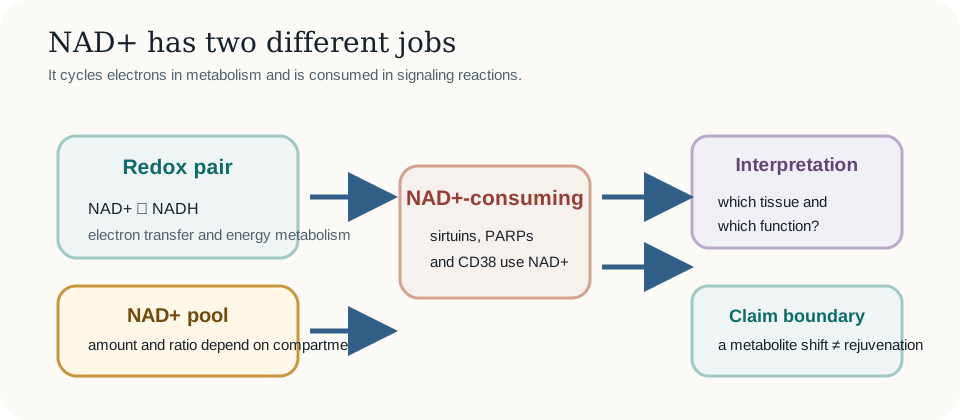
Nicotinamide adenine dinucleotide in its oxidized form, NAD+, is a coenzyme involved in electron transfer and many metabolic reactions. Its reduced form, NADH, carries reducing equivalents. NADP+ and NADPH are related phosphorylated forms used in biosynthesis, antioxidant defense and redox balance. These molecules are connected, but they are not interchangeable labels for a supplement or a clinical effect.
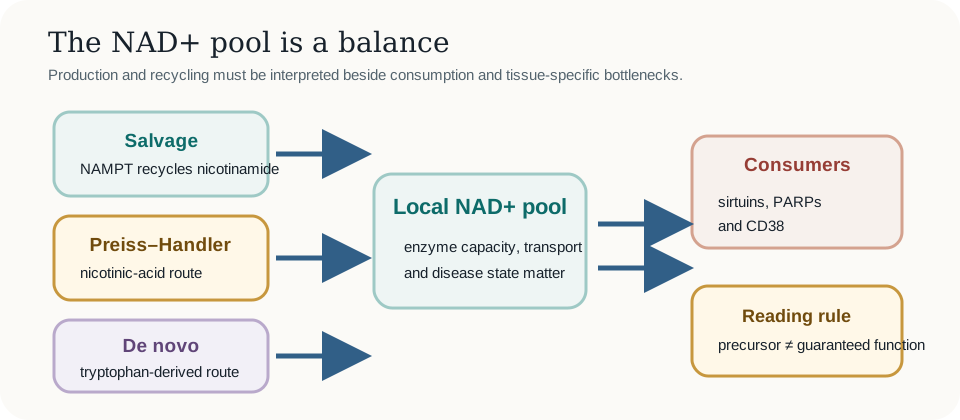
NAD+ is also a substrate for enzymes including sirtuins and poly(ADP-ribose) polymerases. CD38 and other enzymes consume NAD-related molecules. This creates a dynamic system rather than a fixed tank that can simply be topped up. Demand, production, tissue compartment, inflammation, exercise, diet and disease can all affect the measured level.
The NAD metabolism and aging overview explains the pathway in more detail. This page focuses on what human interventions have actually demonstrated and where marketing language runs ahead of evidence.
Why NAD+ became a longevity target
Preclinical aging research links NAD metabolism to mitochondrial function, DNA-damage responses, inflammatory signaling and cellular stress. In rodents, changing NAD-related pathways can influence phenotypes such as metabolic dysfunction or tissue injury. Those findings provide a rationale for human research, but rodents and humans differ in dose, metabolism, tissue distribution, disease context and lifespan biology.
Another problem is that “NAD decline with age” is not a universal human fact established across every tissue. The 2025 Nature Metabolism review concluded that consistent age-related declines in human NAD have been observed in a limited number of studies and that human clinical trials have shown limited efficacy despite strong preclinical rationale.
That is a productive scientific position. It keeps NAD+ important enough to study while resisting the shortcut from a pathway hypothesis to an anti-aging claim. The sirtuins and aging page covers a similar boundary: enzyme relevance does not prove that an over-the-counter booster restores youthful physiology.
NAD salvage and precursor biology
Cells can make NAD+ through several routes, including salvage from nicotinamide, de novo synthesis from tryptophan, and pathways involving nicotinic acid and NR. NMN can be converted into NAD+ by NMN adenylyltransferases, while NR is phosphorylated to NMN before that final step. Oral handling adds another layer: gut enzymes, transporters, liver metabolism and microbial conversion influence what reaches blood and tissues.
This is why a pathway diagram cannot decide which supplement is best. The molecule measured in a capsule may not be the molecule that enters a target cell. A formulation can change dissolution, exposure and metabolite patterns without proving a better clinical outcome.
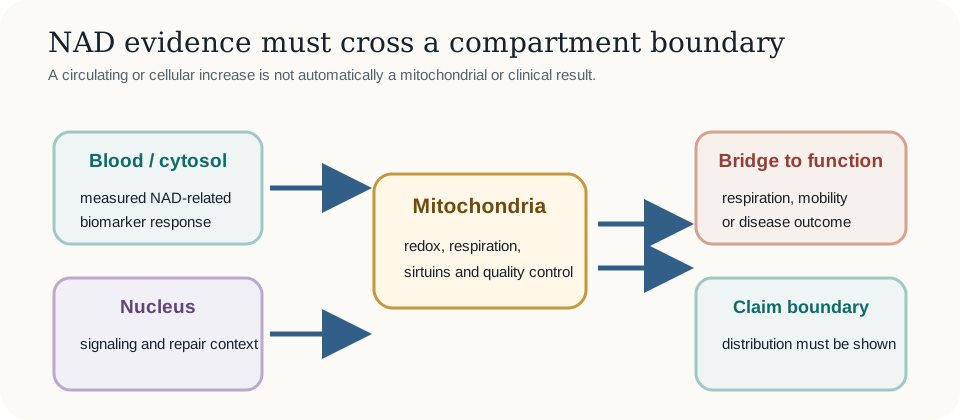
Human studies often measure whole-blood NAD, plasma NAD, peripheral-blood mononuclear-cell metabolites or downstream catabolites. Each matrix answers a different question. Plasma is not the same compartment as red blood cells, muscle, brain or liver.
| Intervention | What human studies can show | What remains unproven |
|---|---|---|
| Direct oral NAD+ | formulation-specific absorption, intracellular or metabolite changes | class-wide effects across ordinary products or long-term aging |
| NMN | short-term changes in NAD-related measures and tolerability in selected trials | preserving function, preventing disease or extending life |
| NR | longer human trial record and changes in NAD metabolism | a validated healthspan or lifespan benefit |
| Niacin / nicotinamide | nutritional and pharmacologic effects in defined settings | equivalence to NMN, NR or direct NAD+ products |
| IV NAD+ | short-term exposure and tolerability signals in small or commercial studies | anti-aging efficacy or a validated infusion protocol |
What the 2026 PRISMA review found
A 2026 PRISMA-guided review mapped 113 eligible NAD-related intervention studies published from 2010 through October 2025. Thirty-three were human interventions, including 28 randomized and five nonrandomized studies; 80 were rodent studies. Human evidence was most often about precursor-based interventions and biomarkers rather than direct NAD+ products and survival.
The review synthesized outcomes narratively because interventions, populations and endpoints were too heterogeneous for a single clinical effect estimate. Many human studies reported increases in NAD-related metabolites in blood-derived matrices, consistent with target engagement. Tissue-level responses were more variable, and the review did not establish broad improvements in function, cognition, metabolic health or longevity.
The review found that the eligible human evidence for parenteral NAD+ anti-aging or wellness efficacy was especially limited. One nonrandomized intravenous NMN study contributed short-term safety and biomarker information, but that is not evidence that an IV wellness protocol extends healthspan.
What human NR studies show
NR has the longer human trial record among the two major newer precursors. Short randomized studies in healthy middle-aged and older adults have reported increased NAD-related metabolites and generally favorable short-term tolerability. That gives NR a deeper pharmacokinetic and safety history, not a demonstrated anti-aging outcome.
Recent clinical evidence remains mixed. A 2025 pilot trial enrolled 54 sedentary adults aged 55 or older with elevated daytime blood pressure and compared 1,000 mg/day NR plus supervised walking with placebo plus the same exercise, or NR alone, for six weeks. NR plus exercise was not superior to placebo plus exercise for daytime systolic blood pressure. A subgroup trend in participants not taking antihypertensive medication was exploratory.
A 2025 meta-analysis of NMN and NR for skeletal muscle in adults with a mean age over 60 did not support either precursor for preserving muscle mass and function. It found no consistent NMN effect on skeletal-muscle index, handgrip strength, gait speed or five-time chair stand. A signal for longer six-minute walking distance appeared in a peripheral-artery-disease population receiving NR, but disease-specific results should not be generalized to healthy older adults.
See the NR evidence review for the longer trial record and its endpoint limits.
What human NMN studies show
NMN has a growing short-term randomized evidence base. A placebo-controlled trial in 30 healthy subjects used 250 mg/day for 12 weeks and reported increased whole-blood NAD+ without obvious adverse effects during the study. Such a result supports a biochemical response under that protocol; it does not show that every product, tissue or population responds the same way.
A 2026 systematic review and meta-analysis included 15 randomized trials of oral NMN or NMN-related preparations. Doses ranged from 250 to 2,000 mg/day and durations from 14 days to 24 weeks. The review found no significant increase in overall, serious or withdrawal-related adverse events and no broad significant effects on body weight, fasting glucose, HbA1c, lipid profiles or systolic blood pressure. Diastolic blood pressure decreased slightly, while HOMA-IR showed a non-significant downward trend.
These findings are best described as short-term tolerability with limited evidence of broad metabolic benefit. They do not validate a longevity dose, prove tissue rejuvenation or establish that NMN is better than NR. The NMN evidence page records the compound-specific data.
Direct oral NAD+: the 2026 LNAD+ Phase 0/1b study
The direct-NAD landscape changed slightly with a 2026 GeroScience report from the RENEWAL-NAD+ study. It was a double-blind, randomized, placebo-controlled Phase 0/1b trial in healthy adults aged 45 to 75. Sixty participants were randomized and the primary analysis included 50. The study evaluated five days of a proprietary oral LathMized NAD+ formulation, called LNAD+.
The primary pharmacodynamic measures were intracellular NAD in whole blood and circulating NAD in separated plasma. At day 6, whole-blood intracellular NAD was about 53% higher relative to placebo, with a very small P value and a large standardized effect. Plasma NAD did not change significantly. Downstream catabolites such as MeNAM and 2PY also rose, consistent with active metabolism.
The compartment difference is scientifically interesting. It suggests that the formulation affected the measured intracellular blood compartment without producing the same plasma signal. But whole blood was driven primarily by red-blood-cell measurements; that is not the same as direct evidence of increased NAD in skeletal muscle, brain, liver or every tissue relevant to aging.
The study reported favorable short-term tolerability, with symptom incidence comparable between groups and one mild nausea event in the LNAD+ arm. No secondary clinical, vital-sign, wellbeing or wearable endpoint survived multiplicity correction. The trial was also retrospectively registered, and the formulation and study involve commercial affiliations. These facts do not invalidate the biomarker result; they define its scope.
| Observed finding | Defensible interpretation | Overreach to avoid |
|---|---|---|
| 53% higher whole-blood intracellular NAD | short-term formulation-specific target engagement | all tissues became younger or healthier |
| No significant plasma NAD rise | different blood compartments behaved differently | the product failed or proved superior overall |
| Catabolites increased | downstream NAD metabolism was engaged | metabolic flux equals clinical benefit |
| Secondary endpoints null after correction | no confirmed short-term clinical signal in those measures | the formulation improves wellbeing or longevity |
| Five-day study | acute pharmacology and tolerability evidence | long-term safety or geroprotection |
Why a proprietary formulation cannot establish a class effect
LNAD+ is not simply interchangeable with every product labeled NAD+. The formulation was designed to alter the molecule’s supramolecular organization and solution behavior, and the study used a specific oral powder under a defined protocol. A different direct-NAD product may dissolve differently, degrade differently or produce another exposure pattern.
Product-specific evidence can be valuable if the product identity, dose, assay and funding are clear. It becomes misleading when a result from one proprietary preparation is used to market an entire category. The appropriate next steps are independent replication, matched formulation testing, tissue-relevant measurements and longer follow-up.
The 2026 NAD review tracker should record direct-NAD studies separately from the larger NMN and NR literature. A proprietary biomarker result is a research signal, not a universal recommendation.
Plasma NAD, intracellular NAD and clinical outcomes
Measurement compartment matters because NAD+ is intracellular and because whole blood contains multiple cell types. Plasma NAD can reflect release, breakdown or circulating chemistry; whole-blood NAD may be strongly influenced by red blood cells; PBMC measures sample a smaller immune-cell compartment. None automatically represents muscle or brain.
Clinical outcomes sit farther downstream. A person may have a biomarker change without improved exercise tolerance, blood pressure, glucose control, cognition, symptoms or independence. Conversely, a medicine can improve a clinical outcome through several pathways without changing a particular clock or NAD measure. Both directions are possible.
A good trial therefore prespecifies the biomarker and the clinical endpoint, measures baseline status, controls multiple testing and reports adverse events. It should also test whether biomarker change mediates outcome change rather than merely occurring alongside it.
IV NAD+ and wellness-infusion evidence gap
IV NAD+ is often marketed as a way to bypass digestion and deliver the molecule directly. The route can change exposure, but bypassing the gut does not prove entry into target tissues or clinical benefit. A 2026 critical review concluded that IV longevity therapy is supported mainly by preclinical data, small clinical series and disease-specific or aesthetic contexts, with scarce placebo-controlled aging trials and heterogeneous protocols.
A retrospective commercial-setting study compared four consecutive days of 500 mg NAD+ IV or NR IV. It reported different infusion tolerability patterns, including moderate to severe gastrointestinal symptoms, increased heart rate and chest pressure in the NAD+ IV group, with longer average infusion times. Because it was retrospective and commercial, it is preliminary safety information, not efficacy evidence.
The 2026 PRISMA review found no eligible outcomes trials supporting clinical anti-aging efficacy of IV or intramuscular NAD+ itself. A small infusion can change plasma or urine metabolites for hours without showing longer-term improvements in health. Do not treat IV protocols, oral precursors and proprietary oral direct-NAD products as one intervention.
Exercise, sleep and metabolic health are NAD-related physiology
Exercise can influence NAD metabolism, mitochondrial function, insulin sensitivity and vascular health. Sleep, diet, body composition and disease control also affect the physiology that NAD studies measure. These are not proof that exercise or sleep works by “boosting NAD” in a way that justifies a supplement claim. They are broader health interventions with outcomes that can be assessed directly.
This distinction matters commercially. A supplement company may use a plausible pathway to imply that the capsule reproduces the effects of training or weight loss. Human trials do not support that equivalence. A precursor study should be compared with placebo and, where relevant, with the background exercise or clinical care rather than with doing nothing.
What evidence would establish meaningful geroprotection?
A meaningful geroprotection claim would require a prospectively powered human trial with a defined population, a reproducible intervention, long enough follow-up and patient-important endpoints. Biomarkers can be included, but the study should show that the biomarker change predicts functional or clinical benefit across independent studies.
For NAD-related interventions, that means separating direct NAD+ from NMN, NR, niacin and IV administration; measuring the relevant compartment; reporting product identity and conflicts; and testing outcomes such as physical function, disease events, quality of life or validated cognitive change. A blood NAD rise alone is not sufficient.
The longevity clinical-trials overview explains why registration, prespecified outcomes and transparent follow-up matter. The apigenin evidence page is another reminder that pathway combinations remain preclinical unless human outcomes are actually measured.
- Define the target outcome before selecting a NAD-related intervention.
- Match the formulation, route, dose studied, assay and population to the claim.
- Require replication and clinical endpoints before calling a biomarker result geroprotection.
Evidence verdict: important biology, incomplete clinical translation
NAD+ deserves serious study because it is central to cellular metabolism and intersects with multiple aging-related pathways. Human studies show that NR, NMN and some direct formulations can alter NAD-related metabolites or intracellular blood measures. That is evidence of pharmacology, not proof that the interventions slow aging in the clinically meaningful sense.
NR currently has the longer human trial history, NMN has a growing short-term randomized record, and the 2026 LNAD+ trial adds formulation-specific direct-NAD evidence. The human muscle and metabolic results remain mixed or null in important syntheses. IV NAD+ wellness claims remain especially under-supported. No NAD-related supplement or infusion has shown human lifespan extension.
The responsible conclusion is target engagement without established geroprotection. Keep NAD+, NMN, NR, niacin and IV infusion evidence separate, treat doses as doses studied rather than prescriptions, and re-evaluate the field when larger prospective trials report durable clinical outcomes.
- Read a blood NAD result as a biomarker result.
- Read a clinical outcome in its actual population and indication.
- Do not infer rejuvenation, disease prevention or longer life from either one alone.