Supplements and molecules · evidence reviewed September 2026
What creatine is and how the phosphocreatine system works
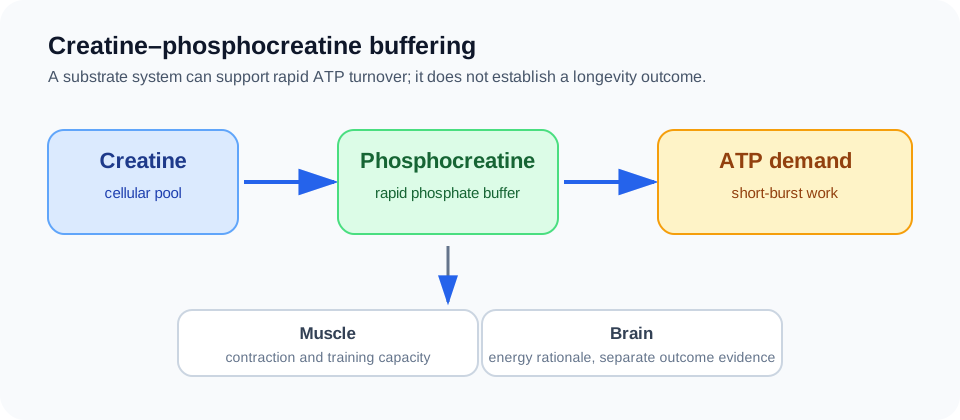
Creatine is a small nitrogen-containing compound made from amino acids and obtained from food. Inside cells, creatine can be converted to phosphocreatine, which helps buffer the rapid demand for ATP. The creatine kinase system transfers high-energy phosphate groups between phosphocreatine and ADP, helping tissues manage short bursts of energy use.
Muscle contains a large creatine pool because contraction can require rapid ATP regeneration. The brain also uses creatine, although brain uptake, synthesis and response may differ from muscle. A supplement can increase creatine availability without guaranteeing that every tissue becomes functionally improved.
Most clinical evidence concerns creatine monohydrate. Novel forms may have different solubility or marketing claims, but they should not be assumed equivalent unless they have comparable human evidence. This page uses “creatine” primarily in the context of studied creatine monohydrate.
Why creatine may matter more with aging
Aging is accompanied by changes in muscle mass, strength, power, activity, diet and recovery. These changes are not identical, but together they can reduce reserve for climbing stairs, rising from a chair, carrying objects or recovering from illness. Creatine is relevant because it can support the energy demands of high-intensity muscle work and may help training adaptations.
A lower muscle creatine pool can reflect lower intake of animal foods, less muscle tissue, altered synthesis or other factors. It should not be treated as a universal deficiency. The intervention question is whether adding creatine to a defined program improves an outcome that matters, such as lean tissue, strength or function.
These are healthspan questions rather than lifespan questions. More strength or lean mass may support independence, but an improvement in a gym test does not prove fewer falls, longer life or slower biological aging. The wider NAD+ metabolism literature illustrates the same principle: a plausible cellular mechanism is not a clinical endpoint.
Muscle stores and age-related functional decline
Muscle performance depends on more than creatine. Neural activation, tendon function, muscle fiber composition, balance, cardiorespiratory fitness, protein intake, sleep and disease all contribute. Creatine can increase the substrate available to the phosphocreatine system, but it does not replace progressive training or repair every cause of weakness.
Body composition measurements also need care. An increase in lean tissue mass on DXA or another method may include water shifts as well as contractile tissue. Strength is a separate outcome, and walking performance is separate again. A credible trial should report which measurement changed and avoid treating them as synonyms.
Older-adult muscle evidence and resistance training
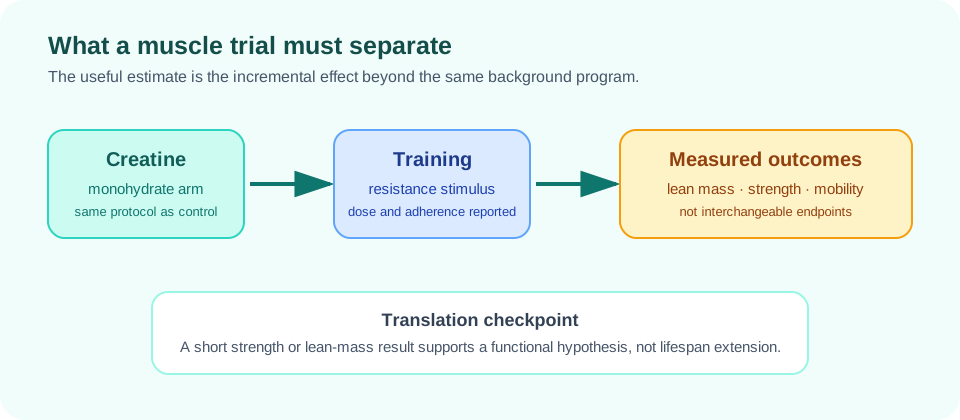
Systematic reviews and meta-analyses generally support a modest additive effect of creatine when older adults perform resistance training. A recent review identified eight randomized trials involving 482 participants and reported improvements in lean tissue mass and lower-limb strength, with duration modifying some outcomes. Earlier meta-analysis also found greater gains in lean tissue mass and upper- and lower-body strength during resistance training.
These results are among creatine’s more credible healthy-aging signals because they measure functional or near-functional outcomes in humans. They still have boundaries: studies differ in age, training dose, diet, baseline creatine status, sex, duration and measurement. An average effect does not predict an identical response for every person.
Creatine should therefore be positioned as a possible adjunct to a training program, not as a replacement for training. The trial’s control group, adherence and primary outcome matter more than a general claim that creatine “builds muscle.”
| Outcome | What it measures | What it does not prove |
|---|---|---|
| Lean tissue mass | Change in measured body composition. | All new mass is contractile or functional. |
| Strength | Performance on a defined test. | Fewer falls or longer life. |
| Walking or mobility | Task-specific physical function. | Universal independence benefit. |
| Training response | Incremental effect beyond the control program. | Creatine works without the training stimulus. |
2026 randomized trial in middle-aged and older adults
A 2026 randomized, double-blind trial analyzed 64 adults aged 45–65 years after a 12-week intervention. Participants received creatine monohydrate or placebo, with some choosing an exercise and diet program and others remaining without that intervention. The studied creatine assignment was 5 g twice daily.
Creatine was associated with higher lean tissue mass, strength and muscular endurance in the reported analyses. Selected blood, cognitive and memory measures also moved favorably. The authors appropriately described individual cognitive and biomarker findings as exploratory, and the study was not a lifespan trial.
Participant-selected exercise status and a relatively short intervention complicate broad interpretation. The study supports continued testing of creatine monohydrate for body composition and strength; it does not prove that every middle-aged or older person will experience the same benefit.
The trial is useful partly because it separates several questions that are often collapsed in supplement marketing. First, does the intervention change a measurable physiological or performance outcome over twelve weeks? Second, are the changes larger when exercise and diet are also present? Third, do exploratory blood or cognitive signals persist in a longer, independently replicated study? Those questions require different designs and should not be answered by one headline result.
Short studies can detect early changes in training capacity or body composition, but they are poorly suited to claims about disability prevention, dementia risk, mortality or biological age. They also cannot establish whether an apparent benefit is maintained after the intervention stops. Replication with prespecified outcomes, transparent adherence reporting and clinically meaningful function would make the finding more useful for longevity decisions.
Physical function and sarcopenia relevance
Sarcopenia involves loss of muscle strength, muscle quantity or physical performance, depending on the diagnostic framework. Creatine may be relevant to the strength and training components, especially when paired with resistance exercise. It is not a complete sarcopenia diagnosis or treatment and cannot address neurological, inflammatory, nutritional or disease-related causes on its own.
Function is the bridge between a laboratory supplement and daily life. Trials that measure chair rise, walking, power, balance or activities of daily living are more informative than trials that report body composition alone. Even then, a short improvement in one task should not be generalized to prevention of disability without longer evidence.
- Check the population and sarcopenia definition.
- Separate strength from lean-mass outcomes.
- Look for a training control and adequate duration.
- Prefer daily-function endpoints when available.
Brain creatine and bioenergetics
The brain uses substantial energy and contains creatine and phosphocreatine systems. This creates a plausible rationale for studying creatine in cognition, sleep deprivation, hypoxia and neurodegenerative disease. Brain creatine concentration may respond less readily or differently than muscle, and blood creatine is not a direct measure of brain exposure.
Dietary intake, body size, muscle mass, physical activity and baseline metabolism can influence the response. People with lower dietary creatine intake may not represent people with higher intake, and older adults with cognitive impairment may differ from healthy community-dwelling volunteers.
Cognition: what the 2026 systematic review found
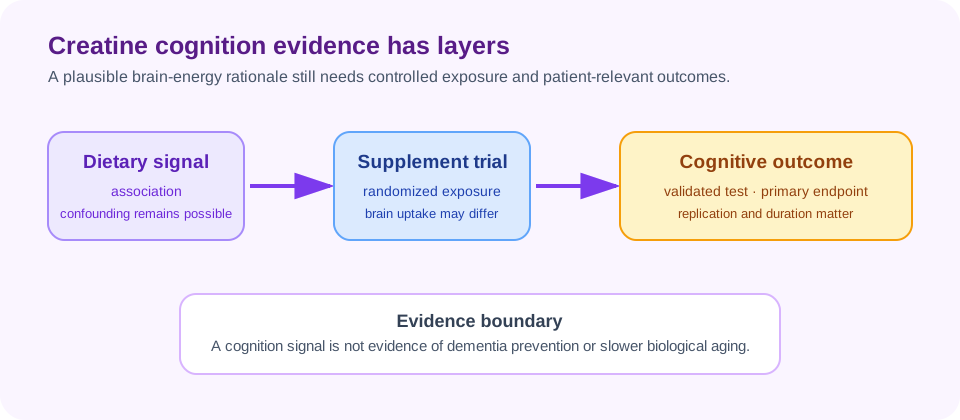
A 2026 systematic review of creatine and cognition in older adults included six studies with 1,542 participants. Five studies reported positive relationships with cognition, particularly memory and attention, but only two were double-blind supplementation interventions and study quality ranged from good to poor. Four studies were cross-sectional dietary analyses rather than randomized treatment trials.
This is encouraging but limited evidence. Associations between dietary creatine and cognition can reflect diet quality, education, activity, health or other differences. A systematic review can identify a signal while also showing why better trials are needed.
Cognition should not be promoted as a settled creatine benefit in older adults. Trials should measure brain creatine when possible, prespecify validated cognitive outcomes, account for practice effects and report whether changes are primary, secondary or exploratory.
2026 resistance-training and neuroplasticity trial
Another 2026 trial examined creatine alongside high-load variable resistance training in older adults, with outcomes spanning physical function, cognition, inflammation and neuroplasticity. This design is valuable because it tests several domains in a defined intervention context. It also creates multiple-comparison and attribution challenges.
A favorable signal in inflammation or a neuroplasticity marker is not equivalent to improved cognition. A strength response does not prove a brain response. The interpretation should follow the prespecified primary endpoint and the correction for exploratory analyses rather than selecting the most favorable measure.
Bone, metabolic markers and exploratory findings
Creatine has been studied in relation to bone density, glucose regulation, lipids, blood pressure and inflammatory markers. Some reviews suggest possible benefits in selected groups, especially when exercise is included, but findings are not uniform and many endpoints are secondary. Bone remodeling and fracture prevention require longer, appropriately powered studies than a short body-composition trial.
Metabolic markers can be useful mechanistic or safety outcomes. They are not automatically clinical benefits. A change in HbA1c, lipid profile or inflammatory marker should be interpreted with the baseline population, statistical plan, magnitude and patient-important endpoint in view.
Bone and metabolic findings also illustrate why the intervention context matters. Resistance training can affect loading, balance and insulin sensitivity independently of supplementation. If the control group receives a different training or diet exposure, it becomes difficult to estimate what creatine contributed. A well-designed trial reports the background program with the same care as the supplement.
- Name the specific marker and direction of change.
- Check whether it was prespecified.
- Ask whether the magnitude is clinically meaningful.
- Do not turn one marker into a disease-prevention claim.
Doses studied and common trial protocols
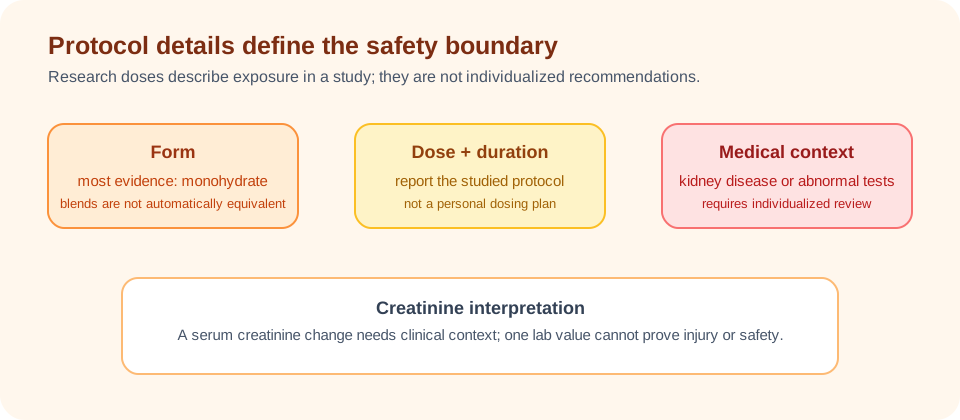
Human studies have used different creatine monohydrate protocols, including lower daily maintenance amounts and higher studied exposures. The 2026 middle-aged and older-adult trial assigned 5 g twice daily for 12 weeks; other trials use different amounts, loading strategies or training schedules. These are doses studied, not personalized recommendations.
Loading is not required for every protocol, and the best approach depends on the research question, product, participant and clinical context. Comparing grams without comparing duration, adherence, training and baseline intake can create a false sense of precision.
| Report | Why it matters | Do not infer |
|---|---|---|
| Form | Most evidence is for creatine monohydrate. | All forms are equivalent. |
| Dose and schedule | Defines the studied exposure. | A personal recommendation. |
| Training context | May provide the main adaptation stimulus. | Creatine works independently of training. |
| Duration | Bounds efficacy and safety evidence. | Indefinite use is established. |
Safety, kidney-function misconceptions and medical review
Creatine monohydrate is generally well studied, but “safe for everyone” is too broad. Serum creatinine can rise because creatine metabolism contributes to the measured marker; that change can complicate interpretation of kidney function without necessarily indicating kidney injury. A clinician may need to use the full clinical picture and appropriate tests rather than one number.
People with known kidney disease, abnormal kidney tests, complex medical conditions, pregnancy, or medicines that affect kidney function should obtain individualized medical advice. This article cannot determine whether creatine is appropriate in those settings. Product contamination, inaccurate labeling and non-monohydrate blends create additional uncertainty.
Short trials and meta-analyses can identify common adverse-event patterns, but they cannot guarantee long-term safety for every user. Any new symptom or abnormal test requires clinical interpretation rather than a generic internet reassurance.
Kidney tests are especially important to interpret in context because serum creatinine is both a laboratory marker and a product of creatine metabolism. A clinician may consider trends, estimated filtration, urine findings, comorbidities and medications rather than assuming that a single number proves either injury or safety.
Does creatine affect biological aging or lifespan?
Creatine has not been shown in long-term human outcomes trials to extend lifespan, reverse biological aging, prevent dementia broadly or eliminate sarcopenia. A strength improvement may support healthspan, but it is not a direct lifespan result. A cognitive or inflammatory biomarker is not a validated aging reversal endpoint.
Creatine is therefore best evaluated against practical outcomes: lean tissue, strength, power, mobility, cognition in a defined population and safety over time. Those outcomes can justify a useful intervention without requiring an exaggerated anti-aging label.
Evidence verdict and ongoing research
Creatine monohydrate has comparatively strong human evidence for supporting lean mass and strength in older adults, especially when paired with resistance training. Cognitive evidence is plausible and encouraging in places, but the 2026 systematic review also showed limited methodological quality and a need for better randomized trials. Bone, metabolic and neuroplasticity findings remain context-dependent or exploratory.
The next decisive research should use adequately powered trials, prespecified primary outcomes, objective tissue measures, clinically meaningful function and longer safety follow-up. It should distinguish creatine’s incremental effect from exercise, diet and practice effects.
For now, creatine is a serious functional-health intervention to study—not a proven lifespan-extending supplement.