Supplements and molecules · evidence reviewed September 2026
What taurine is
Taurine is a sulfur-containing, non-proteinogenic beta-amino acid found in many tissues. It is not incorporated into proteins in the way that leucine or lysine are, but it participates in cellular homeostasis and is present in the brain, heart, skeletal muscle, retina and immune system. Humans can synthesize taurine from sulfur-containing amino acids, and dietary intake contributes additional taurine, especially through animal-source foods.
The word “taurine” therefore does not automatically mean a deficiency disease or a supplement requirement. Nutritional need depends on synthesis, intake, tissue distribution, physiology and health status. A low measured blood concentration could reflect diet, recent activity, illness, kidney handling, assay conditions or other factors. It may be a useful research signal without being a treatment target.
That distinction matters in longevity discussions. A molecule can have real physiological functions, and supplementing it can change a measurable endpoint, without being a universal aging switch. The strongest version of the taurine hypothesis requires more than a plausible pathway: it requires reproducible human evidence that an intervention changes healthspan or clinically meaningful aging outcomes.
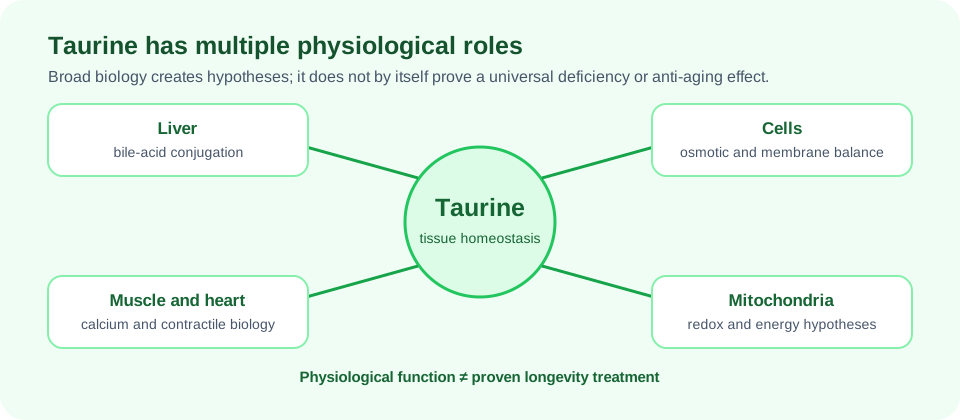
Physiological roles: bile acids, osmoregulation, calcium, mitochondria and redox biology
Taurine’s biology is broad, which is one reason it is easy to overinterpret. In the liver, taurine can be conjugated to bile acids, helping form molecules involved in lipid digestion. Inside cells, taurine contributes to osmotic balance and membrane stability. It is also associated with calcium handling, excitability and contractile function in muscle and heart. These roles are physiologically relevant, but they do not by themselves prove that additional taurine improves aging.
- Bile-acid conjugation links taurine to digestion and lipid handling.
- Osmoregulation helps cells respond to changes in volume and ionic conditions.
- Calcium and membrane effects may influence excitation and contraction.
- Mitochondrial and redox effects are biologically interesting but often come from mechanistic or preclinical work.
Research on mitochondrial dysfunction and aging illustrates the translation problem. Improving a cellular process in a model can be useful for generating a hypothesis, but human benefit depends on dose, tissue exposure, baseline status, disease context and the endpoint selected. “Supports mitochondria” is not a synonym for “slows aging.”
| Claim layer | What it can show | What it cannot show alone |
|---|---|---|
| Mechanism | A pathway or cellular response is biologically possible. | A meaningful benefit in people. |
| Blood concentration | A measured association or change in circulating taurine. | That a universal deficiency caused aging. |
| Supplement trial | Whether a defined intervention changes selected outcomes. | That the same result applies to all adults. |
| Healthspan outcome | Whether function, disease burden or quality of life changes. | Human lifespan extension unless followed long enough. |
Why taurine became a longevity headline in 2023
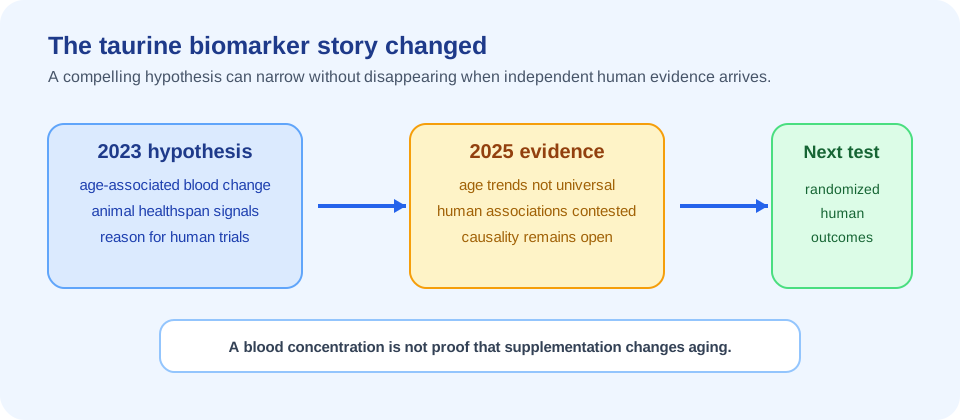
A 2023 Science study proposed taurine deficiency as a driver of aging after reporting age-related changes in circulating taurine across mice, monkeys and humans. In the experimental work, taurine supplementation improved several healthspan measures in aged mice and monkeys, and extended lifespan in worms and mice. The authors also reported links to processes such as cellular senescence, mitochondrial dysfunction, DNA damage and inflammation.
The study was influential because it connected a simple circulating molecule to multiple hallmarks of aging and tested more than one species. It also made a clear translational case for clinical trials. However, the model-organism results were not human lifespan trials, and the human observations were correlational. A concentration associated with age or disease does not prove that restoring it will reproduce animal outcomes.
Animal lifespan and healthspan evidence
Animal evidence remains important, but its role is hypothesis generation and mechanistic testing. In the 2023 report, aged mice given taurine showed changes in body composition, bone-related measures, neuromuscular performance, glucose handling, immune parameters and other outcomes. Worm experiments supported lifespan effects, while monkey work supported selected healthspan signals. These findings suggest that taurine biology can influence multiple systems in at least some experimental settings.
Animal experiments also have boundaries. Species differ in taurine synthesis, metabolism, lifespan, housing, diet, dose scaling and disease susceptibility. A high dose per kilogram in a mouse is not a human prescription. Improvements in grip strength, rotarod performance or a molecular marker are not equivalent to fewer fractures, less disability, lower dementia incidence or longer life in people.
Animal work can still guide better clinical design. It suggests that future human studies should measure metabolic, muscular, mitochondrial and inflammatory outcomes together while prespecifying which are primary. It also argues for testing baseline taurine status and biological context rather than assuming every participant is equally responsive.
The original human observational signal
The human component of the 2023 study reported associations between lower circulating taurine and several age-related diseases, and noted that taurine concentrations could rise after acute endurance exercise. Observational findings like these are useful for identifying patterns, but they are vulnerable to confounding and reverse causation. Activity, diet, body composition, illness, medication use and kidney function can influence both a metabolite and health outcomes.
Circulating taurine is also a snapshot. It may not represent taurine inside skeletal muscle, the brain, mitochondria or other tissues. Timing relative to food, exercise and acute illness can matter. Even a highly reproducible association would not answer whether supplementation restores a meaningful deficit or simply raises a blood measurement.
This is why a longevity article should not treat the original human association as proof of deficiency. The appropriate next step is a controlled intervention with prespecified endpoints, adequate follow-up and measurement of both exposure and outcome.
2025 reversal: taurine does not consistently decline with age
A 2025 Science analysis examined taurine across geographically distinct human cohorts and reported that concentrations increased or remained unchanged with age in longitudinal and cross-sectional comparisons. The authors also found substantial variability in relationships between taurine and age-related measures of motor function and energy homeostasis. This directly challenges the idea that a falling circulating taurine concentration is a universal feature of aging.
The result does not prove that taurine is irrelevant. It shows that age-related taurine biology is context-dependent and that a single population-level pattern should not be treated as a universal deficiency curve. Cohort composition, physical activity, diet, health and measurement timing can alter the observed relationship.
For readers, the practical implication is simple: the 2023 headline and the 2025 challenge should be read together. The first created a testable hypothesis; the second narrowed the claim. An intervention can still work in a selected group even if low taurine is not a general explanation for human aging.
Independent human study: no association with age, performance or mitochondrial function
An independent 2025 Aging Cell study assessed 137 men aged 20 to 93 years, including physically inactive and physically active participants. It reported no association between circulating taurine and age, muscle mass, strength, physical performance or mitochondrial function. The authors concluded that the findings challenge taurine deficiency as a primary driver of aging in humans.
This study is not the final word on supplementation. It is an observational or cross-sectional test of associations, not a randomized trial of a taurine intervention. It does not determine whether a defined dose changes glucose control, blood pressure, exercise tolerance, inflammation or another endpoint over time. It does make a universal biomarker claim harder to defend.
| Evidence type | Main question | Current interpretation |
|---|---|---|
| 2023 observation | Does taurine correlate with age-related health patterns? | Associations were reported, but causality was not shown. |
| 2025 cohort analysis | Does taurine universally decline with age? | No; patterns increased or remained unchanged in several cohorts. |
| 2025 Aging Cell study | Does taurine track human muscle and mitochondrial function? | No association was observed in 137 men. |
| Randomized trial | Does supplementation change a defined outcome? | Still requires adequately designed human intervention evidence. |
Why “not a good biomarker” does not mean “supplement has no effect”
A biomarker question asks whether an endogenous measurement tracks age or predicts an outcome. An intervention question asks whether changing an exposure causes a benefit. Those are related but not interchangeable. Vitamin D concentration, blood pressure and cholesterol illustrate the general principle: an imperfect population biomarker does not automatically rule out every possible intervention, and a biomarker association does not guarantee that supplementation helps.
For taurine, a supplement could theoretically affect a pathway without lowering or raising the same way across all people. Responses may differ with dietary intake, synthesis, exercise, metabolic disease, kidney handling, age, sex and baseline tissue stores. That possibility is a reason to stratify and measure—not a reason to assume benefit.
The evidentiary bar is therefore a prespecified human outcome. A credible study should distinguish the effect of taurine from diet and exercise, report adherence and adverse events, account for missing data, and identify whether results are primary or exploratory. If the trial only changes a blood concentration, it has not yet shown healthspan improvement.
Human supplementation evidence outside longevity
Human supplementation studies have examined taurine in exercise, metabolic health, cardiovascular physiology and other contexts. A 2026 review synthesized mechanistic and nutritional evidence and described possible effects involving inflammation, oxidative stress, calcium regulation, mitochondrial function, lipid metabolism and physical performance. The review is useful context, but it is not a substitute for a large, long-term longevity trial.
Some randomized evidence suggests taurine may influence metabolic markers such as glucose, lipids, blood pressure or inflammatory measures in selected populations. Effects are not automatically clinically important, and results can vary with dose, duration, baseline disease and co-interventions. A change in HbA1c, blood pressure or a laboratory marker should be reported as that outcome—not translated into “slows aging” without a validated bridge.
Exercise findings have a similar limit. A short-term change in endurance, recovery or a training response may be useful for a specific goal, but it does not establish prevention of sarcopenia or disability. Readers interested in muscle aging should connect taurine evidence to the broader muscle aging and sarcopenia framework rather than treating one supplement as a complete intervention.
- Metabolic marker results can inform cardiometabolic research.
- Exercise results can inform performance research.
- Inflammatory or redox signals can support mechanistic hypotheses.
- None of these alone proves lifespan extension.
Doses studied in human trials — reporting, not recommendation
Published human studies have used different taurine amounts, schedules and durations. Reviews describe studies in the approximate range of 1 to 6 grams per day, while individual trials may use a fixed daily dose, divided doses or a single acute exposure. The amount and schedule are part of the intervention being tested; they are not a universal recommendation.
Study participants also differ. A dose tested in adults with metabolic disease, athletes or healthcare workers cannot be assumed appropriate for someone taking prescription medication or managing kidney, liver, cardiovascular or endocrine disease. Product purity, labeling accuracy and co-ingredients can further complicate the comparison between a research protocol and a retail product.
When reading a dose claim, ask whether the study was randomized, how long it lasted, what the primary endpoint was, how many participants completed it and whether adverse events were actively monitored. A dose may be “studied” without being proven effective, necessary or suitable for an individual.
2026 phase II biological-aging and metabolic-health trial
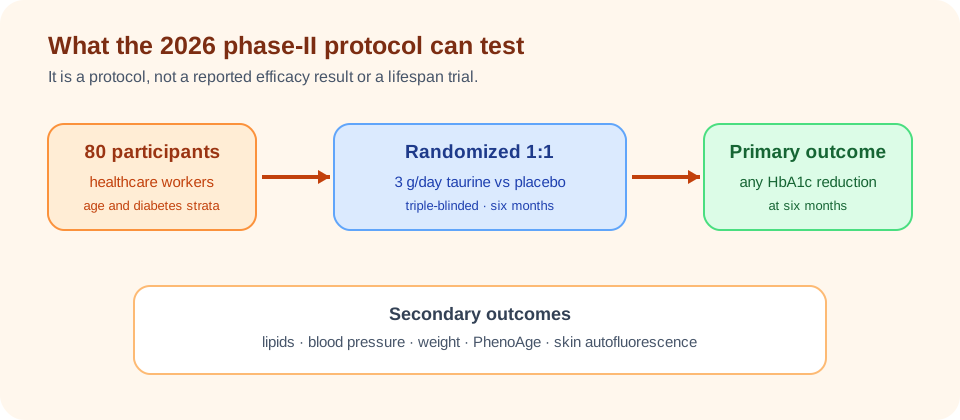
A 2026 PLoS One publication described the protocol for a triple-blinded, Bayesian-optimized phase II randomized controlled trial among healthcare workers. The planned design assigns participants 1:1 to oral taurine at 3 grams per day or an indistinguishable placebo for six months, with stratification by diabetes status and age over 45 years. The study is planned to enroll 80 people, with interim Bayesian assessments after outcome data from 20, 40 and 60 participants.
The primary outcome is the proportion of participants achieving any reduction in HbA1c at six months compared with baseline. Secondary outcomes include plasma lipids, blood pressure, body weight, PhenoAge and a skin autofluorescence index. This is a useful design because it names a primary outcome and treats biological-aging measures as secondary rather than assuming that a composite aging score proves longer life.
It is still a protocol, not a result. Until the trial reports recruitment, adherence, missing data, adverse events and prespecified outcomes, no conclusion about efficacy can be drawn from it. Even a positive phase II result would mainly justify a larger, longer trial; it would not establish human lifespan extension.
Safety and clinical considerations
Taurine is present in foods and has been studied in human supplementation research, but “natural” does not mean risk-free or automatically appropriate. Safety depends on dose, duration, product quality, co-ingredients, medical conditions and concurrent medicines. Short studies may be unable to detect uncommon or delayed harms.
People with kidney disease, abnormal kidney tests, liver disease, diabetes, cardiovascular disease, pregnancy or breastfeeding considerations, or complex medication regimens should obtain individualized advice before using a supplement. The same applies to anyone considering taurine as a replacement for prescribed treatment, nutrition care, exercise rehabilitation or evaluation of a new symptom.
Energy drinks add another complication because their taurine content may appear alongside caffeine, sugar, stimulants and other compounds. Evidence from a purified research product cannot be transferred automatically to a multi-ingredient beverage. Reported tolerability in a trial also does not prove that every retail product is accurately labeled or contamination-free.
What taurine has not been shown to do
As of this review, taurine has not been shown in a completed long-term human outcomes trial to extend lifespan, reverse biological aging, prevent dementia broadly, eliminate sarcopenia, or restore a universal age-related deficiency. A positive metabolic marker, exercise measure or biological-age estimate would remain narrower than those claims.
The phrase “anti-aging” also hides several endpoints. Slowing epigenetic-clock change is not the same as reducing frailty. Improving blood pressure is not the same as preventing cardiovascular events. Increasing exercise capacity is not the same as preserving independence. A credible article keeps these outcomes separate so that a plausible molecule is not asked to carry more certainty than the data provide.
Taurine may ultimately prove useful for a subgroup, a defined metabolic problem or a particular functional outcome. That would be a meaningful result even if it did not extend life. The appropriate conclusion can become more favorable without becoming universal.
Evidence verdict and what would change the conclusion
Taurine is a valuable case study in how longevity science self-corrects. The 2023 study made a compelling cross-species case for testing taurine. The 2025 evidence showed that circulating taurine does not consistently decline with age and was not associated with age, muscle, performance or mitochondrial function in an independent group of men. The result is a narrower, more useful question: can a defined supplementation protocol improve a defined human outcome in a defined population?
The current answer is not yet known. The 2026 phase II protocol is an important next step because it uses placebo control, blinding, a declared primary endpoint and a prespecified six-month window. Its findings will need to be interpreted alongside adherence, adverse events, missing data, baseline taurine status and whether secondary biological-aging measures agree with primary metabolic results.
The conclusion would become more favorable if multiple independent randomized trials showed reproducible improvements in clinically meaningful function or disease outcomes, with an acceptable safety profile and benefits that persisted beyond short-term measurement. A single positive biomarker result would be encouraging but insufficient. A negative or null trial would not erase taurine’s physiology; it would narrow the set of claims worth pursuing.
For now, taurine belongs in the evidence map as a biologically active supplement with intriguing preclinical findings, contested biomarker claims and unfinished human intervention research. It should not be marketed or understood as a proven anti-aging treatment.