What the 2026 review asked
The review evaluated peer-reviewed intervention studies published from January 2010 through October 2025. It covered NAD+ itself, NAD precursors such as nicotinamide riboside (NR) and nicotinamide mononucleotide (NMN), and related strategies administered orally or parenterally. The authors used a PRISMA-guided systematic-review approach rather than presenting a new intervention.
That distinction matters for readers searching for NMN human trials. A review can make the evidence easier to compare, but it inherits the strengths, weaknesses, doses, endpoints and follow-up periods of the studies it includes. It cannot turn a biomarker result into a clinical result by aggregation alone.
How many studies were included?
The review identified 113 eligible studies: 33 human intervention studies, including 28 randomized and 5 nonrandomized studies, plus 80 rodent studies. The animal literature frequently reported metabolic, mitochondrial, inflammatory or functional improvements, but those findings varied by model and endpoint. They are hypothesis-generating rather than direct evidence of human lifespan extension.
The human and rodent totals should therefore not be read as equivalent votes. Rodent experiments can test tissue mechanisms and lifespan-related phenotypes under controlled conditions. Human trials test what happens in a defined population receiving a defined exposure for a defined period. The transfer from one level to the other remains an empirical question.
| Layer | What it contributes | What it cannot establish alone |
|---|---|---|
| Rodent interventions | Mechanistic, metabolic and lifespan-related hypotheses. | Human anti-aging efficacy or safe dosing. |
| Human biomarkers | Target engagement in blood or sampled cells. | Improved function, disease prevention or longevity. |
| Human clinical outcomes | Evidence about a specified physiological or patient-important endpoint. | Benefits beyond the tested population, dose and follow-up. |
What oral NMN and NR changed consistently
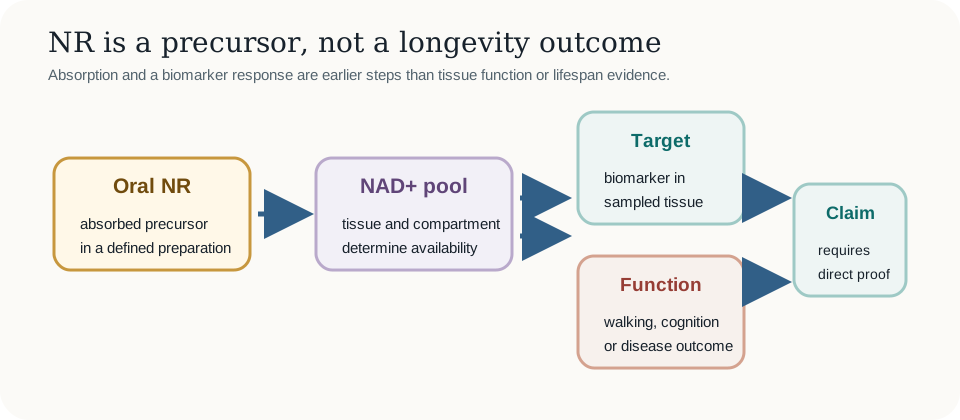
Across the human evidence, oral NR and NMN consistently demonstrated biochemical target engagement. Studies measured changes in circulating plasma or whole-blood metabolites, or in cellular compartments such as peripheral blood mononuclear cells. In plain language, the compounds can alter the NAD-related chemistry researchers intended to influence.
This finding fits the broader biology described on the NAD+ metabolism and aging page. It also explains why search results can look more decisive than the clinical evidence: a measurable biochemical response is easier to detect in a short trial than a durable change in mobility, cognition, vascular events, disease incidence or quality of life.
Which health outcomes were mixed or null?
The review found heterogeneous and often null results for metabolic, vascular, performance and other healthspan-relevant outcomes. “Heterogeneous” means that results differed across populations, products, doses, tissues, comparators, endpoints or study designs. A favorable result in one secondary measure does not erase a null primary endpoint elsewhere.
For example, an intervention may raise a blood NAD-related metabolite without improving insulin sensitivity, exercise capacity or a validated cognitive measure. Conversely, a small functional signal may appear without a clear explanation in the measured biomarker. The interpretation must follow the prespecified endpoint and the study’s statistical design, not the most marketable result.
The independent 2025 review of NAD precursor supplementation in human aging likewise emphasized tissue-specific biology and the limits of translating biochemical changes into clinical claims. That is why the permanent NR evidence page and NMN-versus-NR comparison should remain study-specific rather than promising a single winner.
What did it find about IV or IM NAD+?
No eligible outcomes trials evaluated intravenous or intramuscular NAD+ itself for anti-aging or wellness indications. The review identified one nonrandomized intravenous NMN study that mainly contributed short-term safety and biomarker information. It also identified an intravenous NAD+ pharmacokinetic pilot as contextual evidence, without eligible clinical outcomes.
That is an evidence gap, not proof that parenteral NAD+ is ineffective. It means the review could not establish efficacy for an outcome such as function, disease prevention, quality of life or lifespan. Claims made from infusion testimonials, pharmacokinetics or short-term symptom reports should not be presented as equivalent to randomized outcomes evidence.
Safety and follow-up duration
Oral NMN and NR were generally well tolerated over weeks to months in the included human studies. That is useful short-term information, but it is not a guarantee of long-term safety for every person, combination or route of administration. Safety interpretation depends on dose studied, population, monitoring, adverse-event definitions and follow-up duration.
The 2026 NMN safety and metabolic meta-analysis adds a later synthesis: short-term tolerability was generally favorable, while broad metabolic benefits were not clearly established. It should be read as complementary evidence, not as permission to infer a longevity effect from tolerability.
People with medical conditions, pregnancy, relevant medicines or abnormal laboratory results need individualized clinical advice. This research brief reports studied evidence and does not recommend a product, dose or infusion protocol.
Why target engagement is not clinical efficacy
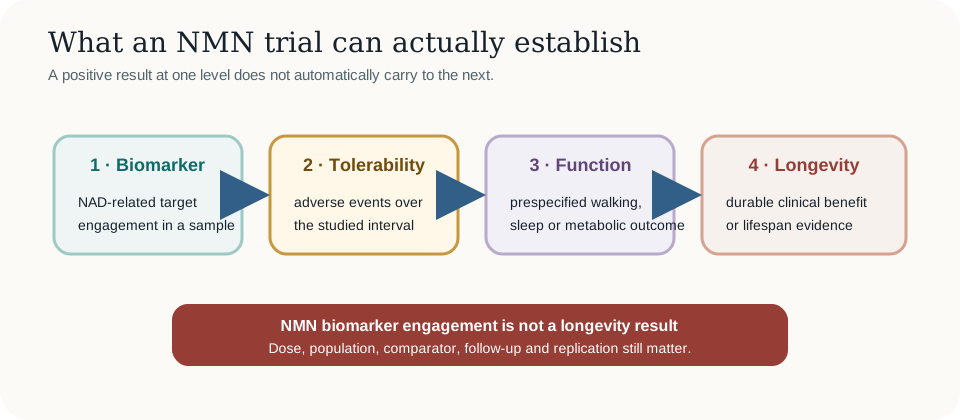
Target engagement answers: did the exposure change the molecule, pathway or compartment the intervention was designed to affect? Clinical efficacy answers: did a prespecified outcome that matters to patients improve, relative to an appropriate comparator, with an effect large and durable enough to matter?
- Biochemical: NAD-related metabolites changed in blood or cells.
- Physiological: a measured system, such as vascular or metabolic function, changed.
- Functional: performance or cognition changed on a defined test.
- Clinical: symptoms, disease events, independence or quality of life changed over meaningful follow-up.
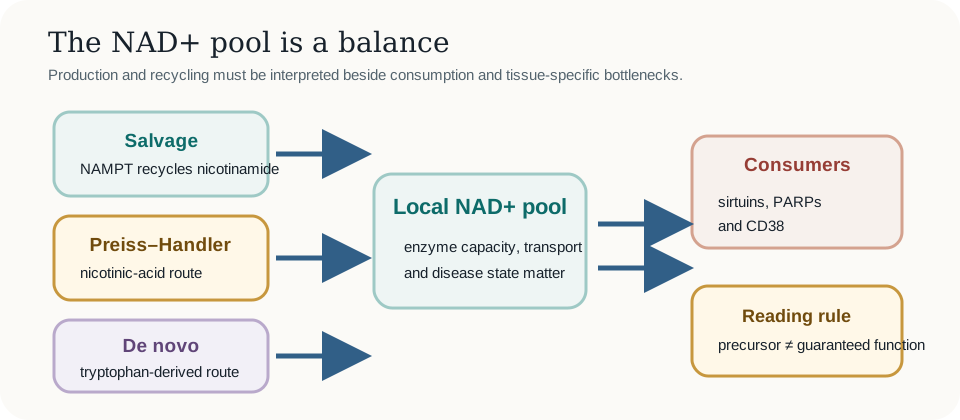
The levels can move independently. A biomarker may be necessary for a mechanism without being sufficient for a health benefit. The review’s most useful contribution is making that separation visible.
Important limitations of the review
The review is limited by the evidence it found: relatively few human interventions compared with rodent studies, varied preparations and protocols, short follow-up, heterogeneous endpoints and incomplete ability to compare tissues. These limitations reduce confidence in broad claims, even when the direction of a biomarker result appears consistent.
Publication bias and selective reporting are also possible in a literature where commercial interest is high. The authors disclose that Cory Gallagher owns a management-services organization serving an aesthetics clinic, which the statement says does not offer NAD+ infusions or supplementation; the authors declare no other competing interests. This disclosure does not invalidate the review, but it is relevant context for independent replication and interpretation.
What this changes for NMN and NR claims
The defensible claim is narrower than “NMN and NR reverse aging.” Oral NMN and NR show biochemical activity in studied humans and are generally tolerated over the reported short-term periods. Whether either compound improves a specific health outcome depends on the population, formulation, dose studied, comparator, endpoint and duration.
The review also strengthens the case for maintaining an evidence map rather than a supplement leaderboard. Readers can move from the Research hub to the permanent Supplements hub, then inspect the NMN and NR pages for study-level updates. This research brief should not become a thin duplicate of those canonicals.
What it does not settle
The review does not settle whether a particular formulation works better in a particular tissue, whether longer treatment changes outcomes, or whether a biomarker-defined subgroup responds differently. It does not establish an IV NAD+ benefit, but it also does not prove that parenteral approaches cannot work. Those questions require adequately powered, preregistered human trials with clinically meaningful endpoints.
It also does not settle lifespan extension. No short biomarker study can substitute for the long follow-up needed to evaluate mortality, disability, disease events or sustained quality of life. Animal lifespan findings remain valuable for hypothesis generation, but they are not direct evidence of human longevity.