What the 2023 Science study reported
The 2023 study reported that circulating taurine concentrations declined with age in mice, monkeys and humans. It also reported that taurine supplementation improved selected healthspan measures in worms, mice and monkeys and extended lifespan in worms and mice. In humans, lower taurine was associated with several age-related conditions and exercise acutely increased taurine concentration.
The paper generated attention because it connected a measurable molecule to multiple species, aging hallmarks and intervention results. But a cross-species pattern and model-organism supplementation result do not establish that low taurine drives human aging. The human biomarker observation still required longitudinal and independent testing.
The distinction is fundamental: a driver can contribute causally to a process, a biomarker can correlate with it, and a therapeutic target can be modifiable in a useful way. One molecule can fit one category without fitting the others.

What the 2025 NIH/NIA longitudinal study tested
The 2025 Science study from researchers at the National Institute on Aging examined taurine across longitudinal and cross-sectional human cohorts, as well as monkeys and mice. Its key advantage was repeated measurement in the same populations, which helps separate age-related change from differences between people. The human longitudinal data covered adults aged 26–100 years in the Baltimore Longitudinal Study of Aging.
The researchers found circulating taurine concentrations increased or remained unchanged with age in the examined settings. The NIH summary also reports that within-person variation often exceeded age-related change. Associations with motor function and energy-homeostasis outcomes were inconsistent across cohorts and species.
This does not prove that every human population has the same trajectory. It does show that “taurine declines with age in humans” is not a universal established fact and should no longer be repeated without qualification.
| Question | Earlier interpretation | 2025 evidence update |
|---|---|---|
| Age trajectory | circulating taurine declines with age. | often increased or stayed unchanged in tested cohorts. |
| Individual variation | age explains the main pattern. | within-person differences can exceed the age trend. |
| Health associations | low taurine aligns with aging phenotypes. | associations vary by outcome, cohort and species. |
| Supplement question | biomarker supports a deficiency hypothesis. | requires separate randomized human efficacy trials. |
Human, monkey and mouse trajectories
The 2023 paper and 2025 follow-up did not ask identical questions in identical samples. Species, sex, age range, feeding, activity, assay, sampling design and health status can all affect taurine concentration. A cross-sectional sample compares different individuals at different ages; a longitudinal sample observes change within the same individuals.
The 2025 results found no universal decline in the measured circulating pool. They do not rule out tissue-specific depletion, disease-related differences, altered transport or a response to supplementation. They do overturn the shortcut from one blood trajectory to a general theory of human aging.
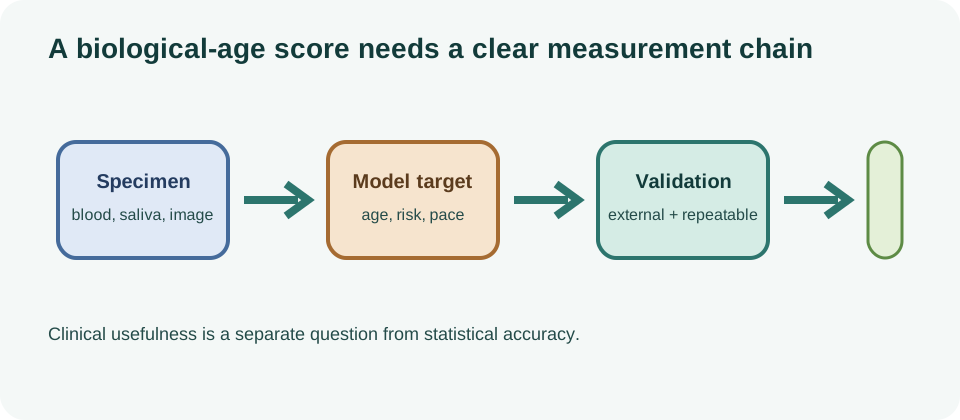
This is why biological-age tests should not treat a single metabolite as a complete aging clock. The related biological-age testing page explains the need for validation, calibration and outcome linkage.
Why within-person variability matters
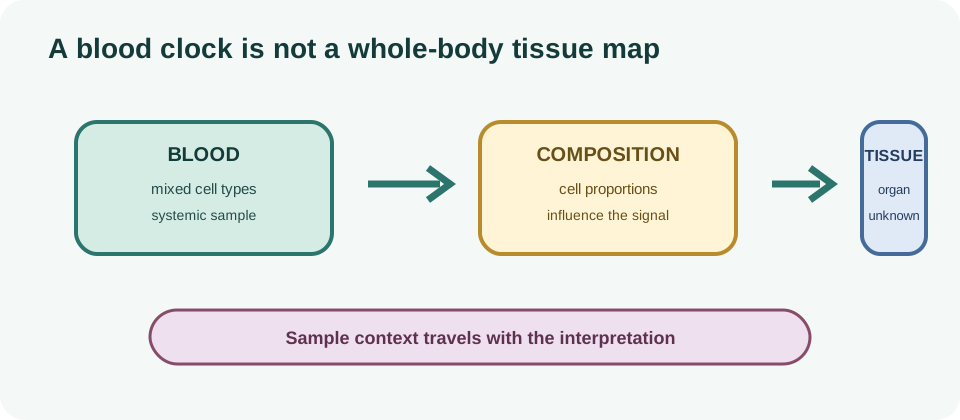
If a molecule varies substantially between people, age-group averages can create a misleading slope. Diet, exercise, illness, medications, kidney function, fasting state, sample handling and circadian timing may all influence a measured concentration. Repeated measurements make the age trajectory more visible but do not remove every source of variation.
Biomarker validity also requires reliability and clinical usefulness. A marker should be measured consistently, associate with a defined outcome, add information beyond existing predictors and ideally change in a way that reflects a modifiable causal process. Taurine did not meet the standard for a universal aging biomarker based on the 2025 evidence.
Independent 2025 skeletal-muscle evidence
An independent 2025 Aging Cell study examined 137 physically active and inactive men aged 20–93 years. It found no association between circulating taurine and age, muscle mass, strength, physical performance or mitochondrial function. This result is narrower than the NIH multi-cohort work, but it points in the same direction: circulating taurine is not a simple proxy for human muscle aging.
It is not a claim that taurine has no role in skeletal muscle. Muscle transport, intracellular pools and responses to exercise or disease could differ from blood concentration. The study challenges the inference that a low circulating level is a primary driver of age-related muscle decline.
| Claim layer | Current reading | Evidence status |
|---|---|---|
| Circulating biomarker | not a universal age-related decline. | challenged by longitudinal and independent human data. |
| Tissue biology | may still vary by organ and condition. | not answered by a blood trajectory alone. |
| Supplement efficacy | requires a defined human intervention trial. | still an open clinical question. |
What the new evidence overturns—and what it does not
The update overturns the broad biomarker claim that circulating taurine reliably declines with human age. It also weakens the idea that low blood taurine alone establishes taurine deficiency as a primary human aging driver. The reversal is an example of scientific self-correction: stronger design and independent data narrowed the claim.
It does not overturn taurine’s ordinary biology. Taurine is involved in osmoregulation, bile-acid conjugation, membrane function, calcium handling and other processes. Nor does it prove that taurine supplementation is ineffective. Supplement efficacy requires a defined product, dose studied, comparator, target population, prespecified outcome and safety follow-up.
A 2026 phase II protocol shows that supplementation remains an active clinical question. A protocol is not a completed efficacy result, but it demonstrates why biomarker validity and therapeutic testing should not be conflated.
How the permanent taurine page should frame the evidence
The permanent taurine and longevity page should preserve the 2023 study as an important hypothesis-generating paper while leading with the 2025 correction. It should state that circulating taurine is not a universal aging biomarker, separate animal healthspan findings from human evidence, and avoid describing human taurine decline as settled.
The page should also distinguish blood concentration, tissue biology and supplementation outcomes. Future randomized trials may still find useful effects in defined populations, but those effects cannot be inferred from the age trajectory of a circulating metabolite.
Bottom line
Taurine remains biologically interesting, but the high-profile biomarker story changed. The best current human evidence does not support a universal age-related decline in circulating taurine, and an independent skeletal-muscle study found no association with age, physical performance or mitochondrial function. Claims about supplementation must now stand on randomized clinical evidence rather than on the biomarker narrative.
- do not repeat circulating taurine decline as an established universal human fact;
- separate driver, biomarker and therapeutic-target claims;
- treat model-organism lifespan findings as preclinical evidence;
- look for defined human outcomes and safety data from supplementation trials;
- retain the 2023 hypothesis and the 2025 correction together in the evidence record.