What sirtuins are and why they depend on NAD+
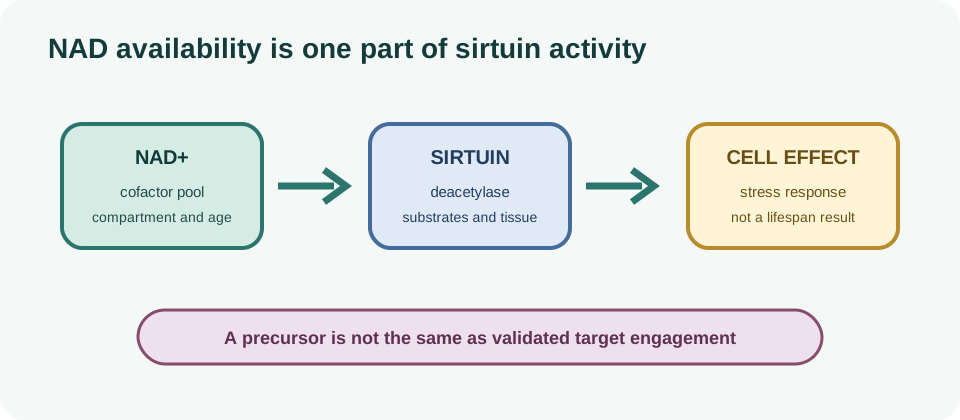
Sirtuins are enzymes that use nicotinamide adenine dinucleotide, or NAD+, as a required co-substrate for deacylation or ADP-ribosylation reactions. In simple terms, their activity is connected to both the protein target and the cell’s metabolic state. NAD+ availability changes with nutrient status, cellular stress, age, tissue and the activity of enzymes that consume or recycle it.
That relationship is often compressed into the slogan that “more NAD+ activates sirtuins.” The actual biology is more conditional. Raising NAD+ in blood does not guarantee a meaningful increase in the right subcellular pool, target engagement in the right tissue, or a favorable change in a clinical outcome. Enzyme activity can also be limited by substrate access, competing reactions, inhibitor levels and the expression of the sirtuin itself.
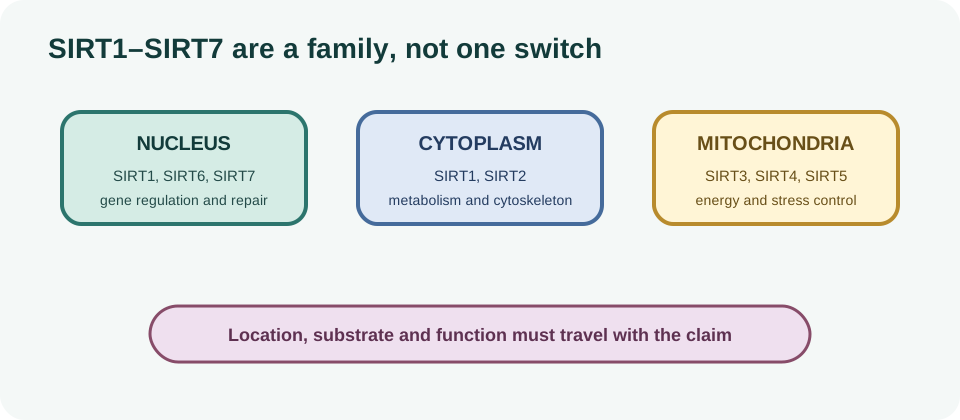
Sirtuins are therefore not a single pathway with one on-off setting. They are a related family of proteins distributed across the nucleus, cytoplasm and mitochondria. Their effects can be protective, neutral or context-dependent. A molecule that changes one enzyme in a cell assay cannot automatically be labeled a systemic anti-aging intervention.
The NAD+ metabolism and aging page provides the broader cofactor context. Here the narrower question is whether changing a sirtuin-related signal has been shown to improve human healthspan or lifespan.
SIRT1 through SIRT7: locations and major functions
SIRT1 is primarily nuclear but can act in the cytoplasm. It deacetylates transcriptional regulators and proteins involved in stress responses, metabolism, inflammation and autophagy. SIRT2 is largely cytoplasmic and is associated with the cell cycle, microtubules, inflammation and protein quality control. Its functions are not interchangeable with SIRT1.
SIRT3 is a major mitochondrial deacetylase. It can modify enzymes involved in oxidative metabolism, antioxidant defense and mitochondrial quality control. SIRT4 is also mitochondrial and participates in metabolic regulation, including amino-acid and lipid-related processes. SIRT5 regulates several mitochondrial and metabolic proteins through desuccinylation, demalonylation and related reactions.
SIRT6 is mainly nuclear and is linked to chromatin, DNA repair, genome stability, telomere biology, inflammation and metabolic regulation. SIRT7 is enriched in the nucleolus and is involved in ribosomal RNA biology, stress responses and chromatin-related regulation. The family shares an NAD+-dependent theme, not one universal physiological job.
Location matters because a result measured in a cultured nucleus may not describe a mitochondrial result in muscle, liver or brain. It also matters for drug development: an activator or inhibitor needs selectivity, tissue exposure and a therapeutic window. Changing expression in a blood sample is not evidence that the intended enzyme was changed in the tissue that determines the clinical outcome.
| Sirtuin | Common location | Representative biology |
|---|---|---|
| SIRT1 | nucleus, cytoplasm | transcription, stress, metabolism and autophagy |
| SIRT2 | cytoplasm, cell cycle structures | microtubules, inflammation and quality control |
| SIRT3 | mitochondria | mitochondrial protein deacetylation and redox biology |
| SIRT4 | mitochondria | metabolic and amino-acid regulation |
| SIRT5 | mitochondria | succinylation and related acylation control |
| SIRT6 | nucleus | DNA repair, chromatin, telomeres and inflammation |
| SIRT7 | nucleolus | ribosomal biology, chromatin and stress responses |
Why the family should not be treated as one pathway
Aging biology is distributed across interacting systems. One sirtuin may promote a stress response in a particular compartment while another changes mitochondrial metabolism or chromatin. Their substrates overlap in some contexts, but they are not redundant copies. A broad “sirtuin activation” label hides the possibility that the same intervention has different effects in different tissues.
Timing also matters. A transient response to fasting, exercise or cellular stress is not necessarily equivalent to chronic pharmacological activation. Biological adaptation can be beneficial within a range and harmful outside it. Some sirtuin functions may protect a damaged cell, while other settings require senescence, apoptosis or immune activation to prevent disease.
Assay choice creates another trap. Gene expression, protein abundance, enzyme activity, acetylation of a substrate and a downstream clinical outcome are separate measurements. A change in one layer can occur without a change in the next. A blood SIRT1 value is not a direct readout of enzyme activity in muscle or brain, and a clock response is not proof of target engagement.
The epigenetic aging guide explains why a molecular readout must not be promoted to a clinical endpoint. The same evidence discipline applies here: mechanism is important, but it is not the final outcome.
Model-organism lifespan evidence and where it is strongest
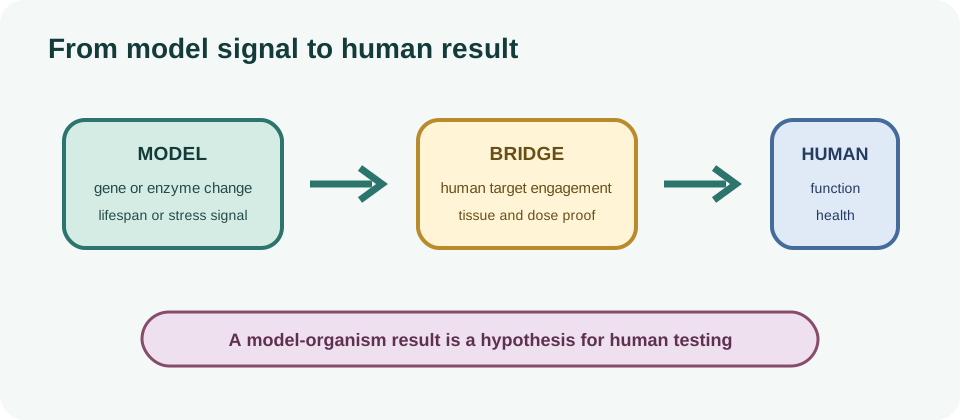
Sirtuins became prominent in longevity research because genetic manipulation of sirtuin-related pathways can alter stress resistance, metabolism and lifespan in organisms such as yeast, worms, flies and mice. These studies can reveal conserved biology and identify conditions under which a pathway is worth testing. They also provide tools for studying tissue-specific function and causality.
Translation is not automatic. Organisms differ in lifespan, metabolism, diet, laboratory conditions and the way a gene is manipulated. Overexpression, tissue-specific knockout and drug exposure answer different questions. A gene dosage that changes lifespan in a worm does not define a safe human dose, and a laboratory diet cannot be assumed to resemble a human dietary pattern.
Model results are strongest when they are replicated, tissue-specific, mechanistically coherent and linked to functional outcomes. They become less persuasive when the effect depends on a narrow strain, a supraphysiological expression system or a surrogate measured only after a short exposure. Even a reproducible mouse lifespan effect needs a human target-engagement and clinical-outcome bridge.
SIRT1: metabolism, stress signaling and autophagy
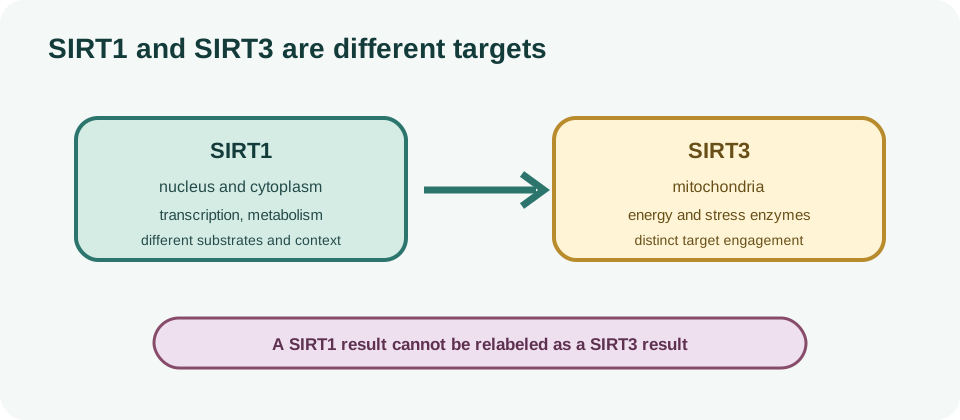
SIRT1 is often discussed as the prototypical longevity sirtuin. It can deacetylate transcription factors and co-regulators involved in energy balance, stress responses, inflammatory signaling and autophagy. These functions make it relevant to fasting biology, exercise adaptation and metabolic disease research.
However, a pathway can be important without being a universally beneficial target. SIRT1 activity may depend on cell type, nutrient state, NAD+ availability and the identity of the substrate. An intervention that increases a SIRT1-related marker in peripheral blood may not reproduce the effects of caloric restriction, exercise or a tissue-specific genetic manipulation.
Resveratrol became a popular proposed SIRT1 activator after laboratory studies suggested effects on SIRT1-related biology. Subsequent work has shown that its pharmacology is complex, including concentration, assay and off-target questions. The correct human question is not whether resveratrol can touch a pathway in a cell, but whether a standardized intervention improves validated outcomes in people.
SIRT3: mitochondrial protein deacetylation
SIRT3 is localized mainly to mitochondria, where it can regulate the acetylation state of proteins involved in oxidative phosphorylation, fatty-acid oxidation, antioxidant defense and mitochondrial stress responses. This makes SIRT3 relevant to the mitochondrial dysfunction and aging page and to research on muscle, heart, liver and brain.
Mitochondrial biology is especially vulnerable to overinterpretation because “better mitochondrial function” can describe many different assays. Oxygen consumption, membrane potential, reactive oxygen species, ATP production and exercise capacity are not interchangeable. A compound can improve one assay while changing another, and a cellular improvement may not persist in a whole organism.
SIRT3 research supports a plausible route from NAD+ metabolism to mitochondrial regulation. It does not establish that an NAD precursor, resveratrol product or unselective activator reaches SIRT3 in the relevant human tissue at a beneficial exposure. Direct human trials with functional aging endpoints remain the missing bridge.
SIRT6: DNA repair, genome stability and longevity genetics
SIRT6 has attracted unusual attention because it connects chromatin regulation, DNA repair, telomere biology, inflammation, metabolism and cellular senescence. Reviews published in 2025 describe SIRT6 as a potential therapeutic target in several age-related diseases. Those reviews are useful maps of the field, but they are not evidence that a SIRT6 drug is ready for general human aging.
In model systems, changing SIRT6 can affect genome maintenance and disease-related phenotypes. The direction and magnitude of the effect depend on tissue, timing and the specific manipulation. A protein that helps preserve genome stability in one context may have different consequences when activated chronically or in a tissue with a different stress burden.
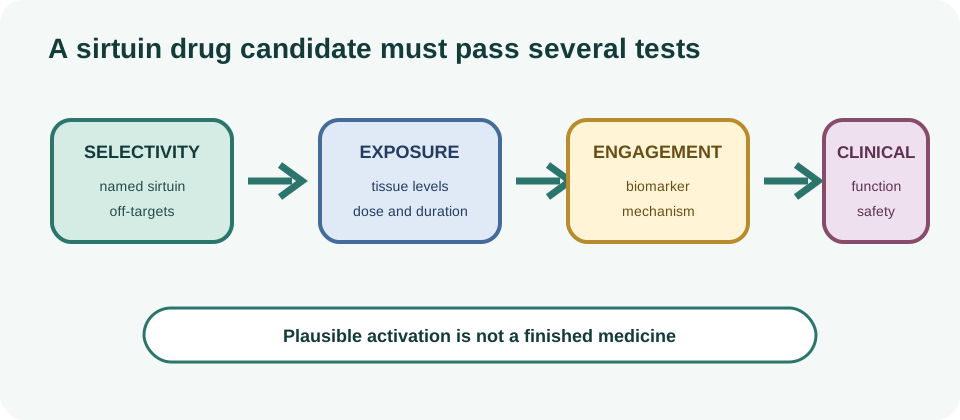
Drug development faces a selectivity problem. A SIRT6 modulator must engage the desired activity, in the desired tissue, without disrupting other sirtuins or essential stress responses. It also needs pharmacokinetics, toxicology and a clinical endpoint. A promising chemical probe is not the same thing as an approved anti-aging therapy.
Human centenarian SIRT6 variants: what they do and do not prove
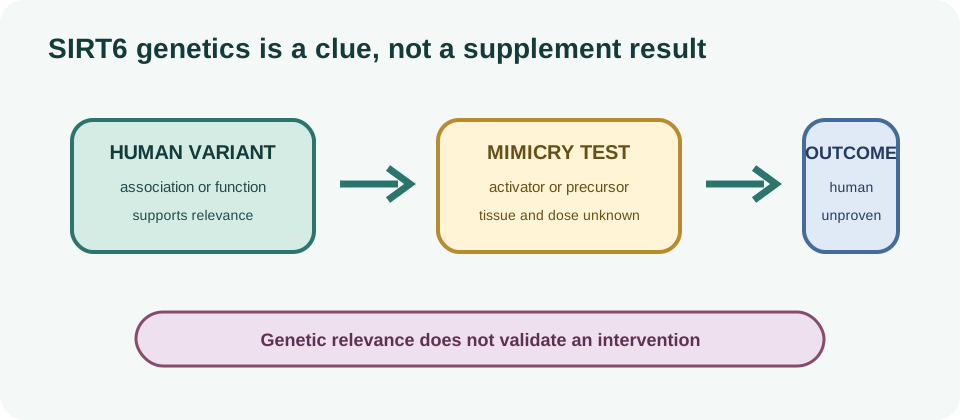
A rare human centenarian variant study provides important genetic evidence. Targeted sequencing in an Ashkenazi Jewish centenarian cohort identified enrichment of a SIRT6 allele containing two linked substitutions. Functional experiments reported stronger suppression of LINE1 retrotransposons, enhanced DNA double-strand-break repair and a stronger interaction with Lamin A/C, while the variant had weaker deacetylase activity but stronger mono-ADP-ribosylation activity under the tested conditions.
This is valuable because it shows that human exceptional longevity can be associated with a functionally characterized SIRT6 variant. It also makes the story more nuanced than “more SIRT6 is better”: the variant changed different enzymatic activities in different directions. The work included a defined population, cell and biochemical experiments, not a randomized human intervention.
A naturally occurring variant cannot be copied simply by taking an NAD precursor or a resveratrol capsule. Genetic background, lifelong exposure, tissue distribution and the exact molecular change all differ. The finding supports SIRT6 as a candidate for further study; it does not demonstrate that a supplement can mimic the variant or extend life in a person without it.
Human cohort evidence for SIRT1, SIRT3 and SIRT6
Human observational studies and pilot cohorts can establish that sirtuin measures vary with age, disease, lifestyle or exceptional longevity. A 2025 exploratory study examining SIRT1, SIRT3 and SIRT6 is useful as preliminary evidence because it evaluates the family in humans rather than relying entirely on models. Its small, exploratory nature limits what can be inferred.
Expression and protein abundance are not the same as enzyme activity. Blood is not every target tissue. A cross-sectional difference between older adults and a comparison group may reflect health status, medication, cell composition, nutrition or survivor selection. Even a prospective association does not prove that changing the measure would change the outcome.
Human cohort work is therefore best used to refine hypotheses and identify measurable target-engagement signals. It should not be used to claim that a product “boosts longevity genes” unless the assay, tissue, comparator and clinical relevance are all established. The biological-age test page offers the same hierarchy for aging biomarkers.
Resveratrol as a proposed SIRT1 activator
Resveratrol is a polyphenol found in some foods and widely sold as a supplement. It became associated with SIRT1 after early laboratory work suggested direct or indirect activation under particular assay conditions. Human pharmacology is harder: absorption, metabolism, conjugation, tissue exposure and product formulation can all separate a cell result from a clinical dose.
The 2025 systematic review and meta-analysis of randomized controlled trials assessed human SIRT1-related measures across 11 trials. It found no significant overall effect on SIRT1 gene expression, protein expression or serum levels. A pooled null result does not prove that every formulation has no biological effect, but it does weaken the claim that resveratrol reliably activates human SIRT1 in a way that has been demonstrated to slow aging.
Clinical outcomes must be reported separately from target markers. A change in glucose, endothelial function, inflammation or a laboratory assay would not establish lifespan extension. Dose studied, duration, adherence, baseline health and adverse effects also matter. Resveratrol should remain an experimental or indication-specific research topic, not a proven sirtuin-based anti-aging intervention.
| Finding | Evidence level | What it does not prove |
|---|---|---|
| SIRT1 expression change | molecular or biomarker | target enzyme activation in every tissue |
| SIRT1 protein or serum measure | human target-related signal | slower aging or longer life |
| metabolic outcome | clinical or intermediate endpoint | general longevity benefit |
| mortality or disability result | patient-important endpoint | transferability to a different product or population |
NAD precursors and indirect sirtuin activation claims
Nicotinamide riboside, NMN and related compounds are studied because they may alter NAD+ metabolism. That is a reasonable research strategy, but it is indirect evidence for sirtuin activation. An increase in circulating NAD-related metabolites does not demonstrate target engagement by SIRT1, SIRT3 or SIRT6 in the tissue that matters.
The NMN longevity page and nicotinamide riboside page separate precursor pharmacology from human outcomes. Product quality, dose, duration, baseline status and metabolic response can differ. Even if a precursor increases NAD+ in a study, the next questions are which sirtuin changed, whether its substrate changed, whether function improved and whether safety was maintained.
“Indirect activation” is therefore a hypothesis, not a guaranteed mechanism. Sirtuins can be influenced by NAD+ availability, but NAD+ is also used by PARPs, CD38 and other pathways. A precursor can change the balance among these systems. Human trials need tissue-aware target-engagement measures and prespecified clinical endpoints before marketing language can move beyond plausibility.
Why changing SIRT expression is not the same as slowing aging
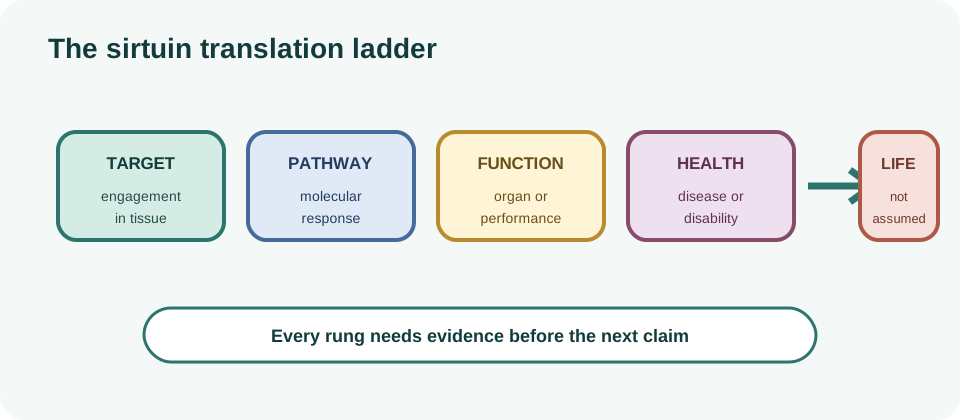
Healthy aging is not defined by one gene-expression value. It includes preserved function, lower disease burden, resilience after stress and meaningful quality of life. A molecular change may be causal, compensatory, incidental or a consequence of medication and illness. Without temporal and intervention evidence, expression cannot tell us which explanation is correct.
There is also no single “correct” level for every sirtuin in every tissue. SIRT1, SIRT3 and SIRT6 may each be beneficial in one context and insufficient or maladaptive in another. A whole-body product can expose tissues differently, and chronic activation may not reproduce a short physiological pulse. These uncertainties make broad anti-aging claims particularly unreliable.
A strong human study would predefine target engagement, functional outcomes and safety. It would distinguish primary endpoints from exploratory biomarkers, report absolute effects and follow participants long enough to detect durable benefit or harm. A lower inflammatory marker, improved mitochondrial assay or younger epigenetic estimate could be supportive, but none substitutes for healthspan or survival evidence.
Drug-development efforts around SIRT6 and other sirtuins
SIRT6 and other sirtuins are active drug-development targets because they sit at the intersection of genome maintenance, metabolism and age-related disease. Current reviews discuss small molecules, activators, inhibitors, engineered proteins and delivery approaches. These efforts can produce valuable probes even before a therapy is clinically established.
Drug development should be judged by selectivity, potency in relevant human systems, pharmacokinetics, tissue exposure, toxicology and a defined indication. A compound that changes a purified enzyme is not necessarily selective in a cell. A compound that changes a cell assay is not necessarily safe or effective in a person. And an intervention aimed at one disease cannot automatically be offered as a general aging treatment.
Human translation also needs a comparator and a meaningful endpoint. If a SIRT6 modulator is being tested for a disease, that disease endpoint is the claim being tested. If the proposed claim is geroscience, the trial must measure function, disability, disease burden or another validated outcome over a suitable period. The AMPK aging page and mTOR aging page show why adjacent nutrient-sensing pathways also require this target-to-outcome discipline.
Evidence verdict and translational gaps
Sirtuins are compelling biology, not settled human longevity medicine. SIRT1 through SIRT7 have different locations and functions. NAD+ availability is relevant but does not guarantee target engagement. Model organisms demonstrate that sirtuin-related manipulation can influence lifespan or healthspan under defined conditions, while human genetics—especially the rare SIRT6 centenarian variant—supports biological relevance without proving that a supplement can imitate it.
Human cohort and pilot evidence remains preliminary. The 2025 resveratrol meta-analysis found no significant overall increase in human SIRT1 measures, and no intervention has shown that activating a sirtuin extends human lifespan. Expression, protein abundance, serum levels and pathway markers should not be presented as validated healthspan surrogates.
The responsible conclusion is sirtuins are credible targets for aging research, but human lifespan extension is unproven. A decisive trial would name the sirtuin and intervention, demonstrate target engagement in relevant tissue, prespecify functional and disease outcomes, monitor adverse effects, and follow participants long enough to test durable healthspan or survival. Until then, “activate your sirtuins” is a hypothesis-led marketing phrase, not an established medical recommendation.
- identify the specific sirtuin rather than treating the family as one switch;
- separate NAD+ availability from direct target engagement;
- treat centenarian genetics as evidence about biology, not a supplement recipe;
- keep molecular markers separate from clinical and lifespan outcomes;
- require human intervention evidence before using anti-aging language.