What sarcopenia is—and why it is more than low muscle mass
Sarcopenia is a muscle disease characterized by adverse changes in skeletal muscle that accumulate across the life course. Aging, inactivity, undernutrition, acute illness, chronic disease, inflammation, medication and hormonal changes can interact. It can occur in later life but is not defined by chronological age alone.
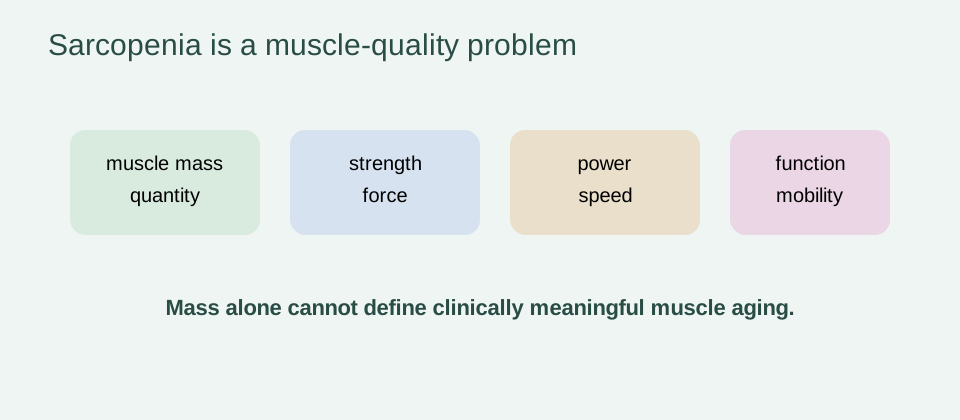
Lean mass is only one component. A person may have a reasonable amount of muscle but poor strength because of neuromuscular, metabolic or muscle-quality changes. Conversely, a smaller person may function well. The diagnosis therefore needs a clinically meaningful hierarchy rather than a single body-composition threshold.
Normal muscle aging versus sarcopenia
Normal aging commonly includes slower muscle protein turnover, loss of motor units, reduced power and changes in fiber composition. These changes increase vulnerability but do not automatically mean that a person has sarcopenia. The disorder is diagnosed when clinically relevant weakness is identified and supported by quantity or quality assessment under a recognized framework.
Secondary contributors should be considered. Recent hospitalization, pain, arthritis, neurologic disease, heart or lung disease, depression, medication effects and inadequate food intake can reduce performance. Treating or accounting for these factors may be part of a safe clinical plan and prevents a muscle label from obscuring another condition.
| Stage | Question | Interpretive role |
|---|---|---|
| Find | is low strength suspected? | case-finding and need for assessment |
| Assess | is strength objectively low? | probable sarcopenia |
| Confirm | is muscle quantity or quality low? | confirmed sarcopenia |
| Severity | is physical performance poor? | severe sarcopenia and higher functional concern |
EWGSOP2 and other diagnostic frameworks
The revised European consensus, EWGSOP2, emphasizes low muscle strength as the key characteristic, uses low muscle quantity or quality to confirm the diagnosis, and treats poor physical performance as a marker of severe sarcopenia. Its Find–Assess–Confirm–Severity sequence is designed to support case-finding and consistent research.
Other groups use related but not identical thresholds, equipment and population references. Handgrip dynamometry, chair-rise testing, gait speed, appendicular lean mass, ultrasound, CT, MRI and bioimpedance each have different strengths. A result should therefore name the framework and measurement method rather than implying one universal cutoff.
Why muscle strength is central
Strength integrates muscle tissue, motor units, nervous-system drive, coordination, pain, motivation and task familiarity. It is often more closely tied to falls, mobility and independence than muscle quantity alone. Power—the ability to produce force quickly—can decline early and is relevant to recovering from a trip or rising from a chair.
Strength testing is not perfect. Results depend on protocol, encouragement, device calibration, hand pain, learning effects and whether the tested movement represents daily function. Repeated standardized tests and a broader performance assessment make interpretation more robust.
Muscle quantity, quality, fat infiltration and physical performance
DXA and bioimpedance estimate body composition, but they do not directly measure contractile quality. Fat infiltration, fibrosis, fiber composition, architecture, mitochondrial capacity and neuromuscular activation can all affect force. CT or MRI may characterize quality more directly in research, although access, radiation, cost and interpretation limit routine use.
Physical performance adds an outcome-facing layer. Gait speed, timed-up-and-go, repeated chair rise, stair performance and walking endurance can reveal whether a muscle change affects daily activity. Poor performance can also arise from cardiopulmonary, neurologic, vestibular or joint disease, so it should not be attributed to sarcopenia without context.
Motor units, denervation and neuromuscular-junction aging
Muscle force depends on the motor units that connect spinal neurons to fibers. Aging can reduce motor-unit number, enlarge surviving units through reinnervation and change neuromuscular-junction stability. These adaptations may preserve force for a time but reduce reserve and make rapid or complex movement more difficult.
Denervation, peripheral nerve disease and inactivity can accelerate weakness. A low grip result is not specific to muscle tissue and may reflect pain, nerve compression or neurologic disease. This is one reason a comprehensive assessment is more useful than a single consumer measurement.
Anabolic resistance, protein synthesis and nutrition
Older muscle may show a smaller synthetic response to a given meal or exercise stimulus, often described as anabolic resistance. Appetite loss, dental problems, swallowing difficulty, food insecurity, hospitalization and chronic disease can worsen inadequate intake. Protein quality and distribution across meals may matter, but there is no one universal prescription for every person.
Nutrition evidence must be interpreted alongside kidney function, liver disease, heart failure, medication, frailty and total energy intake. Supplementation cannot substitute for diagnosis, rehabilitation or treatment of an underlying illness. The safest page-level claim is that nutrition is a component of a supervised, individualized plan rather than a stand-alone anti-aging therapy.
Mitochondrial dysfunction, oxidative metabolism and inflammaging
Mitochondria supply energy for contraction and recovery. Age-related changes in mitochondrial quality control, oxidative metabolism and redox signaling can contribute to fatigue or reduced reserve, but muscle performance is also shaped by blood flow, nervous-system activation and training history. The mitochondrial dysfunction page provides broader mechanistic context.
Chronic inflammatory signaling, endocrine changes and acute illness can promote catabolism or impair recovery. The inflammaging page explains why a lower inflammatory marker is not automatically stronger muscle. Mechanism, biomarker and functional outcome should remain separate claims.
Satellite cells, regenerative capacity and frailty
Satellite cells help repair and remodel skeletal muscle. Their activity, local niche and response to injury can change with age, inflammation, inactivity and repeated stress. Animal and cellular findings are valuable for mechanism, but they do not establish that a regenerative intervention improves strength or survival in older adults.
Frailty and sarcopenia overlap but are not equivalent. Frailty is a broader vulnerability involving energy, mobility, cognition, illness and recovery. Sarcopenia is centered on muscle failure. A person can have one without fully meeting criteria for the other, and both may need attention in a rehabilitation plan.
Clinical context changes the meaning of a performance decline. A fall after hospitalization, a new difficulty climbing stairs and progressive loss of grip strength may require different assessments even when all are described informally as “weakness.” Structured evaluation helps connect a muscle finding with a safe intervention.
Regenerative claims also need a durable endpoint. More satellite-cell activity, improved muscle histology or a larger cross-sectional area could be biologically interesting without improving walking, transfers, independence or recovery from illness. Those distinctions should be explicit in future trials.
Clinically relevant outcomes and the 2025 GLIS consensus
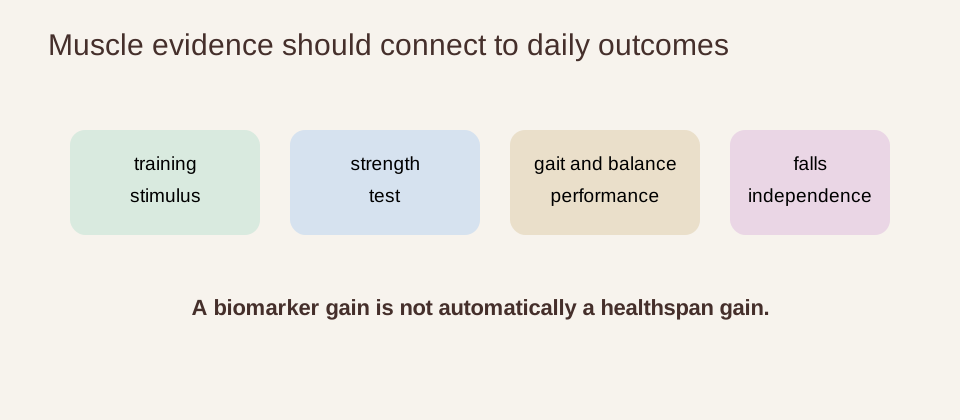
Outcome frameworks increasingly emphasize what happens to the person: falls, mobility, activities of daily living, walking capacity, hospitalization, quality of life and survival. Strength and mass can be important intermediate measures, but a trial should declare which are primary and which are supportive.
The 2025 GLIS consensus is useful because it focuses attention on clinically meaningful sarcopenia outcomes. Consensus improves endpoint selection; it does not prove that every proposed intervention works. A trial with a larger muscle area but no functional or safety benefit should not be described as disease reversal.
Resistance training evidence in diagnosed sarcopenia
Resistance training is the core evidence-based intervention because it directly challenges force production and can improve strength, power, function and sometimes muscle mass. Programs differ in supervision, intensity, frequency, progression, baseline disability and adherence, so results should not be reduced to one routine.
Older adults with severe weakness, balance problems, pain, cardiopulmonary disease or recent illness may require professional assessment and graded rehabilitation. This article does not provide an individualized exercise prescription. The evidence supports resistance-centered care as a category, not unsupervised intensity for every reader.
Protein, amino acids and combined exercise plus nutrition
Protein-based interventions may support muscle remodeling when intake is inadequate or when paired with training, but effects vary by dose studied, protein source, energy balance, baseline status and outcome. Amino-acid or leucine-enriched products can improve selected measures in some studies without proving reduced falls, disability or mortality.
Recent network meta-analyses comparing exercise and protein-based interventions are useful for ranking evidence, but heterogeneity and certainty still matter. The strongest practical conclusion is that exercise and nutrition should be integrated into assessment and rehabilitation, with medical constraints reviewed by qualified professionals.
A supplement can also be difficult to evaluate because it changes several inputs at once: total calories, protein adequacy, training adherence and confidence in recovery. Trials should distinguish the supplement’s incremental effect from the effect of supervised exercise or correction of deficiency.
Strength and function may improve without a large change in lean mass, while body composition may change without better mobility. Reporting both intermediate and patient-important outcomes helps prevent a favorable result in one domain from being marketed as complete muscle rejuvenation.
Creatine and other adjuncts: evidence without overclaiming
Creatine has been studied as an adjunct to resistance training and rehabilitation, with some trials reporting improvements in strength or lean mass. The magnitude and durability of benefit vary, and a supplement result is not evidence that creatine reverses muscle aging or extends lifespan.
The creatine page for older adults and creatine longevity page keep the evidence and safety context separate. People with kidney disease, relevant medicines or complex medical conditions should obtain qualified advice before using supplements.
| Finding | What it may support | What it cannot prove |
|---|---|---|
| Strength gain | improved force production in a study | longer survival |
| Lean-mass gain | body-composition change | better mobility without functional data |
| Biomarker change | mechanistic signal | disease reversal |
Emerging pharmacologic targets and future biomarkers
Myostatin and activin signaling, anabolic hormones, metabolic drugs, senolytic strategies and muscle-regeneration approaches remain active research areas. A drug can increase muscle mass without improving strength or performance, and a biomarker can change without reducing falls or disability. No pharmacologic approach has established reversal of muscle aging or lifespan extension through sarcopenia treatment.
Future geroscience trials should prespecify diagnosis, strength, quantity or quality, physical performance, patient-reported function, falls, hospitalization, adverse events and follow-up. Biomarkers can explain mechanism, but the decisive endpoints should remain meaningful to patients and caregivers.
Myostatin-pathway results are especially vulnerable to endpoint mismatch: a larger muscle may not translate into better force if neuromuscular activation, tendon function, balance or cardiorespiratory reserve remains limiting. A disease-modifying claim therefore needs more than an anabolic signal.
Safety duration matters as much as early efficacy. Older adults may have multimorbidity and polypharmacy, and a therapy that changes muscle or metabolism could affect cardiovascular, hepatic, renal or oncologic risk. Long-term follow-up should be part of the evidence plan, not an afterthought.
Evidence verdict and clinical boundaries
Sarcopenia is a clinically important muscle disorder associated with falls, disability and mortality. Modern frameworks prioritize low strength and use muscle quantity or quality to confirm the diagnosis, with physical performance indicating severity. This is why a body-composition report alone is insufficient.
Resistance-centered exercise, often combined with appropriate nutrition, remains the strongest human intervention foundation. Creatine and other adjuncts may be studied in defined contexts, while myostatin, senescence and metabolic therapies remain emerging. Improvement in strength, mass or gait does not prove lifespan extension.
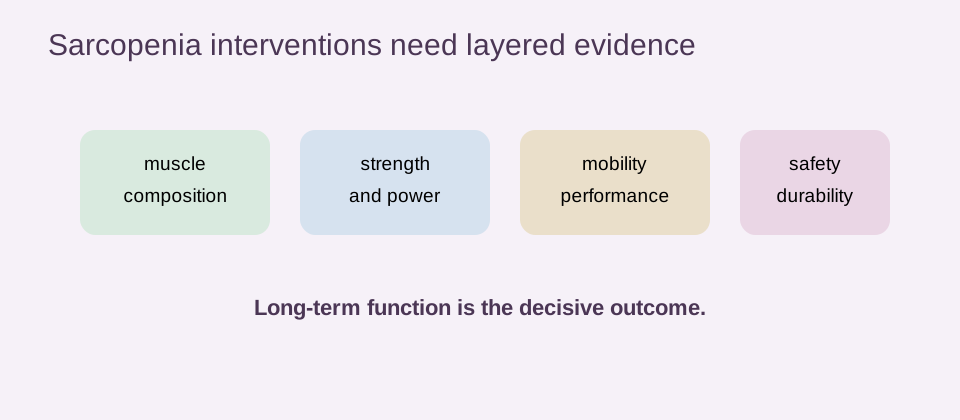
The responsible conclusion is sarcopenia care should be function-led and clinically contextualized, while drug-based muscle rejuvenation remains unproven. Future trials must show durable improvements in meaningful outcomes and acceptable clinical safety, not just a larger muscle or a favorable biomarker.
- do not diagnose sarcopenia from lean mass alone;
- put strength and function at the center;
- separate consensus definitions from treatment efficacy;
- label supplement and drug results by study design and outcome;
- avoid individualized exercise or protein prescriptions without clinical context.