Why taurine became an aging candidate
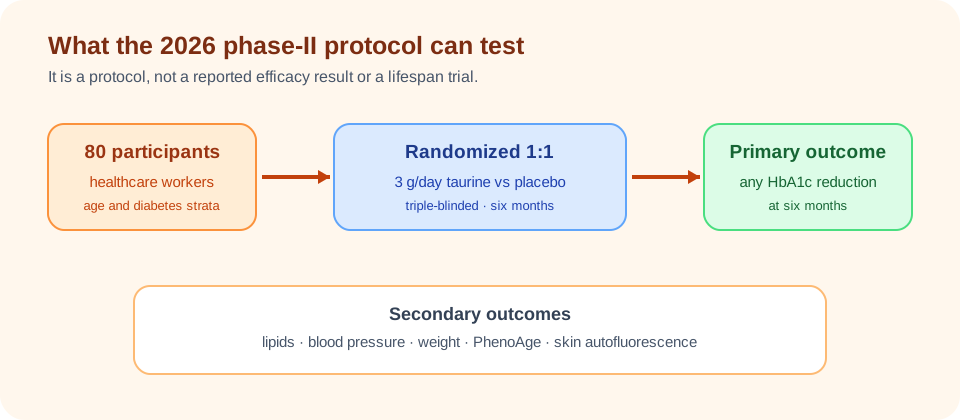
Taurine is a sulfur-containing compound present in human tissues and food. It has been studied in relation to osmoregulation, bile-acid biology, mitochondrial function, inflammation and oxidative stress. Animal findings and observational associations helped create interest in whether taurine availability changes with age or metabolic health.
Those mechanisms are reasons to test a defined intervention, not evidence that supplementation slows aging. The effect of a supplement depends on baseline taurine status, diet, health, dose, duration and the outcome selected. An antioxidant-marker change may be biologically interesting while remaining far from a clinical aging endpoint.
The wider taurine longevity page covers the broader hypothesis. This brief focuses on what the new human studies actually registered and what their designs can answer.
NCT06613542: the six-month TauAge study
The ClinicalTrials.gov record for NCT06613542 describes a randomized controlled study sponsored by the Technical University of Munich. Adults aged 55–75 were assigned to 4 g of taurine daily or placebo for six months. The record reports actual enrollment of 90 participants, an actual study completion date of November 13, 2025 and a last posted update of November 18, 2025. I rechecked the registry on September 27, 2026: it still lists the study as completed and has no results posting.
The study includes proteomic biological-age and organ-age estimates, DNA methylation, inflammatory biomarkers, fasting glucose, insulin, HOMA-IR, HbA1c, lipids, BMI, handgrip strength, leg-extensor strength, physical work capacity, resting energy expenditure, cognitive questionnaires, quality of life, physical activity and nutrition. This is a broad measurement package, not a guarantee that every endpoint will be analyzed as a primary outcome.
The record is marked completed, but it does not display posted results. “Completed” means the study phase ended; it does not mean the intervention worked. Until a results publication or registered results table is available, the correct status is completed without public efficacy results.
| Registered feature | What it supports | What remains unknown |
|---|---|---|
| Population | adults aged 55–75; actual enrollment 90 | generalizability to other ages or illnesses |
| Intervention | 4 g taurine daily for six months versus placebo | long-term safety or lifespan effect |
| Measures | proteomic age, methylation, metabolism, fitness and cognition | which endpoint is primary and whether it changed |
| Current result status | study completed; record has no posted results | efficacy, harms and prespecified analysis |
Proteomic biological age, fitness and metabolic outcomes
The TauAge design is valuable because it does not reduce aging to one number. It combines proteomic age and organ-age estimates with fitness, metabolic, inflammatory, cognitive and quality-of-life measures. That allows researchers to ask whether a biomarker response, if observed, is accompanied by changes in function or health-related outcomes.
It also creates a multiple-testing problem. The more outcomes a study measures, the more important it is to distinguish primary, secondary and exploratory analyses. A favorable change in one proteomic estimate should not be reported as if the whole study demonstrated rejuvenation.
Proteomic age and organ-age measures are prediction tools, not literal readings of how old an organ is. The biological-age test page explains why responsiveness, prediction and surrogate validation are separate standards. A change in a score would need replication and clinical interpretation before it could support a healthspan claim.
The 2026 phase II healthcare-worker protocol
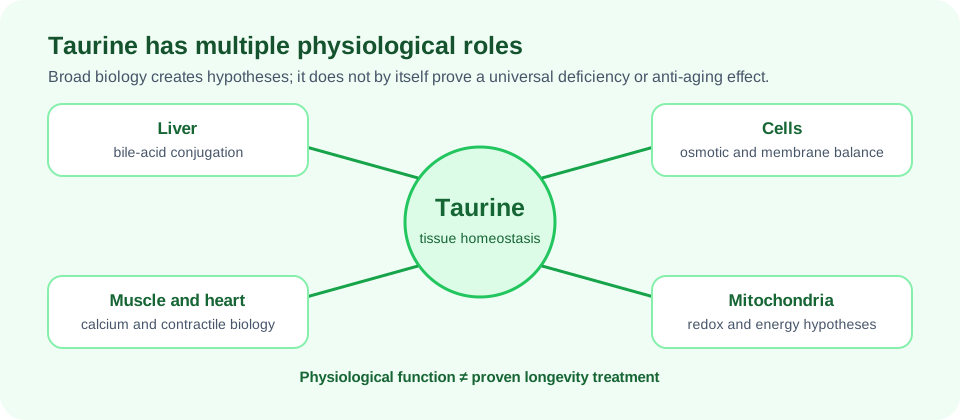
A 2026 PLOS One publication describes the Taurine Or Placebo, or TOP, healthcare-worker trial as a triple-blinded, Bayesian-optimized phase II randomized controlled trial. The protocol plans to randomize up to 80 participants to 3 g/day taurine or indistinguishable placebo for six months, with stratification by diabetes status and age above or below 45 years.
Its primary outcome is the proportion of participants with any reduction in HbA1c at six months compared with baseline. Secondary outcomes include plasma lipids, blood pressure, PhenoAge, body weight and skin autofluorescence. This hierarchy matters: the protocol is principally a metabolic phase II test. A secondary change in PhenoAge would not automatically establish that taurine slows aging.
The Bayesian design evaluates posterior probabilities at interim data points after 20, 40 and 60 participants, with planned stopping for futility or superiority before a total enrollment of 80 if the prespecified rules support it. Interim monitoring can make a study more efficient, but it does not remove the need for transparent reporting of the stopping rule, missing data, harms and final analysis.
How studied doses differ from a longevity recommendation
The two current protocols use 4 g/day and 3 g/day, respectively. Those amounts describe the interventions selected by researchers; they are not individualized dosing advice. The studies also differ in population, endpoint hierarchy and design, so their doses cannot be compared as if they were a head-to-head dose-finding trial.
Earlier human work provides context but not a definitive dose. A 2022 double-blind trial randomized 24 women aged 55–70 to 1.5 g/day taurine or placebo for 16 weeks and measured oxidative-stress biomarkers, with SOD increasing in the taurine group. That is a small biomarker study with a different dose and endpoint from both 2026 protocols.
Why protocol publication is not a positive trial result
A protocol tells readers what investigators intended to test: eligibility, allocation, dose, duration, endpoints and analysis. It does not tell readers the direction, size or certainty of the eventual result. A registered study can be important even when it is null, because null results constrain claims and reveal which hypotheses did not survive a controlled test.
For taurine, a meaningful update would require the primary results of the TauAge study and the TOP trial, including adherence, adverse events, missing data, prespecified endpoint hierarchy and absolute changes. Biomarker results should be presented alongside metabolic and physical outcomes, not as a substitute for them.
The taurine biomarker debate page tracks that distinction. The proteomic aging clocks page covers why an age-prediction model should not be treated as a validated surrogate for lifespan.
Evidence verdict and what would change it
Taurine has moved from mostly preclinical and small biomarker evidence into registered randomized human research. The TauAge study tested 4 g/day for six months in 90 adults aged 55–75 and included proteomic age, fitness, metabolic and cognitive measures, but the current record has no posted results. The TOP phase II protocol tests 3 g/day for six months with HbA1c as the primary endpoint and PhenoAge and skin autofluorescence as secondary outcomes.
The responsible conclusion is these trials demonstrate scientific interest and methodological progress, not that taurine slows human aging. A stronger evidence verdict would require public results, clinically interpretable effect sizes, transparent harms and independent replication. Even a favorable biomarker result would not prove longer life without validation against outcomes that matter.
- label 3 g/day and 4 g/day as study doses;
- separate HbA1c from PhenoAge and proteomic-age outcomes;
- treat completed-without-results as unknown efficacy;
- keep the 2022 oxidative-stress trial in the small-biomarker category;
- watch for registered results and peer-reviewed primary reports;
- do not provide personalized taurine dosing or longevity advice.