Scope: This Research Watch explains one cohort study and its NHANES replication. It does not diagnose a sleep disorder or advise people to restrict sleep.
What the study measured
The 2026 Nature Communications analysis included 85,618 UK Biobank participants with at least three valid days of accelerometer data. Participants had a mean age of 61.8 years; 43.5% were male. Investigators analyzed 574,230 person-nights and followed participants for a median of 8.0 years, during which 3,549 deaths were recorded. The exposure was a pattern across observed nights, not a randomized sleep schedule.
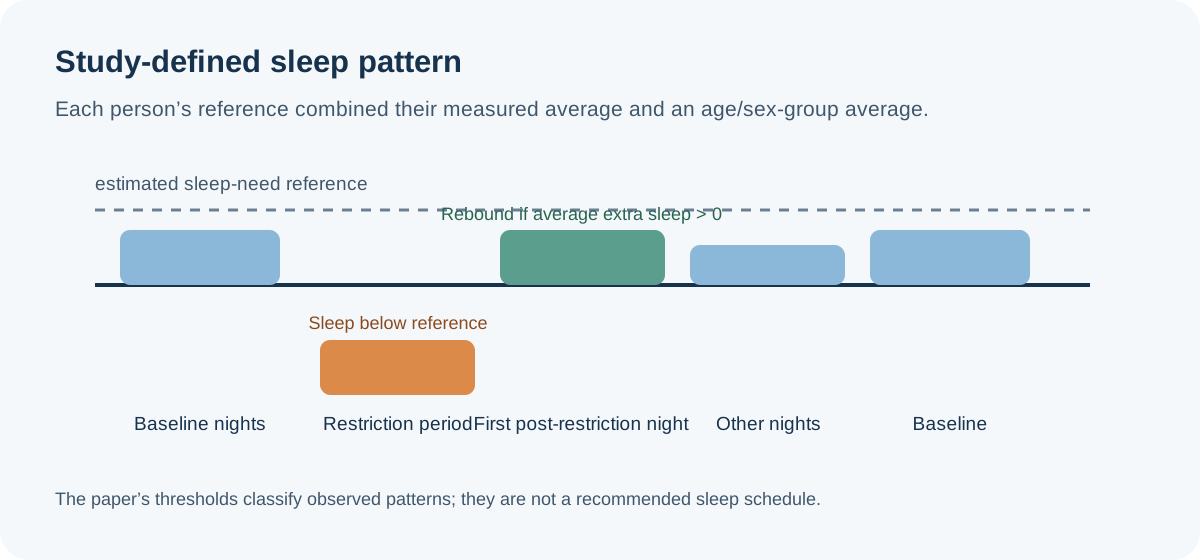
How restriction and rebound were defined
The study estimated sleep need using the greater of each participant’s average sleep during valid device days or the mean for people in the same age and sex categories. A restriction night was at least 2.5 hours below that estimated reference. The first night after each restriction period was the post-restriction night. “Rebound” meant average extra sleep greater than zero relative to the estimated need on those post-restriction nights.
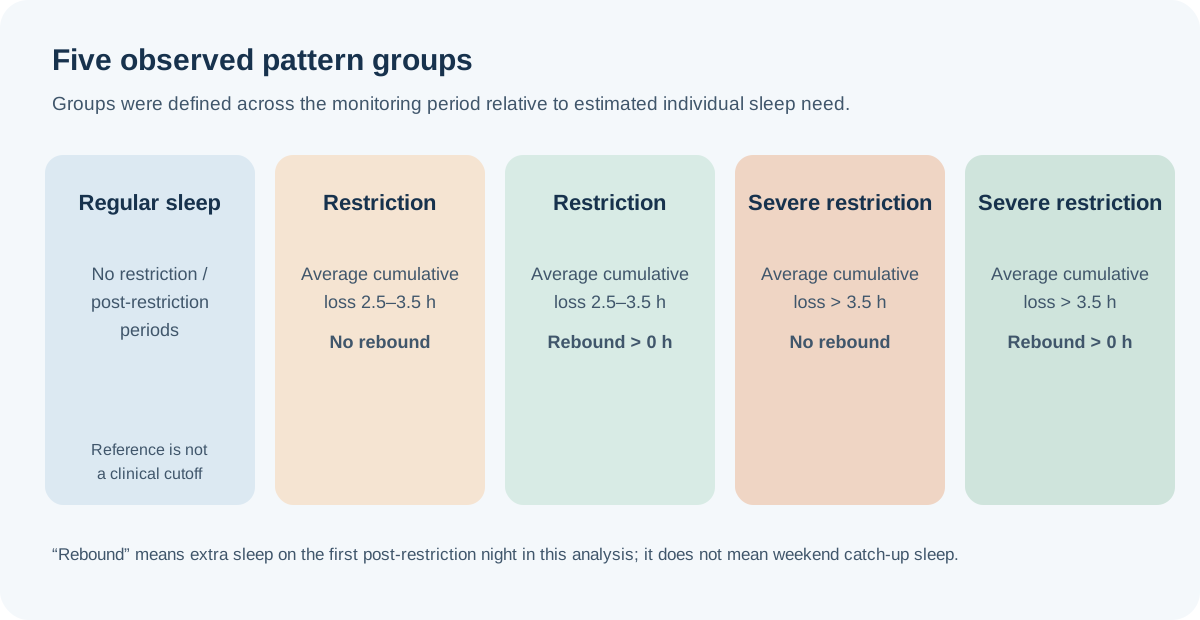
Across restriction periods, average cumulative sleep loss of 2.5 to 3.5 hours defined sleep restriction; more than 3.5 hours defined severe restriction. These are operational categories in this paper. They are not clinical cutoffs or recommendations for how much sleep a person should lose or recover.
What the mortality estimates showed
In fully adjusted models, both regular-sleep comparison groups without rebound had higher all-cause mortality estimates than the regular-pattern group. The standard restriction-without-rebound group had a hazard ratio (HR) of 1.15 (95% confidence interval [CI] 1.01–1.31); severe restriction without rebound had an HR of 1.42 (95% CI 1.24–1.63). For groups with rebound, estimates were 1.12 (95% CI 0.98–1.28) and 1.13 (95% CI 0.95–1.36). Their confidence intervals included 1.0.
| Study-defined group | HR | 95% CI | What the estimate supports |
|---|---|---|---|
| Restriction, no rebound | 1.15 | 1.01–1.31 | Higher estimated hazard in this adjusted comparison |
| Restriction, rebound | 1.12 | 0.98–1.28 | Estimate uncertain; CI includes 1.0 |
| Severe restriction, no rebound | 1.42 | 1.24–1.63 | Higher estimated hazard in this adjusted comparison |
| Severe restriction, rebound | 1.13 | 0.95–1.36 | Estimate uncertain; CI includes 1.0 |
What the NHANES replication adds
The investigators repeated the pattern analysis in 4,586 NHANES participants and reported 646 deaths over a median 6.8 years. Under the same principal thresholds, severe restriction without rebound was associated with higher mortality than the regular-pattern group (HR 1.41, 95% CI 1.03–1.93). Replication in a separate cohort makes it less likely that the reported pattern is unique to one UK Biobank analysis.
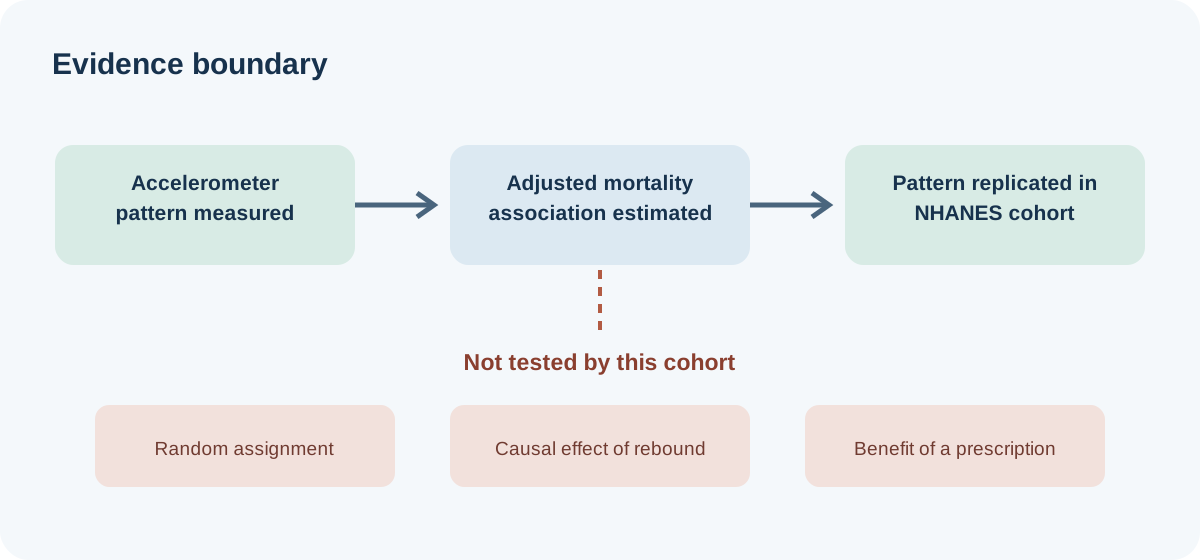
Replication does not remove shared limitations in the exposure definition, accelerometer measurement or observational design. The NHANES analysis also used a different device and sleep-time algorithm, and the cohort’s average measured sleep duration differed from UK Biobank. The result strengthens consistency of an association; it does not establish the mechanism or prove that changing sleep behavior changes mortality.
Why these categories are hard to interpret causally
Sleep restriction was not assigned. Work schedules, caregiving, stress, shift work, socioeconomic conditions, health behaviors and illness can influence both sleep patterns and later health. The authors adjusted for demographic and lifestyle factors, including employment, education, body mass index, smoking, alcohol frequency, activity, night work, chronotype and baseline sleep duration. Additional adjustments and exclusions produced broadly similar findings, but measured covariates cannot remove all unmeasured confounding.
Underlying frailty or preclinical illness could shorten, fragment or otherwise alter sleep before death. The investigators explicitly note that restriction patterns without rebound may reflect underlying frailty rather than cause mortality. Some covariates were measured a median 5.4 years before accelerometry, which can leave residual measurement error. The all-cause outcome also cannot tell which disease process accounts for an association.
Measurement limits and the meaning of rebound
Accelerometry is useful for observing sleep-related movement patterns at scale, but the study’s device window covered only 3–7 days. A short measurement period may capture an atypical week rather than habitual sleep across seasons or life circumstances. The processing algorithm estimated the main sleep period from movement; it was not a clinical sleep study with polysomnography, and estimated sleep duration is not the same as time in bed, sleep quality or a diagnosis of insomnia or sleep apnea.
The sleep-need proxy is another source of uncertainty. Using the greater of a person’s observed average and an age/sex-group mean may overestimate need for some natural short sleepers, as the authors note. Re-estimating the reference using age/sex means gave similar results, but no cohort-wide formula can measure an individual’s biological sleep requirement directly.
The “rebound” window was the first night after a restriction period, which could occur on any day. It should not be conflated with weekend extension, a nap, long-term recovery sleep or a treatment plan. A non-significant mortality estimate in a group does not show that recovery completely cancels earlier restriction, nor that chronic cycles are harmless.
How this fits with sleep guidance and aging research
A joint American Academy of Sleep Medicine and Sleep Research Society consensus statement recommends that adults aged 18–60 regularly obtain at least seven hours of sleep. That public-health context is distinct from this study’s relative, age/sex-informed sleep-need proxy and does not convert the study thresholds into a personal target. The 2026 paper did not randomize people to restrict or extend sleep.
This analysis concerns accelerometer-derived sleep patterns and mortality, not sleep regularity as a separate exposure and not an aging clock. It cannot show that rebound slows biological aging, reverses a health problem or increases lifespan. For related context, see our brain-aging overview, limits of biological-age testing and the Research hub.
What would answer the intervention question?
A stronger test would measure sleep over longer periods, use prespecified categories and outcomes, and include diverse populations with repeated assessment of illness, medications, work schedules and sleep disorders. To test whether acute recovery itself changes health, investigators would need a well-designed intervention that does not deliberately impose unsafe sleep restriction, with clinically relevant outcomes and adequate follow-up. Mortality is important but rare; function, cardiometabolic outcomes, sleepiness and safety may also help answer shorter-term questions.
- Was sleep observed repeatedly, and for how many nights?
- How did the researchers estimate personal sleep need and define recovery?
- Are hazard ratios comparisons with a reference group or direct comparisons between rebound categories?
- Could illness, frailty, work schedules or medication affect both sleep and health?
- Was a sleep intervention tested, or were naturally occurring patterns only observed?
For study updates and evidence reviews, visit the Research hub. Broader sleep-and-aging work is a separate evidence question from the mortality association reviewed here.