What senolytics are
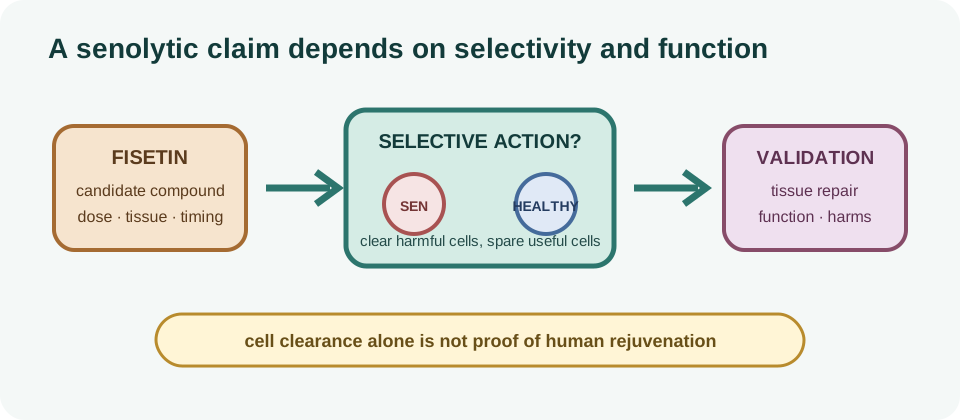
Senolytics are interventions intended to preferentially eliminate vulnerable senescent cells. Senescent cells can resist apoptosis through pro-survival networks, and a senolytic aims to exploit differences between those cells and healthy neighbors. The concept is selective elimination, not indiscriminate toxicity and not removal of every non-dividing cell.
Senomorphics or senostatics take a different approach: they attempt to modify harmful secretory or survival behavior without necessarily killing the cell. Immune-mediated clearance, vaccines, engineered cells and tissue-directed delivery are additional strategies under investigation. These categories can overlap experimentally, but their safety and efficacy questions differ.
The related cellular-senescence page explains why senescence is heterogeneous. A compound that kills one senotype may spare another, harm a beneficial transient state, or fail to reach the tissue that matters.
Why selective vulnerability is difficult
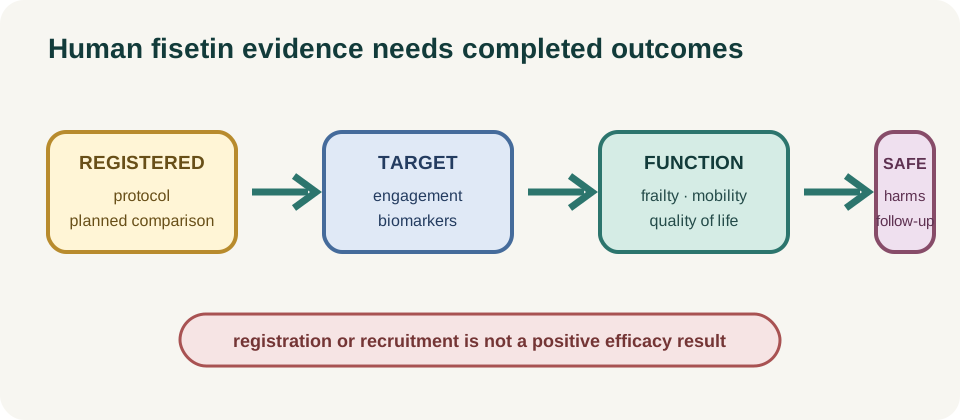
Senescent cells may depend on BCL-2 family proteins, PI3K/AKT signaling, heat-shock responses, inflammatory pathways or other survival mechanisms. But healthy cells can use many of the same networks. Selectivity depends on cell type, drug concentration, exposure time, disease state, tissue penetration and baseline reserve.
Senescent cells also differ in their secretome and anti-apoptotic wiring. A senolytic discovered in cultured fibroblasts may not behave the same way in adipose tissue, lung, kidney, vasculature, muscle or brain. A cell-culture kill curve is therefore a screening result, not a human treatment margin.
| Question | Why it matters | Common overclaim |
|---|---|---|
| Which senotype? | survival dependencies differ by trigger and cell type. | all senescent cells share one drug sensitivity. |
| Which tissue? | delivery, barrier and neighboring cells shape exposure. | a blood signal proves organ clearance. |
| Which endpoint? | target engagement and function are different outcomes. | marker movement proves rejuvenation. |
| Which safety margin? | repair, immune defense and tumor surveillance may be affected. | intermittent use makes all risks disappear. |
Dasatinib plus quercetin: the best-known combination
Dasatinib is a tyrosine-kinase inhibitor used in oncology; quercetin is a plant flavonoid. The combination became prominent because preclinical studies suggested complementary activity against selected senescent-cell populations. The presence of a plausible combination does not make either ingredient a generally proven human senolytic.
Dasatinib has clinically important adverse effects and drug interactions, including hematologic, cardiovascular, fluid-retention and pulmonary concerns in appropriate clinical contexts. Quercetin products vary in formulation, absorption and quality. Combining a prescription medicine with a supplement outside medical supervision can create risks that are not represented by a mouse study or a consumer product label.
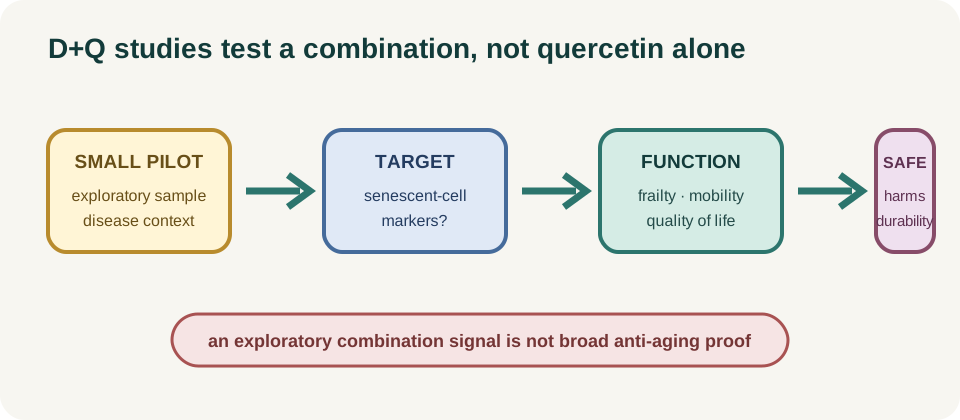
Human D+Q studies have generally been small, short and disease-specific. Their most defensible contribution is feasibility or a preliminary target-engagement signal. They do not establish a safe intermittent schedule for healthy adults or prove a durable anti-aging effect.
First human target-engagement evidence in diabetic kidney disease
A small open-label pilot studied dasatinib plus quercetin in nine people with diabetic kidney disease. The investigators reported reductions in selected markers associated with senescence after a short intervention. This was important proof that a senescence-oriented intervention could be studied in humans, but the sample was too small and the design too limited to establish efficacy.
There was no placebo-controlled basis for separating treatment effects from time, regression to the mean, concurrent care, laboratory variation or disease fluctuation. Marker reduction also does not prove selective clearance of harmful kidney senescent cells. A stronger study would pair validated tissue or circulating target engagement with renal function, symptoms, events and safety.
The kidney setting illustrates a broader rule: an intervention can produce a molecular signal in a high-risk disease population without being appropriate for healthy aging. Disease-specific risk, concomitant medicines and organ reserve must remain visible in interpretation.
Idiopathic pulmonary fibrosis pilot studies
Idiopathic pulmonary fibrosis (IPF) is a disease in which abnormal repair and fibrosis can involve senescence-related pathways. A randomized placebo-controlled D+Q pilot included 12 participants and focused primarily on feasibility and tolerability rather than being powered for definitive efficacy. A study of that size can identify practical issues and generate effect estimates, but a null or positive signal is uncertain.
IPF studies have explored walking capacity, physical function, biomarkers and symptoms. Those outcomes are clinically relevant, but they must be interpreted alongside baseline severity, concurrent antifibrotic treatment, missing data, adverse events and the prespecified primary endpoint. A change in a six-minute walk or blood marker is not evidence that the same intervention benefits healthy aging.
The current clinical synthesis describes early functional signals in selected conditions while emphasizing heterogeneity, biomarker limitations and unresolved long-term safety. The correct conclusion is that senotherapeutics have entered human testing—not that the class has been clinically validated.
What randomized IPF data did and did not show
Randomization improves causal inference, but it cannot create statistical power that a 12-person study does not have. The IPF pilot can inform recruitment, procedures, outcome selection, adherence and safety monitoring. It cannot reliably estimate a small functional effect, rule out rare harms or determine whether biomarker movement mediates benefit.
For senolytics, the evidence chain should be explicit: the drug reached the intended compartment; the intended senotype changed; the change was selective; a prespecified function or clinical outcome improved; and the effect persisted without unacceptable harm. Most early studies answer only one or two of these questions.
| Evidence layer | Example | What is still needed |
|---|---|---|
| Exposure | drug or metabolite reaches blood or tissue. | selective action at a safe exposure. |
| Engagement | senescence-associated marker or phenotype changes. | validated specificity and persistence. |
| Function | walking, kidney, lung or another prespecified outcome. | adequate randomized comparison and replication. |
| Health outcome | fewer events, disability or disease progression. | longer follow-up and generalizability. |
Human evidence in other disease settings
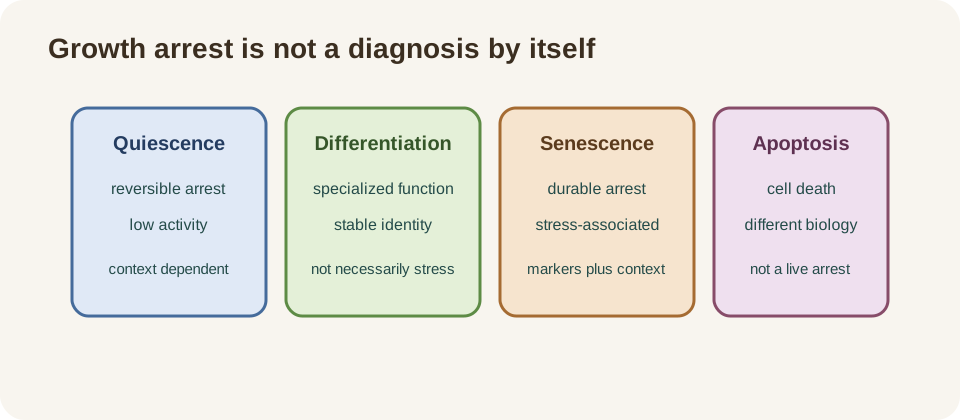
Senescence has been investigated in metabolic, vascular, kidney, lung, musculoskeletal and neurodegenerative contexts. Early human work is not uniform: some studies report feasibility or changes in selected markers, while others remain protocols, uncontrolled pilots or preclinical experiments. A disease-specific signal should be described with its exact population and endpoint.
The 2026 inflammageing review summarizes preliminary functional benefit in selected pulmonary and kidney settings but emphasizes limited biomarker specificity and unresolved safety. That review supports a precision-medicine agenda, not a class-wide efficacy claim.
Clinical-trial registries are useful for identifying what is planned, but a registered protocol is not a completed result. The longevity clinical-trials page should distinguish recruiting studies, protocols, completed analyses and peer-reviewed outcomes.
| Evidence type | What it can support | What it cannot support alone |
|---|---|---|
| Protocol | what investigators plan to test. | a completed clinical result. |
| Small pilot | feasibility and preliminary signals. | general efficacy or long-term safety. |
| Disease trial | an effect in the studied condition and population. | healthy-aging benefit across people. |
Fisetin and quercetin: preclinical popularity exceeds clinical proof
Fisetin and quercetin are often marketed as accessible senolytics because they can kill or alter selected senescent cells in laboratory systems. That evidence is useful for discovery, but dose, metabolism, tissue exposure and selectivity in humans remain uncertain. A food-derived identity does not guarantee senolytic action or safety at concentrated supplement exposure.
Neither a quercetin product nor a fisetin product should be called a proven human senolytic solely because a cell line, mouse model or mechanistic review uses that label. Human trials must report the actual formulation, verified exposure, target-engagement assay, comparator, primary outcome and adverse events.
The dedicated fisetin page and quercetin page should inherit the same language: promising preclinical candidates, insufficient evidence for self-directed anti-aging use.
BCL-2, BCL-xL and other pharmacologic strategies
Some senescent cells depend on anti-apoptotic networks involving BCL-2 family proteins. BCL-xL inhibition and related strategies can be potent in models, but those proteins also protect healthy cells, platelets and other tissues. The therapeutic window is therefore a central question, not a detail to be solved by taking a drug intermittently.
Other approaches target PI3K/AKT, heat-shock proteins, p53 regulation, lysosomes, inflammatory signaling or metabolic dependencies. Each may remove or remodel one subset while sparing another. Combination strategies may broaden activity but can also increase toxicity and make attribution harder.
Immune-mediated clearance, vaccines and engineered approaches
The immune system naturally recognizes and clears some senescent cells. Researchers are exploring ways to improve recognition, train immune responses, deliver antibodies or engineer cells. These approaches may offer selectivity unavailable to a small molecule, but they also raise questions about autoimmunity, tissue damage, manufacturing, persistence and control.
Clearance is not always beneficial. Transient senescence can support repair and tumor suppression, and immune recruitment can be part of a useful response. Any engineered or vaccine-based strategy must define the target, tissue, timing and stopping rules before a broad anti-aging claim is considered.
How target engagement should be measured
A convincing senolytic trial needs more than a change in a circulating SASP factor. It should show that the intervention reached the relevant compartment, changed a validated senescence-associated state, preserved healthy cells and produced a prespecified clinical or functional benefit. Where tissue sampling is impossible, a composite approach should make the uncertainty explicit.
Useful measurements may include cell-type-resolved markers, spatial tissue data, persistent-arrest features, secretory profiles, apoptosis or clearance signatures, and longitudinal function. Static p16, p21, SA-β-gal or cytokine values are not universal stand-alone tests.
Why biomarkers are the bottleneck
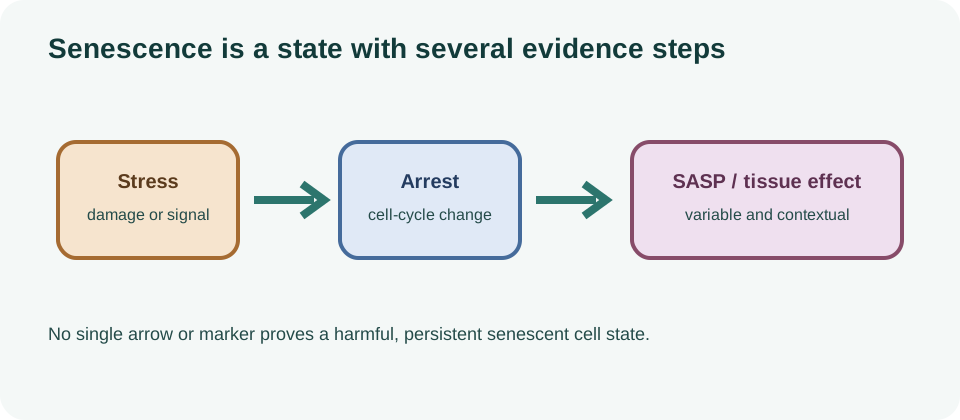
Senescence is heterogeneous, tissue distribution is uneven, and many candidate SASP factors are produced by non-senescent cells. A circulating panel can track risk or inflammation without identifying the causal senotype. A biopsy can be more specific but samples only a small area and may not be practical for repeated measures.
The 2026 human biomarker compendium and the SENESCENCE2030 roadmap both point toward standardized, clinically actionable and cell-type-aware measures. The roadmap emphasizes functional classification, precision translation and regulatory frameworks. That consensus is important because it identifies what the field still needs; it is not evidence that current consumer tests are validated treatment-selection tools.
Intermittent dosing and unresolved long-term safety
Intermittent exposure is sometimes proposed because senescent cells may be vulnerable during a treatment window while healthy tissue recovers between exposures. This is a hypothesis about pharmacology and risk management, not proof that intermittent use is safe or effective. It does not remove drug interactions, delayed toxicity, tissue accumulation or the possibility of incomplete clearance.
Safety needs to be studied in the actual population and product. Monitoring should include organ-specific toxicity, blood counts where relevant, infection risk, wound repair, cardiovascular events, pulmonary effects, renal function, interactions and late outcomes. A short tolerability statement cannot support indefinite self-treatment.
Drug-specific safety matters
Dasatinib is a prescription anticancer medicine whose known risks are clinically significant and context dependent. BCL-xL-directed strategies can affect platelets and other healthy cells. Quercetin, fisetin and combination products can vary in purity, bioavailability and interaction profile. A senolytic label does not override ordinary pharmacology.
People with cancer, cardiovascular disease, lung disease, kidney disease, liver disease, bleeding risk, pregnancy, complex medication regimens or frailty may face different risks from those in a pilot. A general web article cannot determine individual suitability. This is why early studies should not be turned into consumer protocols.
| Claim | Minimum useful outcome | Why a pilot may not answer it |
|---|---|---|
| Disease treatment | validated disease-specific function or event. | population and risk are condition-specific. |
| Healthy aging | durable function, disability or health outcome. | requires longer follow-up and broader safety. |
| Lifespan | survival outcome. | biomarkers and short studies cannot establish it. |
Why disease benefit is not healthy-aging benefit
A therapy may help a disease because it changes a disease-specific cell population or inflammatory circuit. That does not mean it improves the same process in healthy people, where the target may be smaller, distributed differently or serving a protective function. Disease treatment and prevention require different risk–benefit thresholds.
Healthy-aging claims also require outcomes such as function, disability, disease events or survival over meaningful follow-up. A short study with a biomarker or symptom endpoint cannot establish delayed aging. The inflammaging page and brain-aging page show why tissue and outcome specificity matter.
The 2026 precision-senescence roadmap
The 2026 SENESCENCE2030 consensus roadmap calls for functional classifications of senescent states, standardized clinically actionable biomarkers, precision senescence medicine, stronger translational and regulatory frameworks and international collaboration. Those priorities align with the current human evidence problem: the field needs better measurement before it can safely match a treatment to a senotype.
Precision does not mean a more complicated marketing claim. It means identifying the relevant cell, tissue, trigger, persistence, target and clinical outcome, then testing the intervention with transparent prespecified methods. The roadmap is best read as a quality standard for future studies.
Evidence verdict and what a convincing trial would require
Senolytics remain compelling because persistent senescent cells can contribute to pathology in models and because small human studies have shown that senescence-oriented interventions can be tested. But the clinical record is early: nine-person target-engagement work and a 12-person IPF feasibility study cannot establish class-wide efficacy, healthy-aging benefit or long-term safety.
A convincing trial would use a characterized intervention, a validated target-engagement panel, adequate randomization and power, a prespecified patient-important endpoint, transparent adverse-event monitoring, appropriate follow-up and independent replication. It would distinguish selective clearance from secretory modulation and disease improvement from broader aging claims.
- define the senotype, tissue and causal disease hypothesis;
- measure exposure, target engagement and functional outcome separately;
- predefine safety stopping rules and monitor delayed harms;
- disclose funding, product relationships and all primary outcomes;
- avoid extrapolating a disease pilot to healthy human longevity.