Why “best longevity supplement” needs an evidence definition
The phrase best longevity supplement sounds like a shopping question, but it hides several different questions. Does the product correct a nutrient deficiency? Improve strength or physical function? Reduce the risk of a specific cardiovascular event? Change a biological-age calculation? Or extend life itself? These endpoints are not interchangeable, and a ranking that mixes them can make weak evidence look stronger than it is.
This article uses “longevity” in the stricter sense of healthspan and survival, while reporting narrower benefits at their own level. An intervention can be worthwhile for a deficiency or a disease-specific indication without being an anti-aging therapy. A supplement can also raise a biomarker without improving how a person feels, functions or lives.
Use the supplements hub for the wider evidence map and the creatine guide for older adults for a deeper look at the strongest muscle signal discussed here. The ranking below is a living evidence page, not a product recommendation or a personalized treatment plan.
Ranking criteria: what counts as stronger evidence?
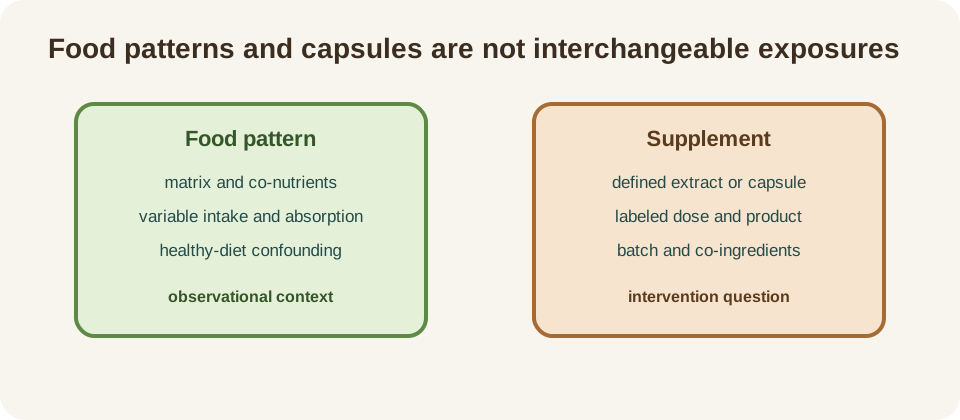
A compound earns a higher tier when several features line up: human randomized comparisons, a prespecified outcome that matters to people, an effect that is large enough to be relevant, reasonable follow-up, transparent adverse-event reporting and results that do not depend on a single exploratory subgroup. A large observational association is useful context but remains vulnerable to healthy-user bias, diet patterns and confounding.
Biological-age clocks need the same caution. They are measurements, not direct readings of remaining lifespan. The 2025 DO-HEALTH analysis randomized older adults to vitamin D, omega-3 and exercise arms but examined DNA-methylation clocks in a post hoc analysis of 777 participants. Omega-3 slowed several clocks, and standardized effects corresponded to roughly 2.9 to 3.8 months over three years. That is an interesting biomarker signal, not evidence that the supplement adds months to a person’s life.
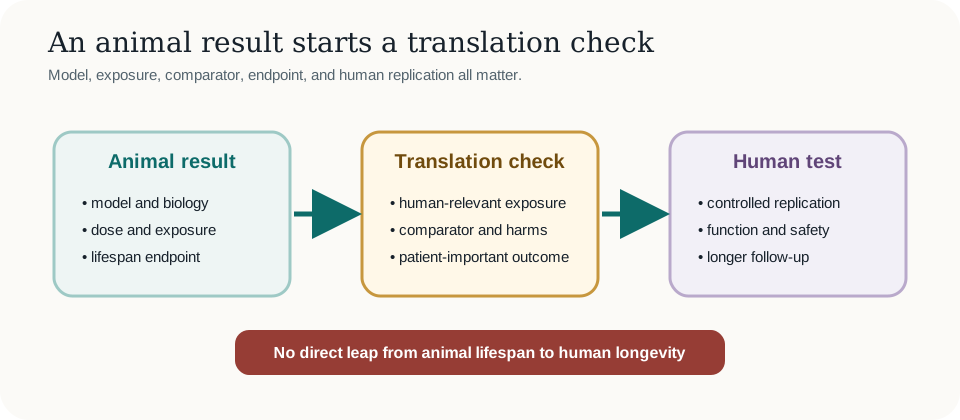
Animal studies are even further from a consumer conclusion. They can identify mechanisms and test whether a compound deserves a human trial, but species, dose, metabolism, timing and disease background can differ sharply. The alpha-ketoglutarate evidence review shows why a positive earlier mouse result should not be treated as a durable human forecast.
- Tier 1: comparatively strong human evidence for a defined aging-relevant function, while lifespan remains unproven.
- Tier 2: plausible or useful in a narrower disease, biomarker or muscle context, with important uncertainty.
- Tier 3: early, inconsistent or mechanism-heavy evidence that should not support a longevity claim.
Why lifespan extension is not a realistic current ranking endpoint
To prove that a supplement extends lifespan in healthy humans would require a very large, long-running study with reliable exposure measurement, a suitable comparator and enough deaths to estimate an effect. Short trials can test strength, blood pressure, walking distance, cognition or a laboratory marker. They usually cannot test survival.
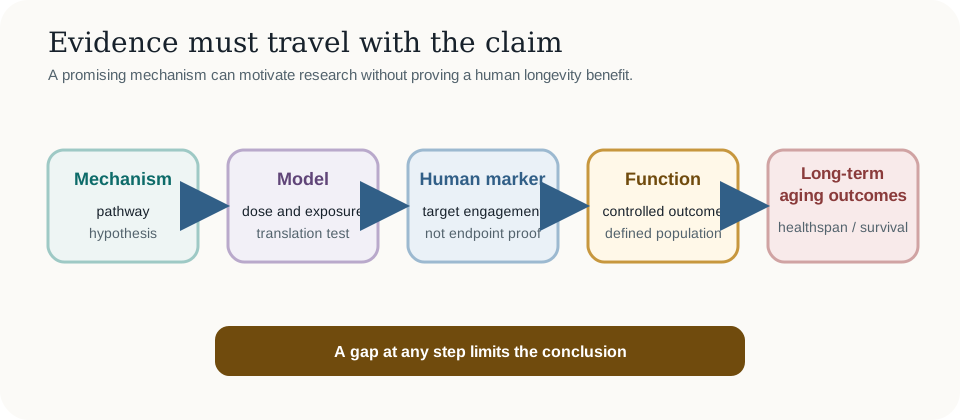
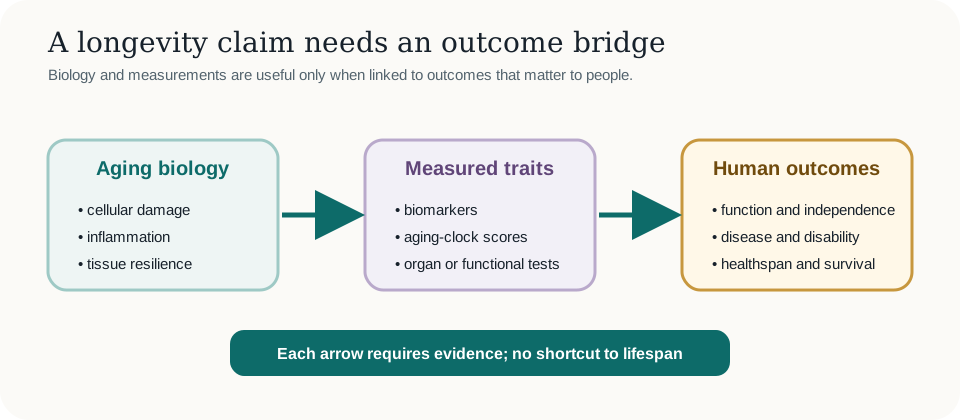
That distinction matters because marketers often move through a chain of increasingly distant claims: a compound affects a pathway in cells; a mouse lives longer; a human blood marker changes; therefore a customer will live longer. Each arrow needs evidence. A plausible pathway is not a clinical endpoint, and a favorable surrogate does not automatically predict mortality.
Even a healthspan improvement is endpoint-specific. A supplement that modestly improves a chair-rise test might matter to independence, but it does not establish dementia prevention, cancer prevention or longer life. The responsible question is not whether a molecule is “anti-aging” in the abstract. It is which outcome improved, in whom, compared with what, over how long and at what cost or risk.
Tier 1: creatine for muscle and selected function outcomes
Creatine is one of the more defensible supplements to discuss when the goal is a defined muscle-related outcome in an older adult who can participate in an appropriate exercise program. A 2025 systematic review of eight randomized trials involving 482 participants found that creatine added to resistance training produced a small improvement in lower-limb strength and lean tissue mass compared with placebo plus training. Upper-extremity strength was not significant overall, although a shorter-duration subgroup showed a signal.
Another 2025 synthesis of 20 articles and 1,093 older participants found a pooled 1RM benefit and a small reduction in body-fat percentage, but no significant total-body bone-density effect. A 2026 review in postmenopausal women found small gains in lean mass and leg-press strength, with the clearest signal when creatine was paired with resistance training. These findings are useful because they focus on human function, but study quality, duration, measurement and generalizability still limit the claim.
Creatine therefore ranks high for a narrow reason: the human evidence for selected muscle outcomes is more developed than the evidence for many compounds sold as “longevity” agents. It does not rank high as a proven lifespan supplement. The page on creatine and longevity keeps that distinction explicit, while the sarcopenia and muscle-aging resource explains why diagnosis and progressive training are not replaced by a powder.

Omega-3: substantial cardiovascular context, real trade-offs
Omega-3 is difficult to rank with a single label because food intake, low-dose supplements, high-dose prescription preparations and different EPA/DHA formulations are not the same intervention. Cardiovascular trials have produced mixed results. A systematic review of randomized evidence found no consistent broad reduction in major cardiovascular events or all-cause mortality for ordinary supplementation, while other syntheses report modest benefits for selected myocardial-infarction or cardiovascular outcomes in particular populations and formulations.
The 2025 DO-HEALTH analysis adds a small DNA-methylation-clock signal in older adults, but the result was a post hoc biomarker analysis and not a survival trial. That makes omega-3 relevant to an aging research conversation without making it a biological-age treatment.
Safety changes the ranking. An updated meta-analysis of 34 trials and 114,326 participants examined atrial fibrillation risk and reflects the broader concern that higher-dose omega-3 treatment can increase AF risk, especially in people with cardiovascular risk. The NIH Office of Dietary Supplements also notes potential bleeding concerns at high doses with warfarin or other anticoagulants. People with atrial fibrillation, bleeding risk or cardiovascular disease should not treat a supplement label as a substitute for clinical advice. The omega-3 longevity review covers formulation and endpoint differences in more detail.
| Supplement | Human signal | Current tier | Major boundary |
|---|---|---|---|
| Creatine | selected lean-mass and strength outcomes with training | Tier 1 for muscle function | no human lifespan proof; kidney and medication context matters |
| Omega-3 | cardiovascular and small biomarker findings vary by formulation and risk group | Tier 1–2, context-specific | AF and bleeding trade-offs; not a general anti-aging treatment |
| CoQ10 | plasma levels rise; older-adult mitochondrial trial was neutral | Tier 2 | disease-specific evidence cannot be generalized to healthy aging |
| Urolithin A | small short-term RCT base; pooled walking result inconclusive | Tier 2–3 | low-certainty evidence and heterogeneous outcomes |
| Spermidine | SmartAge primary cognition result was null | Tier 3 | animal rationale and exploratory signals are not clinical efficacy |
| NMN or NR | NAD-related biomarkers can change; clinical benefits remain limited | Tier 3 | biomarker response is not healthspan or lifespan extension |
| Taurine | trials and protocols remain active or exploratory | Tier 3 | no established aging efficacy |
| AKG | 2026 ITP mouse study did not increase lifespan | Tier 3 | preclinical enthusiasm was not replicated in that study |
Tier 2: CoQ10 and urolithin A are narrower questions
Coenzyme Q10 has a coherent role in mitochondrial electron transport and antioxidant biology, and it can be useful to study in specific clinical settings. But a 2026 double-blind randomized trial in 40 community-dwelling older adults found that 400 mg daily for 12 weeks raised plasma CoQ10 without improving the measured mitochondrial function outcomes. That is a valuable corrective result: reaching the bloodstream does not guarantee that a target tissue or patient-important endpoint improves.
CoQ10 should therefore be ranked by context. A heart-failure or statin-associated symptom question is not the same as a healthy-aging question. The CoQ10 evidence page distinguishes those populations and avoids treating a biochemical role as proof of longer life.
Urolithin A is another reasonable research target because it is linked to mitophagy and has been tested in human muscle studies. A 2026 systematic review identified five randomized trials with 236 participants. Only two trials could be pooled for the six-minute walk test; the estimated mean difference favored urolithin A by about 17 meters but the confidence interval crossed no effect, and certainty was rated low. Strength, endurance and mitochondrial markers were too heterogeneous for a firm quantitative synthesis.
That puts urolithin A in the promising-but-limited range. It may deserve larger, longer and better-standardized trials, but it is not a clinically proven longevity supplement. See the urolithin A review for the distinction between exploratory muscle signals and reproducible efficacy.
Tier 3: interesting biology with limited clinical outcomes
Spermidine: a null primary cognition trial matters
Spermidine is marketed around autophagy and healthy-aging biology. The SmartAge trial was a 12-month randomized, double-masked, placebo-controlled phase 2b study in 100 older adults with subjective cognitive decline. The primary memory outcome did not differ significantly between groups, and secondary outcomes were also not significant. Exploratory findings for inflammation and verbal memory require validation rather than promotion as established efficacy.
This is exactly why a null primary endpoint should remain visible in a ranking. The spermidine evidence page can discuss the biological rationale without allowing animal findings or exploratory analyses to outrank the randomized result.
NMN and NR: raising NAD is not the same as improving aging
Nicotinamide mononucleotide and nicotinamide riboside are NAD precursors. Their mechanism is attractive because NAD participates in cellular metabolism, but the 2025 Nature Metabolism review concluded that human clinical trials have shown limited efficacy and that evidence for an age-related decline in human NAD levels is consistent only in a limited number of studies. Tissue-specific metabolism and disease context remain unresolved.
That review changes how the headline should be written. It is reasonable to say that a precursor can affect NAD-related measurements in some settings. It is not reasonable to say that it reverses aging, restores youthful biology or extends human lifespan. The NMN versus NR comparison keeps the compounds and the evidence questions separate.
Taurine: active research is not a positive result
Taurine has generated attention from animal and observational work, but registered trials and protocols remain the appropriate current evidence boundary. The 2026 phase II protocol describes a randomized, triple-blinded study of taurine with HbA1c as the primary outcome and biological-age measures as secondary outcomes. A protocol tells readers what investigators plan to test; it does not establish efficacy.
The taurine trial tracker should therefore report recruitment, completion and posted results separately. “Under study” is not the same as “shown to work.”
AKG: the 2026 mouse result is a corrective signal
Alpha-ketoglutarate has a central metabolic role and earlier animal work supported interest in aging biology. A 2026 Interventions Testing Program study evaluated AKG among several compounds in genetically heterogeneous UM-HET3 mice and did not find a significant lifespan increase. The value of this study is not that it proves AKG can never matter; it shows why multi-site, sex-inclusive replication and dose-and-timing checks are important before preclinical enthusiasm is translated to consumers.
Even a replicated mouse result would still be preclinical. It would support a human trial, not an over-the-counter lifespan claim. The AKG evidence review records that boundary directly.
Fisetin and quercetin: senolytic marketing outruns human monotherapy evidence
Fisetin and quercetin are often grouped into “senolytic stacks,” based on cell and animal studies suggesting that senescent cells may be selectively targeted. Human research is more complicated: combinations, dosing, tissue exposure and disease populations vary, and a mechanistic hypothesis does not prove that an over-the-counter combination clears harmful senescent cells or improves survival.
The senolytics evidence review should be read as a research map, not as a self-experiment protocol. There is currently no responsible basis for ranking a universal senolytic stack above interventions with direct human function data.
Deficiency correction changes the answer
A deficiency is a different clinical problem from taking a supplement to slow normal aging. If a person has a confirmed or likely deficiency, replacing the missing nutrient can prevent or treat deficiency-related harm. That does not mean that taking more than needed will extend life.
Vitamin B12 illustrates the point. The NIH Office of Dietary Supplements notes that older adults may absorb less B12 from food because of reduced stomach acid, and people with pernicious anemia, gastrointestinal disease, certain surgeries, vegan diets or prolonged medication exposure can be at higher risk. Testing and clinical assessment can identify a deficiency or an absorption problem. A B12 supplement may be appropriate in that context, while the same evidence does not support calling B12 an anti-aging pill.
Vitamin D also has a role in correcting inadequacy and supporting bone health, especially in people with risk factors. But randomized evidence in healthy, community-dwelling adults without deficiency or osteoporosis does not automatically justify high-dose supplementation for lifespan extension. Food pattern, sunlight exposure, kidney function, bone status and medications all matter.
Use vitamin D evidence and the B12 review to separate nutritional adequacy from pharmacologic or anti-aging claims. The correct question is often “am I deficient, and why?” rather than “which stack should I buy?”
- Confirm a suspected deficiency with an appropriate history, examination or laboratory test.
- Identify causes such as malabsorption, restricted diet, kidney disease, medication effects or excessive replacement.
- Reassess the relevant clinical endpoint rather than assuming a normal lab value equals longer life.
Safety, interactions, contamination and product quality
Safety is part of efficacy. A small possible benefit can become an unattractive trade when the product has a meaningful risk, uncertain purity or interaction with a necessary medicine. The NIH Office of Dietary Supplements notes that high-dose omega-3 products can interact with anticoagulants, and current randomized evidence continues to examine atrial-fibrillation risk. “Natural” does not mean interaction-free.
Product quality also limits what can be inferred from a trial. A study uses a defined preparation with a known identity, strength and stability. A marketplace product may use a proprietary blend, a different salt or extract, an unverified dose or multiple ingredients that were never tested together. Independent quality seals can help with manufacturing and label verification, but they do not guarantee that a product is safe or effective for a particular person.
People taking anticoagulants, diabetes medicines, blood-pressure medicines, immunosuppressants or drugs that affect kidney or liver function deserve a medication-specific review before adding a supplement. Pregnancy, cancer treatment, surgery, kidney disease, liver disease and a history of arrhythmia are reasons to avoid relying on a generic “longevity stack” article for personal decisions.
Why a personalized “stack” cannot be responsibly ranked here
A stack is not just a list of ingredients. It is an interaction between a person’s diet, baseline nutrient status, goals, medications, kidney and liver function, training, sleep, allergies, budget and tolerance. The more ingredients a person combines, the harder it becomes to identify which one helped or caused harm.
There is also an evidence problem. Most compounds are tested alone, or alongside a standardized intervention, not in the exact combinations sold by influencers. If a study of creatine plus resistance training finds a modest strength difference, that does not validate adding NMN, taurine, quercetin and a dozen antioxidants. More mechanisms do not automatically create more clinical benefit.
A better framework is to start with a defined goal, correct known deficiencies, use interventions with direct evidence for that goal, and set a reassessment point. For healthy aging, exercise, sleep, diet quality, vaccination, blood-pressure control, tobacco avoidance and social connection have a broader evidence base than a speculative supplement stack. This article ranks supplements because readers ask about them; it does not imply that supplements outrank those foundations.
How this ranking will be updated
This is a living evidence ranking, planned for review every three months and sooner when a large human outcome trial, high-quality systematic review or major safety signal changes the balance. Updates should record what changed: population, intervention, comparator, endpoint, effect estimate, confidence, adverse events and competing interests.
A new biomarker study may change the research narrative without changing the consumer tier. A new randomized trial may strengthen a narrow function claim without proving survival. A safety signal can lower a tier even when efficacy remains uncertain. The ranking should move when the evidence moves, not when a product becomes more visible online.
For readers comparing individual topics, start with the supplements hub, then follow the specific pages for creatine, omega-3, urolithin A, NAD precursors and senolytic evidence. If a target page is not yet live, the link is a future-link placeholder and should not be mistaken for published evidence.
Bottom line: rank evidence, not hype
No over-the-counter supplement has been proven to extend lifespan in healthy humans. The most credible 2026 ranking therefore starts with direct human outcomes. Creatine sits near the top for selected muscle and strength outcomes when paired with resistance training. Omega-3 belongs in a context-specific cardiovascular tier, where formulation, baseline risk, atrial fibrillation and medication interactions matter. CoQ10 and urolithin A remain narrower research questions. Spermidine, NMN, NR, taurine, AKG and senolytic stacks remain too limited or indirect for a general longevity claim.
Deficiency correction is important, but it is not the same as taking more of a nutrient to slow aging. Biomarker movement is worth studying, but it is not a substitute for function, symptoms, clinical events or survival. A careful evidence ranking should help readers ask better questions, not turn uncertainty into a shopping list.
- Define the health outcome before choosing an ingredient.
- Prefer replicated human randomized evidence over animal lifespan or mechanism-heavy marketing.
- Separate deficiency treatment and disease-specific use from healthy-aging claims.
- Check interactions, product quality and the population actually studied.
- Do not call any supplement proven anti-aging or lifespan-extending without direct evidence.